Showing posts with label Germany. Show all posts

Friday, November 16, 2012

FEELING LIKE KYLE BASS


MOCKING LAUGHTER
Oddly enough, the most viewed posts on my website over the past three years relate to Kyle Bass, the founder of Hayman Capital.  I'm not sure if I should take that as an affirmation that I've done a good job of finding interesting and relevant material or just that I have been a conduit for posting his newsletters and trading ideas from time to time.

Prior to the latest market swoon, I've been feeling a bit like Kyle Bass as I've been reflecting on the market's performance and direction over the last four years and have been personally lamenting to myself that all of the gains in the market are not truly based on a real recovery or fundamental economic production.  Yes, I've been able to document many winning strategies over the course of this volume-less levitation as I've suggested that corporate bonds, dividend paying stocks, defensive industries like healthcare would shine, metals would benefit, and refiners would surge higher.  While those plays have led to healthy gains, I'm not a big fan of holding your nose and buying, I'd like to invest (long) when I felt convicted that there were solid underpinnings for company and economic growth rather than an approach based on reactions to unlimited QE and stupid government fiscal ineptitude.

WHEN WILL IT END?
In a way, I probably feel much like Kyle Bass as he is frequently poked and mocked for his "doom" trades where he has shorted JGBs and has other several sovereign bond disaster bets in play.  One only has to look at the Japanese 10 Year Bond yield to note that the Hayman Capital short there hasn't been a pleasant one to hold.


While Bass may be a loser in this trade, the magic question will simply be, "How long can he stay in it?" since yields have fallen almost 25%.  The answer is certainly, I don't know, but the thing I am certain of is that directionally, Kyle Bass is correct.  The toughest part of one of these macro theme trades is staying solvent long enough to see the strategy through till the prediction is manifest.  Personally I've felt like the fall of Chipolte (CMG) would never come and took some significant losses along the way.  Happily though, reality does set in and if you have managed your exposure well enough, you can see the fruits of your shorts....

Kyle shared in a recent Bloomberg interview more of his dire and reasonable predictions about Europe.  Please enjoy, it is very short, only about two and a half minutes.


It is interesting to note that he is now using a 3 to 4 year time frame.  I am betting that he really thinks it will be shorter, but we've been able to witness just how adept sovereign nations are at extending and pretending and somehow keeping reality from actually hitting.  The central banks and politicians may be able to delay the day in which payments are due by rolling debt and cramming it down on investors, but I think I agree with Kyle that unemployed teens and disgruntled citizens will ultimately force an end to an ugly and financially unstable system.


GOATMUG

Goatmug is an investor that cares about you and your family. Goatmug's Blog - Financial Perspectives From The Mountain Top is a collection of thoughts on our economy and how it impacts the lives of investors and average people. While several specific investments are named in many of his posts, these articles are simply invitations for you to do your own research and reference to these securities does not constitute financial advice. Your situation is complex and unique and you should seek professional assistance with your trading and investing. Please visit Goatmug and share your comments athttp://www.goatmug.blogspot.com/

Tuesday, September 11, 2012

ALL IN - ECB PUSHES ITS LUCK


Photo by Phil 

STRONG MOVE
Ok, I admit it, I am one of those people that watch the World Series of Poker on ESPN every year.  It's not because it is good television or even that I like poker, it is simply that I like watching people attempt to win using a number of interesting strategies.  Sometimes players will be loud and almost belligerent, others will be quiet attempting to hide any emotion and even covering their eyes and wearing hoodies, finally others will talk and blab in an effort to throw off their opponent.  The competition is a perfect mix of bullying, guile, and negotiation all in a venue that is shockingly rewarding to the final winner.

BINARY EVENTS
We've discussed how the markets continually are positioned to offer binary outcomes and frankly I hate them!  We face some serious issues this week where the direction of the market will certainly trade based on two huge headline events that happen tomorrow (Sept 12) and Thursday.  First, the German high court will weigh in on the constitutionality of the ECB's measures and determine if there is a violation of the German constitution.  Second, the Fed will meet and the market expects some further market stimulus probably in the form of continued low interest rates, cessation of payments on excess reserves, and more "twisting" by targeting the yield curve and buying specific treasury bonds. It is pretty obvious, if the German courts rules against the ECB's moves or the Fed only partially delivers stimulus in the form of more QE, we probably see markets go down significantly.

DRAGHI GOES ALL IN
As if there wasn't already pressure on the German high court, ECB head Mario Draghi  doubled down in the past couple of weeks and issued statements that the ECB would begin unlimited bond purchases of countries that had yields that "were not reflective" of real market pricing.  In otherwords, the ECB just promised unlimited bond purchasing to manage rates and keep them under the critical 6%, 7%, or 8% level (who knows what really is critical now as 6% was the key rate).

By issuing this promise, Mario Draghi simply pushes all the ECB and Euro's chips into the pot and has demanded that market participants fold in the face of an overwhelming and serious threat.  The question that investors, traders, and speculators must ask is, "Does Draghi really have anything in his hand?"

ROYAL FLUSH OR HANDFUL OF CRAP?
So, despite the back drop of the two headlines this week, the real story is the ECB's head and his promise to save the Euro no matter what.  The bet sounds convincing and seems to have been exactly what markets needed to hear to drive investor confidence higher.  I've read a number of bullish stories that emphatically state that the Euro is saved and there will soon be a rush to purchase fire-sale priced European assets as the fix will stabilize markets and put a floor under them.  The USD and Euro have been trading like it is Draghi's pot too.

So what could lead us to believe that perhaps the ECB Chief doesn't really have a royal flush?  What didn't get much attention in Draghi's announcement is that all of the unlimited purchases would be contingent on the nation receiving aid to comply with full austerity measures and submit to the IMF and ECB conditions.  In otherwords, Spain and Italy will be required to become Greece-like and bow down and implement processes they just haven't been willing and able to do.  In otherwords, Draghi's promise is based on the requirement that distressed nations reign in spending and raise taxes even more.

PUSHING PEOPLE AROUND
In reality then, Mario Draghi probably has nothing in his hand, but he probably was able to win the pot as his competitors don't have a strong hand that would be worth challenging such a bold and overwhelming bluff.  Effectively, the ECB has played a similar hand to what the Fed has and the all-in moves force reasonable players in the markets to simply bow out and hope they can survive and capture a hand on better terms.

Ultimately, sterlization of bond purchases won't do the trick and rates for distressed sovereign nations will get out of hand, but the Fed's and ECB's strategy has nothing to do about winning long term, these players are only interesting in winning the next few hands and extending the game as long as possible.

While I don't think we'll see any shocking news coming from the next two days, I suggest that you review your positions and watch for a continued move higher in commodities and metals.  While we are promised that sterlization and QE hasn't produced inflation we need only look to the charts of gold, silver, oil, and corn to note that central banker promises, bluffs, and all-in bets produce commodity charts that go up and to the right.


GOATMUG

Goatmug is an investor that cares about you and your family. Goatmug's Blog - Financial Perspectives From The Mountain Top is a collection of thoughts on our economy and how it impacts the lives of investors and average people. While several specific investments are named in many of his posts, these articles are simply invitations for you to do your own research and reference to these securities does not constitute financial advice. Your situation is complex and unique and you should seek professional assistance with your trading and investing. Please visit Goatmug and share your comments athttp://www.goatmug.blogspot.com/

Friday, August 10, 2012

THE MOUNTAIN TOP VIEW - MACRO THOUGHTS


A friend of mine asked me about my thoughts on the market and I wanted to capture my thoughts and also put some charts up for review (I did this under two other posts.... CHART-SLAW and SON OF SLAW).  Now we have made it through the Fed meeting and the ECB meeting we are coming to a point where we see that central banks may be boxed in and have little ability to do much other than talk about what they could do..... until they are forced to do something entirely out of the box (yes, this is still coming).

Let's break the perspective into two broad categories.  First, we'll talk about all the reasons the market looks bad and how the gathering clouds could reduce the gains that the market has posted so far this year.  Second, we'll review all of the reasons that the market could actually go higher.

CLOUDS ON THE HORIZON

ECB - LOT'S OF BARK, NO BITE
Draghi and pals really did have great success a month or so ago when they claimed they would do anything and everything without limit to save the Euro.  Well, it sounded good and the market was happy..... till everyone realized that practically no other country would approve the measures and possibly the most important one, Germany, can't constitutionally do what needs to be done to save Europe.  I'm hearing more whispers that perhaps Germany is beginning to see the light and might even consider their own exit from the Euro.  Mark September 7th on your calendar as this is the day the German High Court will decide if the extraordinary measures proposed by the ECB are allowable in the context of their constitution.  If the German court pulls a Chief Justice Roberts and twists their laws to promote a greater government, then the Euro could very well emerge stronger (with a little addition by subtraction as Greece has to go).  If though, the law really is the law, we can expect a very messy situation until the people demand to be saved by the ones that are destroying them.

FED - ON HOLD TILL NEXT MONTH
The Fed last week told us that conditions in the US were slowing, but hadn't gone so far that they would intervene.  Of course they didn't miss the opportunity to let us know that more QE could still come later.  The reality here is that more "twisting" probably won't help too much as rates are in the cellar anyway.  I had an interesting thought the other day that ultimately we would see the Fed buying index futures to bolster stock prices at some point, but so far I don't think this has happened (except during the flash crash --- we'll never know).  When we do see this type of extraordinary action, you can be sure that it will be implemented when the complete collapse is unavoidable.

What do I expect in September?  Well, I think the easy thing to expect is that we will have them tell us that they will not only keep interest rates low through 2014, but we'll also see them promise rate stability through 2015.  This could make some opportunities very interesting and will highlight those ideas later.

The script is already being played out in front of us as we've had a host of Fed Governor's give us their views on what needs to be done.  We've had calls for more stimulus and of course we've had the token hawk, Dallas Fed President Fisher explain that nothing more needs to be done except for fiscal actions by Congress.  As we've discussed at length, Fisher and any other hawks are just useful tools to make it look like there is a reasonable discussion going on.  Dudley, Yellen, and Bernanke are the only votes that count and we all know that ultimately more QE is coming.

DECOUPLED?
Despite the powerful interventions of QE, QE II, QEIII, and all sorts of other efforts, we really are slowing down in the US and globally the economic turn seems to have happened in Europe and in Asian countries.  I think we have determined that the US has not decoupled from the world and likewise, the world has not decoupled from the US.  As world economies slow, we could see the unorthodox intervention I mentioned above to save the US system.  Transports like the rails and UPS are all showing weakness and the sudden and abnormal spike in gasoline prices in July won't help them much either.  Today's MCD same store sales data suggests that Europe is a total disaster so watch those multi-nationals.


NO TRUST - GOOD KNIGHT CONFIDENCE, GOOD KNIGHT
I have posted quite a few notes lately suggesting that the retail investor is simply not on the same playing field as the high frequency trading bots and institutions.  The entire system seems to be structured in a way to rip money away from Mom and Pop and remove them from the markets.  Banks through their trading of derivatives and manipulation of LIBOR continue to show that the culture is rotten in that industry.  We also see the  regulators asleep at the wheel and the PFGBest scandal is a damning indictment of their inability to see any of these acts until the collapse of the ponzi is complete. Finally, the Knight Trading incident added to the fat-finger May 6th flash crash may be the final straw that breaks the back of small investors that are actually paying attention to their accounts.  While I am pretty confident that the average investor has no idea what happened last week to Knight and their bots-gone wild match-making test software fiasco they may hear and learn about it as more dominos appear to fall and of course liquidity will suffer in the long run.  It appears that Knight was able to somehow salvage itself and obtain critical financing to stay in business, but this event shows just how significant "fat-finger" errors can be in terms of lost capital and potential job losses.  Knight employed more than 1,500 people and it boggles the mind to think that all of them could have been out of a job as a result of a software program that ran for 45 minutes.  Makes you want to buy some stocks doesn't it?

Here is a great article today highlighting the impact our markets feel under the weight of HFT attacks.  This post looks at 1 second in time in the trading of gold prices.
http://www.financialsense.com/contributors/dimitri-speck/a-high-frequency-attack-on-gold


FISCAL CLIFF AND POLITICS
Let's not kid ourselves at all.  While Obama has a few left leaning views, Romney is no super-conservative savior either.  In fact, other than a few guys that say they are Tea-Party guys (and then don't actually act like it or don't have any power to actually do anything) both sides are equally terrible.  The bottom line is that the arguments between these two disaster parties are stupid and not based on any real substance.  In order to actually make a real dent in things we need to halt deficit spending and actually force government to quit growing!  These cuts will hurt, and our economy would absolutely grind to a halt..  Unfortunately addictions are really tough to quit and so the process will be painful.  The adults in the room need to ask themselves if they want a few years of pain or a complete collapse.  Since there are no adults in the room (Executive branch or in the Senate or Congress), we will continue down the path of destruction till Japan implodes and it will be too late to do anything but watch the event happen here.

The theatrics of budget cutting and the fiscal cliff are a sham and will certainly be a distraction and may get markets rolling over soon.  Let's not kid ourselves, we'll be rolling over the debt we'll just be subjected to political posturing from both sides with little real substantive cuts or fixes.

SMALL BUSINESS OWNERS = NO JOBS
Policy, policy, policy.  The bottom line is that no smart employer is going to add to headcount in this environment.  Why would you attempt to grow your business with the threat of more regulation and more tax obligations unless you knew there was a significant upside?  While the passage of the Healthcare Act and it's affirmation by the Supreme Court clears the uncertainty it also ensures that employers will think harder about providing benefits and adding people to the roles.  The tax roll-back issue is also one that prevents smart employers from taking significant risks at this time.

COMMODITY PRICES
Commodity prices are really at a critical juncture.  Europe is slowing.  Australia says that China has stopped slowing.  Droughts have caused massive spikes in corn and soybean prices.  Gas dropped significantly since May 1st (when we said to get out...thank you) and now have roared back in a very unusual July move.  Gold and silver seem to have gained some traction, yet also are poised to rally or fall significantly shortly.  So what is the point?  I believe that the main item we need to watch is oil and gas prices.  If oil and gas move higher, Europe and China suffer and we will too.  If oil stays below $90, we could see a domestic improvement here in the US despite some of the headwinds I've noted above.

MIDDLE EAST - ARE YOU PAYING ATTENTION?
Last, them me wrap up this section about the threats to the economy with a thought on the Middle East.  The Arab Spring, or better stated the Islamic Revolution, that seized Africa and the Middle East last year still continues to have a destabilizing impact on the region and the world.  In very short order, the very nature of the Middle East was changed.  The situation is clearly not settled in Egypt and the region's stability is very much in question until this is resolved.  The Syrian situation too seems to just be getting started and the nation's importance is not to be underestimated.  Iran needs Assad and Assad needs Iran and Russia needs a strong Iran in this theater of the world as a thorny irritant of the USA.  If Assad is close to being overthrown we could easily see the use of chemical weapons on the Syrians and or Israel in an attempt to muddy the waters and draw by-standers into the fray (NATO or the US as Russia and Iran already have assets there).  Once Assad reaches this point of desperation, there won't be a check on him as he attempts anything to delay an end to his power.

An attack like this or an entry into this conflict will move oil prices significantly higher and a sustained period of time with high prices will absolutely slow our economy and our consumption.

CONSUMER ISSUES
We are seeing a few signs that all isn't well and that the US consumer is still able to recall what it was like in the financial pit of 2008.  Revolving credit is beginning to fall again as consumers pay down debt and also the high-end retailer Coach missed big last week when they reported their earnings.  Finally, Priceline also fared poorly this week as they cited that European travelers are way down.  Remember, 70% of the US economy is based the American consumer being a total clown and spending their way to poverty.  Without Joe-6-pack blowing his wad of cash on payday, much of the Fed's improvement scheme will have been for nothing.

ALRIGHT, THAT'S ALL NEGATIVE, WHY WILL THE MARKET LAUNCH HIGHER?

THE FED
We've said it before and we'll say it again, the Fed has this market's back.  When the street is actually hoping for negative news, you know that we live in a crazy world!  As I mentioned above, we will see action within the next several months from the Fed and this must be counted as a positive for equities.  I've heard thoughts that the next move will be to drive mortgage rates so low that absolutely everyone will refinance in hopes that it causes every market participant to rush out there and buy a rent house with their uninvested cash.  Perhaps that strategy is starting to work already as I speak with someone every day about low interest rates and the potential for buying rent houses......watch out bubble here we come!

HOUSING
Housing construction and existing sales seem to be improving and certainly homebuilder stock prices continue to do well.  XHB is at 3 year highs too.  Housing related plays like Mohawk Industries all have similar charts that are right at the edge of multi-year break outs higher.

JOBS
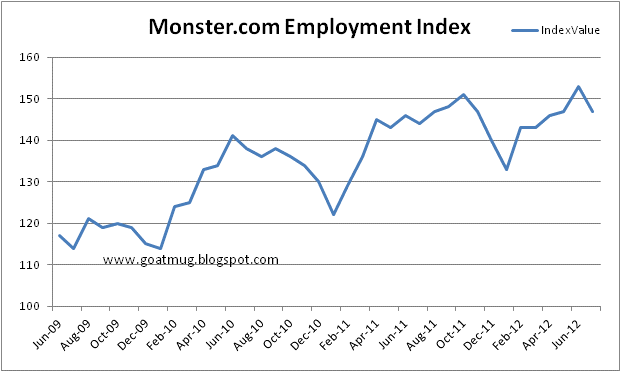
Employment continues to look better here in the US.  We have seen great momentum in agriculture, trade, and transportation areas along with retail.  Negative areas continue to be in public education, public administration, and food service and hotels.  Broadly speaking, jobs are out there and this is shown by the continued growth in online job listings available.  The Monster.com online job index shows that the number of available listings and postings continues to grow, although at a slower pace. MONSTER INDEX


USD TOO STRONG
A quick glance at the USD Index chart indicates that the USD has gone just a bit too far, too fast as it was recently at the top of the 2 standard deviation bollinger band.  Since mid July, that has corrected a bit and thus we've had a nice equity rally.  I think I still might continue to believe that markets will continue to try to believe in Draghi and the ECB's successful management of their crisis.  I do believe that Draghi is crazy smart and was so smart in his recent tact to dismiss concerns about Spanish long term bonds while crowing about the relatively low funding cost levels in the 2 year bonds.  This powerful David Copperfield-like distraction has worked well and I assume it will till it doesn't.  If it does for a bit more time, we'll see the USD Index fall to near $80.


TRADING OUTLOOK - ALL SYSTEMS GO FOR 1 MORE MONTH
In closing, I've laid out both sides of the near term arguments for a higher and lower market.  The US economy seems to be sliding along, but mostly due to a lack of clarity on policy and fiscal issues.  Elections do matter as well, but nothing matters as much as the September 7th German High Court ruling on the fate of the ECB's coordination to save the Euro.

Until September 7th, I do believe we'll see the market defy gravity and wander up simply because this market is one where absolutely 100% of the participants believe it is too high and due for a correction.

The bond market is usually the best indicator of big macro moves, but we know that each credit market is so distorted that real decisions cannot be made based on manipulated treasury rates, Lie-bor rates, and any spread that is derived from them.  Interestingly, I have noticed some odd activity in the corporate bond market in the last several days where new bond positions have appeared for sale at unusually high yields.  While I personally haven't been able to purchase them despite my best efforts, the fact that they are there for just a few minutes indicates to me that really smart money may be liquidating positions since yields are so low (smart money exiting).  While this has only happened 4 times so far this week, this is odd that the offer price was so low and I will continue to monitor these events.


GOATMUG
Goatmug is an investor that cares about you and your family. Goatmug's Blog - Financial Perspectives From The Mountain Top is a collection of thoughts on our economy and how it impacts the lives of investors and average people. While several specific investments are named in many of his posts, these articles are simply invitations for you to do your own research and reference to these securities does not constitute financial advice. Your situation is complex and unique and you should seek professional assistance with your trading and investing. Please visit Goatmug and share your comments athttp://www.goatmug.blogspot.com/

Wednesday, July 4, 2012

CRISIS IN EUROPE SMELLS LIKE OPPORTUNITY


Happy 4th of July.  I pray that God blesses the USA more and we as a nation return to the pursuit of a relationship with Him and as a nation we honor Him, recognizing where all of our blessings have come from.  A student of history cannot escape from noting that the USA was a product of so many circumstances that can only be attributed to divine and miraculous intervention.  May Jesus reign in our hearts and minds more today than yesterday.  Enjoy the holiday.

TROUBLE IN EUROPE MEANS WE NEED MORE POWER!
Please read the interview that appeared in Der Spiegel last week with German Finance Minster Wolfgang Schäuble. - EUROCRISIS MEANS EU STRUCTURES MUST CHANGE

As you read, make sure that you note the tone of the Spiegel interview which seems to be quite negative with the suggestion that the Euro was a miscarriage.

Why is the interview important? - After reading the passage you have to be impressed that the Eurocrat leadership seems to be committed and unwavering in their support for the Euro and EU.  Statements like this below help us see that those that want the Euro actually want more integration rather than less and they will not waiver in the commitment to move forward.
 "The world is moving closer together, and we're talking about the possibility of each country in Europe going its own way? This cannot, must not and will not happen!"
Ultimately the end game here is centralization of power in the ECB an manifests itself in a fiscal union, one where nation states give up their individual control of their purses and release autonomy to a group of leaders that know best how to manage finances and can determine the course for the whole of Europe  (yuck!!!).

Further, Schäuble describes how he desires the structure to look like;
"In an optimal scenario, there would be a European finance minister, who would have a veto against national budgets and would have to approve levels of new borrowing. It would be up the individual countries to decide how to spend the approved funds, that is, how to answer the question: "Should we spend more money on families or on road construction?"
Spiegel goes on to point out that citizens of the individual nations would be outraged to give up their discretion over monetary allocations and Germany's finance ministers responds;
"There is certainly the risk that there would be national reactions, and that's why all of this requires intensive discussion. But one thing is also clear: Those who want a strong Europe also have to be willing to surrender decisions to Brussels. But even then parliamentary responsibilities are needed."
Last, let me highlight the give and take that was shared near the end of the interview.  This part is key as the interview points out that the popular notion is that further integration is not the correct path and the periphery states eye further integration as a bad thing (especially since they are on the austerity path).

SPIEGEL: In your euphoria, you overlook the fact that most people in Southern Europe tend to see Brussels as a threat.Schäuble: I'd be careful with statements like that. In the most recent election in Greece, more citizens voted for parties that support the course that was agreed to with Europe than in the first election.
SPIEGEL: Although voter turnout was lower.
Schäuble: That may be. Of course, a lot of people in Europe are worried about the future. But as far as I can see, the vast majority of Germans and people in other countries are pro-European. Aside from relatively small movements, there are no nationalist tendencies.

Schauble flat out lies here by omission.  While it is true that the Greeks essentially elected a government that continues to support the path of the Euro, popular support for an exit from the Euro is actually greater.  So yes, they did elect a government that cows to the ECB, but popular sentiment is of the mind that the EU is now a bad thing. See the following graphic that described the Greek vote that appeared in the Dailymail.
Essentially 45% of the Greeks want to pullout of the bailout ponzi and there is a slim 6% that rides the fence.


POWER ELITE WANT MORE
SPIEGEL: In Germany, the Federal Constitutional Court has imposed tight restrictions on relinquishing further sovereignty. Given the German constitution, how much more European integration is possible?
Schäuble: If the things that I've just outlined were in fact implemented and we concluded that the limits of the constitution had been reached, the Constitutional Court would be correct in saying: There's no problem with transferring more rights to Brussels, but the German people will have to make that decision.


I'm not so sure that German citizens would be so excited about transferring more rights to Brussels.  Why is it that these guys believe that people desire to give power to bureaucrats that will only take power and siphon off money in the long run?

CONQUERING NATIONS WITHOUT A SHOT
To wrap this up I was left with the sense that these guys adhere to the notion that a little crisis is good for moving things in the direction you want.  While I think the normal person would believe that these troubles with funding in the poorer nation states would create a movement to slow things down, the opposite it true in that the leaders feel like it is a reason to push harder.

In addition, there is also a feeling as I read his comments that it seems like this is part of the plan, that was set in motion a long time ago.  We simply cannot underestimate the long-term commitment and vision to put a centrally run Europe in place.  The challenge I see here is to begin looking at this group as conquerors.  If you wanted to be dictator or president of a huge slice of the world would you have the notion that you could do it in a year or two (doesn't matter if you did it through violence or by some other means)?  No, in fact, you'd probably lay out a 10 to 20 year plan.  Different cultures and nations would have different time tables.  For example, in the West, we might implement a 10 year plan.  If you were Russian, you might envision a 30 year or 40 year plan.  In China, because they see time and history differently, they might have a 100 year plan.  My guess is that the EU experiment is nothing of the sort, but is a means to achieving what so many want, power and control.  It isn't shocking to see that the leadership won't give up and is committed to going further using failures as an excuse to centralize and consolidate power.  Look for more of this is the future.


GOATMUG

Goatmug is an investor that cares about you and your family. Goatmug's Blog - Financial Perspectives From The Mountain Top is a collection of thoughts on our economy and how it impacts the lives of investors and average people. While several specific investments are named in many of his posts, these articles are simply invitations for you to do your own research and reference to these securities does not constitute financial advice. Your situation is complex and unique and you should seek professional assistance with your trading and investing. Please visit Goatmug and share your comments athttp://www.goatmug.blogspot.com/

Monday, June 4, 2012

THEY DID IT ON PURPOSE....

EURO DOWN ON THE CANVAS?
George Soros gave a speech on June 2nd that is worth a read.  I will not make any comment to it here, but will make a post shortly about Europe, the Eurozone, the fall, the recovery, and a stronger scarier Unionized Europe.  I'll make a few predictions that will be 100% correct and you'll wonder how I can be so amazingly accurate three to four years out.  Until I make that post in the next week or two, Mr. Soros will keep us entertained.  Yes, this speech is important as I think he is impacting the moves that people make simply by talking about the choices and the appropriate direction.

SOROS SHAPING THE OUTCOME BY TALKING ABOUT THE OUTCOME


George Soros Remarks

Festival of Economics

June 2, 2012

Trento, Italy

Ever since the Crash of 2008 there has been a widespread recognition, both among economists and the general public, that economic theory has failed. But there is no consensus on the causes and the extent of that failure.

I believe that the failure is more profound than generally recognized. It goes back to the foundations of economic theory. Economics tried to model itself on Newtonian physics. It sought to establish universally and timelessly valid laws governing reality. But economics is a social science and there is a fundamental difference between the natural and social sciences. Social phenomena have thinking participants who base their decisions on imperfect knowledge. That is what economic theory has tried to ignore.

Scientific method needs an independent criterion, by which the truth or validity of its theories can be judged. Natural phenomena constitute such a criterion; social phenomena do not. That is because natural phenomena consist of facts that unfold independently of any statements that relate to them. The facts then serve as objective evidence by which the validity of scientific theories can be judged. That has enabled natural science to produce amazing results.

Social events, by contrast, have thinking participants who have a will of their own.  They are not detached observers but engaged decision makers whose decisions greatly influence the course of events. Therefore the events do not constitute an independent criterion by which participants can decide whether their views are valid. In the absence of an independent criterion people have to base their decisions not on knowledge but on an inherently biased and to greater or lesser extent distorted interpretation of reality. Their lack of perfect knowledge or fallibility introduces an element of indeterminacy into the course of events that is absent when the events relate to the behavior of inanimate objects. The resulting uncertainty hinders the social sciences in producing laws similar to Newton’s physics.

Economics, which became the most influential of the social sciences, sought to remove this handicap by taking an axiomatic approach similar to Euclid’s geometry. But Euclid’s axioms closely resembled reality while the theory of rational expectations and the efficient market hypothesis became far removed from it. Up to a point the axiomatic approach worked. For instance, the theory of perfect competition postulated perfect knowledge. But the postulate worked only as long as it was applied to the exchange of physical goods. When it came to production, as distinct from exchange, or to the use of money and credit, the postulate became untenable because the participants’ decisions involved the future and the future cannot be known until it has actually occurred.

I am not well qualified to criticize the theory of rational expectations and the efficient market hypothesis because as a market participant I considered them so unrealistic that I never bothered to study them. That is an indictment in itself but I shall leave a detailed critique of these theories to others.

Instead, I should like to put before you a radically different approach to financial markets. It was inspired by Karl Popper who taught me that people’s interpretation of reality never quite corresponds to reality itself. This led me to study the relationship between the two. I found a two-way connection between the participants’ thinking and the situations in which they participate. On the one hand people seek to understand the situation; that is the cognitive function. On the other, they seek to make an impact on the situation; I call that the causative or manipulative function. The two functions connect the thinking agents and the situations in which they participate in opposite directions. In the cognitive function the situation is supposed to determine the participants’ views; in the causative function the participants’ views are supposed to determine the outcome. When both functions are at work at the same time they interfere with each other. The two functions form a circular relationship or feedback loop. I call that feedback loop reflexivity. In a reflexive situation the participants’ views cannot correspond to reality because reality is not something independently given; it is contingent on the participants’ views and decisions. The decisions, in turn, cannot be based on knowledge alone; they must contain some bias or guess work about the future because the future is contingent on the participants’ decisions.

Fallibility and reflexivity are tied together like Siamese twins. Without fallibility there would be no reflexivity – although the opposite is not the case: people’s understanding would be imperfect even in the absence of reflexivity. Of the two twins, fallibility is the first born. Together, they ensure both a divergence between the participants’ view of reality and the actual state of affairs and a divergence between the participants’ expectations and the actual outcome.

Obviously, I did not discover reflexivity. Others had recognized it before me, often under a different name. Robert Merton wrote about self-fulfilling prophecies and the bandwagon effect, Keynes compared financial markets to a beauty contest where the participants had to guess who would be the most popular choice. But starting from fallibility and reflexivity I focused on a problem area, namely the role of misconceptions and misunderstandings in shaping the course of events that mainstream economics tried to ignore. This has made my interpretation of reality more realistic than the prevailing paradigm.

Among other things, I developed a model of a boom-bust process or bubble which is endogenous to financial markets, not the result of external shocks. According to my theory, financial bubbles are not a purely psychological phenomenon.  They have two components: a trend that prevails in reality and a misinterpretation of that trend. A bubble can develop when the feedback is initially positive in the sense that both the trend and its biased interpretation are mutually reinforced. Eventually the gap between the trend and its biased interpretation grows so wide that it becomes unsustainable. After a twilight period both the bias and the trend are reversed and reinforce each other in the opposite direction. Bubbles are usually asymmetric in shape: booms develop slowly but the bust tends to be sudden and devastating. That is due to the use of leverage: price declines precipitate the forced liquidation of leveraged positions.

Well-formed financial bubbles always follow this pattern but the magnitude and duration of each phase is unpredictable. Moreover the process can be aborted at any stage so that well-formed financial bubbles occur rather infrequently.

At any moment of time there are myriads of feedback loops at work, some of which are positive, others negative. They interact with each other, producing the irregular price patterns that prevail most of the time; but on the rare occasions that bubbles develop to their full potential they tend to overshadow all other influences.

According to my theory financial markets may just as soon produce bubbles as tend toward equilibrium. Since bubbles disrupt financial markets, history has been punctuated by financial crises. Each crisis provoked a regulatory response. That is how central banking and financial regulations have evolved, in step with the markets themselves. Bubbles occur only intermittently but the interplay between markets and regulators is ongoing. Since both market participants and regulators act on the basis of imperfect knowledge the interplay between them is reflexive. Moreover reflexivity and fallibility are not confined to the financial markets; they also characterize other spheres of social life, particularly politics. Indeed, in light of the ongoing interaction between markets and regulators it is quite misleading to study financial markets in isolation. Behind the invisible hand of the market lies the visible hand of politics. Instead of pursuing timeless laws and models we ought to study events in their time bound context.

My interpretation of financial markets differs from the prevailing paradigm in many ways. I emphasize the role of misunderstandings and misconceptions in shaping the course of history. And I treat bubbles as largely unpredictable. The direction and its eventual reversal are predictable; the magnitude and duration of the various phases is not. I contend that taking fallibility as the starting point makes my conceptual framework more realistic. But at a price: the idea that laws or models of universal validity can predict the future must be abandoned.

Until recently, my interpretation of financial markets was either ignored or dismissed by academic economists. All this has changed since the crash of 2008. Reflexivity became recognized but, with the exception of Imperfect Knowledge Economics, the foundations of economic theory have not been subjected to the profound rethinking that I consider necessary. Reflexivity has been accommodated by speaking of multiple equilibria instead of a single one. But that is not enough. The fallibility of market participants, regulators, and economists must also be recognized.  A truly dynamic situation cannot be understood by studying multiple equilibria.  We need to study the process of change.

The euro crisis is particularly instructive in this regard. It demonstrates the role of misconceptions and a lack of understanding in shaping the course of history. The authorities didn’t understand the nature of the euro crisis; they thought it is a fiscal problem while it is more of a banking problem and a problem of competitiveness. And they applied the wrong remedy: you cannot reduce the debt burden by shrinking the economy, only by growing your way out of it. The crisis is still growing because of a failure to understand the dynamics of social change; policy measures that could have worked at one point in time were no longer sufficient by the time they were applied.

Since the euro crisis is currently exerting an overwhelming influence on the global economy I shall devote the rest of my talk to it. I must start with a warning: the discussion will take us beyond the confines of economic theory into politics and the dynamics of social change. But my conceptual framework based on the twin pillars of fallibility and reflexivity still applies. Reflexivity doesn’t always manifest itself in the form of bubbles. The reflexive interplay between imperfect markets and imperfect authorities goes on all the time while bubbles occur only infrequently. This is a rare occasion when the interaction exerts such a large influence that it casts its shadow on the global economy. How could this happen? My answer is that there is a bubble involved, after all, but it is not a financial but a political one. It relates to the political evolution of the European Union and it has led me to the conclusion that the euro crisis threatens to destroy the European Union. Let me explain.

I contend that the European Union itself is like a bubble. In the boom phase the EU was what the psychoanalyst David Tuckett calls a “fantastic object” – unreal but immensely attractive. The EU was the embodiment of an open society –an association of nations founded on the principles of democracy, human rights, and rule of law in which no nation or nationality would have a dominant position.

The process of integration was spearheaded by a small group of far sighted statesmen who practiced what Karl Popper called piecemeal social engineering. They recognized that perfection is unattainable; so they set limited objectives and firm timelines and then mobilized the political will for a small step forward, knowing full well that when they achieved it, its inadequacy would become apparent and require a further step. The process fed on its own success, very much like a financial bubble. That is how the Coal and Steel Community was gradually transformed into the European Union, step by step.

Germany used to be in the forefront of the effort. When the Soviet empire started to disintegrate, Germany’s leaders realized that reunification was possible only in the context of a more united Europe and they were willing to make considerable sacrifices to achieve it.  When it came to bargaining they were willing to contribute a little more and take a little less than the others, thereby facilitating agreement.  At that time, German statesmen used to assert that Germany has no independent foreign policy, only a European one.

The process culminated with the Maastricht Treaty and the introduction of the euro. It was followed by a period of stagnation which, after the crash of 2008, turned into a process of disintegration. The first step was taken by Germany when, after the bankruptcy of Lehman BrothersAngela Merkel declared that the virtual guarantee extended to other financial institutions should come from each country acting separately, not by Europe acting jointly. It took financial markets more than a year to realize the implication of that declaration, showing that they are not perfect.

The Maastricht Treaty was fundamentally flawed, demonstrating the fallibility of the authorities. Its main weakness was well known to its architects: it established a monetary union without a political union. The architects believed however, that when the need arose the political will could be generated to take the necessary steps towards a political union.

But the euro also had some other defects of which the architects were unaware and which are not fully understood even today. In retrospect it is now clear that the main source of trouble is that the member states of the euro have surrendered to the European Central Bank their rights to create fiat money. They did not realize what that entails – and neither did the European authorities. When the euro was introduced the regulators allowed banks to buy unlimited amounts of government bonds without setting aside any equity capital; and the central bank accepted all government bonds at its discount window on equal terms. Commercial banks found it advantageous to accumulate the bonds of the weaker euro members in order to earn a few extra basis points. That is what caused interest rates to converge which in turn caused competitiveness to diverge. Germany, struggling with the burdens of reunification, undertook structural reforms and became more competitive. Other countries enjoyed housing and consumption booms on the back of cheap credit, making them less competitive. Then came the crash of 2008 which created conditions that were far removed from those prescribed by the Maastricht Treaty. Many governments had to shift bank liabilities on to their own balance sheets and engage in massive deficit spending. These countries found themselves in the position of a third world country that had become heavily indebted in a currency that it did not control. Due to the divergence in economic performance Europe became divided between creditor and debtor countries. This is having far reaching political implications to which I will revert.

It took some time for the financial markets to discover that government bonds which had been considered riskless are subject to speculative attack and may actually default; but when they did, risk premiums rose dramatically. This rendered commercial banks whose balance sheets were loaded with those bonds potentially insolvent. And that constituted the two main components of the problem confronting us today: a sovereign debt crisis and a banking crisis which are closely interlinked.

The eurozone is now repeating what had often happened in the global financial system. There is a close parallel between the euro crisis and the international banking crisis that erupted in 1982. Then the international financial authorities did whatever was necessary to protect the banking system: they inflicted hardship on the periphery in order to protect the center. Now Germany and the other creditor countries are unknowingly playing the same role. The details differ but the idea is the same: the creditors are in effect shifting the burden of adjustment on to the debtor countries and avoiding their own responsibility for the imbalances. Interestingly, the terms “center” and “periphery” have crept into usage almost unnoticed. Just as in the 1980’s all the blame and burden is falling on the “periphery” and the responsibility of the “center” has never been properly acknowledged.  Yet in the euro crisis the responsibility of the center is even greater than it was in 1982. The “center” is responsible for designing a flawed system, enacting flawed treaties, pursuing flawed policies and always doing too little too late. In the 1980’s Latin America suffered a lost decade; a similar fate now awaits Europe. That is the responsibility that Germany and the other creditor countries need to acknowledge. But there is now sign of this happening.

The European authorities had little understanding of what was happening. They were prepared to deal with fiscal problems but only Greece qualified as a fiscal crisis; the rest of Europe suffered from a banking crisis and a divergence in competitiveness which gave rise to a balance of payments crisis. The authorities did not even understand the nature of the problem, let alone see a solution. So they tried to buy time.

Usually that works. Financial panics subside and the authorities realize a profit on their intervention. But not this time because the financial problems were reinforced by a process of political disintegration. While the European Union was being created, the leadership was in the forefront of further integration; but after the outbreak of the financial crisis the authorities became wedded to preserving the status quo. This has forced all those who consider the status quo unsustainable or intolerable into an anti-European posture. That is the political dynamic that makes the disintegration of the European Union just as self-reinforcing as its creation has been.  That is the political bubble I was talking about.

At the onset of the crisis a breakup of the euro was inconceivable: the assets and liabilities denominated in a common currency were so intermingled that a breakup would have led to an uncontrollable meltdown. But as the crisis progressed the financial system has been progressively reordered along national lines. This trend has gathered momentum in recent months. The Long Term Refinancing Operation (LTRO) undertaken by the European Central Bank enabled Spanish and Italian banks to engage in a very profitable and low risk arbitrage by buying the bonds of their own countries. And other investors have been actively divesting themselves of the sovereign debt of the periphery countries.

If this continued for a few more years a break-up of the euro would become possible without a meltdown – the omelet could be unscrambled – but it would leave the central banks of the creditor countries with large claims against the central banks of the debtor countries which would be difficult to collect. This is due to an arcane problem in the euro clearing system called Target2. In contrast to the clearing system of the Federal Reserve, which is settled annually, Target2 accumulates the imbalances. This did not create a problem as long as the interbank system was functioning because the banks settled the imbalances themselves through the interbank market. But the interbank market has not functioned properly since 2007 and the banks relied increasingly on the Target system. And since the summer of 2011 there has been increasing capital flight from the weaker countries. So the imbalances grew exponentially. By the end of March this year the Bundesbank had claims of some 660 billion euros against the central banks of the periphery countries.

The Bundesbank has become aware of the potential danger. It is now engaged in a campaign against the indefinite expansion of the money supply and it has started taking measures to limit the losses it would sustain in case of a breakup. This is creating a self-fulfilling prophecy. Once the Bundesbank starts guarding against a breakup everybody will have to do the same.

This is already happening. Financial institutions are increasingly reordering their European exposure along national lines just in case the region splits apart. Banks give preference to shedding assets outside their national borders and risk managers try to match assets and liabilities within national borders rather than within the eurozone as a whole. The indirect effect of this asset-liability matching is to reinforce the deleveraging process and to reduce the availability of credit, particularly to the small and medium enterprises which are the main source of employment.

So the crisis is getting ever deeper. Tensions in financial markets have risen to new highs as shown by the historic low yield on Bunds. Even more telling is the fact that the yield on British 10 year bonds has never been lower in its 300 year history while the risk premium on Spanish bonds is at a new high.

The real economy of the eurozone is declining while Germany is still booming. This means that the divergence is getting wider. The political and social dynamics are also working toward disintegration. Public opinion as expressed in recent election results is increasingly opposed to austerity and this trend is likely to grow until the policy is reversed. So something has to give.

In my judgment the authorities have a three months’ window during which they could still correct their mistakes and reverse the current trends. By the authorities I mean mainly the German government and the Bundesbank because in a crisis the creditors are in the driver’s seat and nothing can be done without German support.

I expect that the Greek public will be sufficiently frightened by the prospect of expulsion from the European Union that it will give a narrow majority of seats to a coalition that is ready to abide by the current agreement. But no government can meet the conditions so that the Greek crisis is liable to come to a climax in the fall. By that time the German economy will also be weakening so that Chancellor Merkel will find it even more difficult than today to persuade the German public to accept any additional European responsibilities. That is what creates a three months’ window.

Correcting the mistakes and reversing the trend would require some extraordinary policy measures to bring conditions back closer to normal, and bring relief to the financial markets and the banking system. These measures must, however, conform to the existing treaties. The treaties could then be revised in a calmer atmosphere so that the current imbalances will not recur. It is difficult but not impossible to design some extraordinary measures that would meet these tough requirements. They would have to tackle simultaneously the banking problem and the problem of excessive government debt, because these problems are interlinked. Addressing one without the other, as in the past, will not work.

Banks need a European deposit insurance scheme in order to stem the capital flight. They also need direct financing by the European Stability Mechanism (ESM) which has to go hand-in-hand with eurozone-wide supervision and regulation. The heavily indebted countries need relief on their financing costs. There are various ways to provide it but they all need the active support of the Bundesbank and the German government.

That is where the blockage is. The authorities are working feverishly to come up with a set of proposals in time for the European summit at the end of this month. Based on the current newspaper reports the measures they will propose will cover all the bases I mentioned but they will offer only the minimum on which the various parties can agree while what is needed is a convincing commitment to reverse the trend. That means the measures will again offer some temporary relief but the trends will continue. But we are at an inflection point.  After the expiration of the three months’ window the markets will continue to demand more but the authorities will not be able to meet their demands.

It is impossible to predict the eventual outcome. As mentioned before, the gradual reordering of the financial system along national lines could make an orderly breakup of the euro possible in a few years’ time and, if it were not for the social and political dynamics, one could imagine a common market without a common currency. But the trends are clearly non-linear and an earlier breakup is bound to be disorderly. It would almost certainly lead to a collapse of the Schengen Treaty, the common market, and the European Union itself. (It should be remembered that there is an exit mechanism for the European Union but not for the euro.) Unenforceable claims and unsettled grievances would leave Europe worse off than it was at the outset when the project of a united Europe was conceived.

But the likelihood is that the euro will survive because a breakup would be devastating not only for the periphery but also for Germany. It would leave Germany with large unenforceable claims against the periphery countries. The Bundesbank alone will have over a trillion euros of claims arising out of Target2 by the end of this year, in addition to all the intergovernmental obligations. And a return to the Deutschemark would likely price Germany out of its export markets – not to mention the political consequences. So Germany is likely to do what is necessary to preserve the euro – but nothing more. That would result in a eurozone dominated by Germany in which the divergence between the creditor and debtor countries would continue to widen and the periphery would turn into permanently depressed areas in need of constant transfer of payments. That would turn the European Union into something very different from what it was when it was a “fantastic object” that fired peoples imagination. It would be a German empire with the periphery as the hinterland.

I believe most of us would find that objectionable but I have a great deal of sympathy with Germany in its present predicament. The German public cannot understand why a policy of structural reforms and fiscal austerity that worked for Germany a decade ago will not work Europe today. Germany then could enjoy an export led recovery but the eurozone today is caught in a deflationary debt trap. The German public does not see any deflation at home; on the contrary, wages are rising and there are vacancies for skilled jobs which are eagerly snapped up by immigrants from other European countries. Reluctance to invest abroad and the influx of flight capital are fueling a real estate boom. Exports may be slowing but employment is still rising. In these circumstances it would require an extraordinary effort by the German government to convince the German public to embrace the extraordinary measures that would be necessary to reverse the current trend. And they have only a three months’ window in which to do it.

We need to do whatever we can to convince Germany to show leadership and preserve the European Union as the fantastic object that it used to be. The future of Europe depends on it.

GOATMUG

Goatmug is an investor that cares about you and your family. Goatmug's Blog - Financial Perspectives From The Mountain Top is a collection of thoughts on our economy and how it impacts the lives of investors and average people. While several specific investments are named in many of his posts, these articles are simply invitations for you to do your own research and reference to these securities does not constitute financial advice. Your situation is complex and unique and you should seek professional assistance with your trading and investing. Please visit Goatmug and share your comments at http://www.goatmug.blogspot.com/ 

Tuesday, May 15, 2012

A LITTLE INFLATION AIN'T SO BAD AFTER ALL...

And so it begins.  In our discussions over the last two years we've described the tendency for central banks around the work to talk a tough game but always resort to liquidity providing measures when push comes to shove.  All developed nations do it, all emerging nations do it, and yes, even the Germans, those steadfast, disciplined, hard-working, determined wunderkinds will fall back on printing and inflation when the cracks in the Euro become too great to ignore.

A LITTLE INFLATION AIN'T SO BAD AFTER ALL......
In the linked article above we are beginning to hear the change in tone of Germans as Peter Bofinger, adviser to the German government, suggests that perhaps a touch of inflation isn't so bad after all.

Here are a few snippets from the interview in Der Spiegel.  Notice how the notion is now becoming more tolerable to allow inflation into the system since this is the only option left for central bankers.  Remember, inflation equals devaluation of the currency.

"SPIEGEL: In 2011, prices in Germany rose by 2.3 percent. Should we fear higher inflation? 
Bofinger: No. During the years of the Bundesbank (before the introduction of the euro), the average loss of purchasing power stood at 2.7 percent per year. We are still far away from that figure. Despite a strong economy, the inflation rate currently stands at just 2.1 percent. And even if prices rose by more than three percent, it would not be a disaster. The logic of the euro-zone is that the booming regions have higher inflation than those that are growing more slowly."

Notice how he suggests that just "a little" inflation would be just fine?


"SPIEGEL: Can faster price growth in Germany help stabilize the currency union? 
Bofinger: Absolutely. If our wages were to rise faster than in the past, thus slightly increasing the inflation rate, that would be a good way to help us get out of the euro crisis. To boost the competitiveness of crisis countries, they can cut their salaries, which is a very painful step -- or, alternatively, our wages could increase further."


This statement actually addresses one of the major concerns that Germans have had for years.  As their wages have been stagnant for the last 5 years they have watched salaries in the weaker Eurozone countries increase 10% - 25%.  How frustrating is that?


WHY IS THIS SIGNIFICANT?
The German government is about as willing to accept inflation as the Chinese are open to accept an uncensored internet.  If you are beginning to hear highly respected advisers suggest that inflation wouldn't be the end to the Euro, it is similar to George Bush stating that "We have to abandon free market principles to save the free market".  In other words, options are limited and now we are willing to try things we know are not consistent with our values and that haven't ever worked before.  Another way of saying it is that they are beginning to become desperate.

So what is an investor to do when central banks and governments begin to take actions that are doomed and  can only result in bad things?  The only answer is to invest in commodities.  As we've mentioned over and over central banks ultimately end up seeing printing and devaluation as the answer to every problem, and the only thing that will protect the average Joe will be a healthy holding in hard assets.

HARD ASSETS / WHAT ABOUT GOLD?
As I examine the chart of gold, there really isn't anything here I'm happy about.  Gold's chart looks as though it is now breaking down pretty hard, breaking through support.  Chinese inflation is abating and this spells further doom for commodity bulls.  So how could one disregard technicals and even macro-related indicators?  Simple, what is the one action that can defeat technicals and macro-related events in the short-term (meaning 1 to 3 years)?  Central Bank action of course!  We do need a sudden and major whoosh down in the markets and a little QE3 action by our Fed along with some inflationary targeting by the ECB and we'll see a pretty significant turnaround in hard assets.  Don't go out there and blow your whole wad in one purchase!  I am still sticking to my plan that I will add to my gold at $1,400 and silver at $26.  As you keep hearing how gold and metals are dead, remember that it is when everyone repudiates an asset is when you want to buy it, not the other way around.  I have a sense that this will be the last good chance to accumulate these assets before a significant market dislocation.  No matter what, create a plan and stick to it.


Everything about gold looks nasty here as it has broken down through support and its 14 day EMA is now below the 40 day EMA on a weekly chart.  This is a very bad long-term signal.  There are only two reasons to add gold here.  First, you believe it is a form of insurance.  Second, if you believe in the unfaltering stupidity of central banks to respond with emergency liquidity and printing.  Be aware that if you are a US investor you could be correct in terms of a direction of gold and assets relative to the Euro, but be a net loser if the USD climbs higher.  Be careful adding here and make sure you have a trading plan.


GOATMUG

Goatmug is an investor that cares about you and your family. Goatmug's Blog - Financial Perspectives From The Mountain Top is a collection of thoughts on our economy and how it impacts the lives of investors and average people. While several specific investments are named in many of his posts, these articles are simply invitations for you to do your own research and reference to these securities does not constitute financial advice. Your situation is complex and unique and you should seek professional assistance with your trading and investing. Please visit Goatmug and share your comments at http://www.goatmug.blogspot.com/


Tuesday, November 15, 2011

"HAVING GERMANY BY THE SHORT HAIRS"

KYLE BASS ADDS HUMOR WHERE THERE IS NONE
As I was postulating that Euro leaders saw no other way out of their debt problem than to speed up the fiscal reorganization and consolidation of power at a supra-national level, Kyle Bass was giving another wonderful interview with the BBC.  Since Kyle works in Dallas, he absolutely uses Texan slang and references even in the most stoic and formal settings.  In the interview he breaks down the challenges that the Eurozone faces and outlines a result that is 100% the opposite of what I described would happen.  He also logically lays out an argument as to why Germany would be stupid to continue bailing out the other Eurozone "partners".

While Kyle Bass is absolutely correct, I think he gives the leadership in Europe too much credit and assumes that they will be able to realize that they are throwing good money after bad and that it is just better to stop.  Funny, the Euro political class hasn't realized this yet and according to my post earlier today and the article by Clive Cook, they rationally won't either.

LOGICAL LEADERS NEED NOT APPLY
Please check out the EURO NATION which highlights just how disfunctional the thinking is at the ECB level and just why Kyle's logical conclusions may be totally wrong.  I think this is why it is so difficult to judge the outcomes of this situation, because these leaders are not managing the situation as a business owner would, they are driven by ideological motives that they feel are much greater than mere financial concerns.

The interview with Kyle is only a couple of minutes long and I highly recommend it. (Click the caption below the screenshot).


KYLE BASS INTERVIEW ON BBC
And just as I was publishing this, I noted this Tweet from none other than the Fed's mouthpiece Steve Liesman from CNBC.  This message contained within 140 characters summarizes everything wrong with central bankers, Euroleaders, and fiscal union supporters.


Steve basically says, "PRINT, PRINT, PRINT, cause if you don't the Eurozone is going to blow up, so might as well try to print anyway."  Thus, in a simple statement we see why Kyle Bass is so right, but will be wrong in predicting how Euro leaders will react to the situation.

GOATMUG
Goatmug is an investor that cares about you and your family. Goatmug's Blog - Financial Perspectives From The Mountain Top is a collection of thoughts on our economy and how it impacts the lives of investors and average people. While several specific investments are named in many of his posts, these articles are simply invitations for you to do your own research and reference to these securities does not constitute financial advice. Your situation is complex and unique and you should seek professional assistance with your trading and investing. Please visit Goatmug and share your comments at http://www.goatmug.blogspot.com/


Tuesday, September 27, 2011

FRANKEN-TARP & THE PHANTOM BAILOUT (DJIA UPDATE)

We've rallied almost 550 points on the Dow based on the rumor that we are all saved and that the ECB in coordination with the alphabet soup of Eurozone entities will create a Euro-version of the TARP (Trouble Asset Relief Program).  As of this typing, Europe has created nothing real in terms of negotiating this facility although we've heard that it will involve a TARP-esque approach to trade poorly performing financial assets (Greek bonds that are garbage) for shiny, glimmering, and sterilized Eurobonds (that don't exist yet).

Clearly the market thinks this is a great strategy and solution to the sovereign debt woes of Europe and the developed world, however I don't think it does anything significant to really address the core issues that at driving investors to shun the financial debt obligations of countries like Greece, Portugal, Spain, and Italy.

JUST LIKE THE US?
In the US TARP, there was a panic-stricken financial world that didn't know how to value mortgage assets because every single debt instrument was being treated like trash.  Good mortgages and bad mortgages were seen as untouchable and therefore the entire market seized up.  Although government regulators and financial market wizards act like this was the worst thing ever, the market repudiation of all mortgage debt was an accurate response because the entire market was tainted.  Yes, TARP eased things as a savior emerged (US Taxpayer) to backstop anything and everything that could be bad.

Unlike the US situation, markets in the Eurozone are operating extremely well AND there is no need for additional liquidity.  Stronger countries that are not overspending like Germany have bonds that are well bid, while disasters like Greece that can't pay their bills or meet interest payments are completely shut out of the market.  THIS IS EXACTLY HOW IT SHOULD BE.  Franken-TARP is really about hiding the bad debt under an ECB SPV (special purpose vehicle --- Enron and other off-balance sheet manipulators should be coming to mind here) and asking the other countries to continue to write checks to Greece to keep its head above water and to pretend that the European banks that hold this crap are financially just fine.  In other words the Euro leadership is asking everyone in the world to just pretend that all is well.  To add to the awesome power of the approach, the ECB and IMF are rumored to intend to allow for levering up these debts too so they can get the biggest bang for their buck.  

PROBLEMS WITH FRANKEN-TARP
The problem with the plan is that it still requires the richer countries to send money to the poor.  This wealth "spreading" will come to a stop at some point as the citizens of Germany simply tell their leadership to stuff it.

Second, as much as the poor countries promise to change their ways, they are still in a depression and won't meet financial targets for spending reductions or for country economic growth, so we will see future shortfalls.

At this moment, I don't see anyone losing either.  Healthy markets have losers (I hate to say it) and this Euro-Franken-TARP approach doesn't have any investors taking haircuts.  The no-loss solution means that risky minded investors didn't learn a thing and can now be counted on to double down and increase the odds of a more cataclysmic implosion in the future.

THE RETURN OF THE PHANTOM.....RUMOR
Finally, I don't see any real action, just a lot of rumor floating and hoping!  We have lots of phantom rumors and then we get other rumors that refute the initial market moving rumor.  The problem with the EU is that you 17 members that don't have any real authority or central decision making power over each other, this is why a central Eurobond is actually the DESIRED outcome as it will bind them together even more and has the potential (based on new agreements that must be put in place to handle EU Bonds) to trump national and sovereign interests.  Those silly conspiracy nuts have long suggested that the Eurozone currency union was really only an initial step toward unification and regional command and control that would result in the abdication of national rights and interests.  As long as the citizens have a say in these accords, there will not be a move to go this direction, however we've seen time and time again political leaders trash their own people's will in an effort to maintain and improve the regional interests of the EU.  (Just ask Greeks if this is true.)

So as much as I simply swoon over the notion that all is better and the all clear has sounded (although nothing has actually been approved or implemented) I just cannot help remembering the days in 2008 where each day a new facility and measure were created to stop the financial damage as bank after bank was swallowed up by their own financial mismanagement and leverage.  It is interesting to me that we see that leverage of 30:1 killed Lehman, but the cobbling together of Greek and other damaged credit into some Frankenstein-like TARP will save Europe.  Good luck with that.

TWO UPDATES
As I was typing and proof-reading the post I noticed that there has been a denial of the levering up for the EFSF.....we'll see if that is true or not.

Also, I found this nice summary of what could be happening as it seems like all of us are simply trying to put a finger on how the Europeans will try to do anything but take a write down.
CNBC - by John Carney - Officials working on a Sovereign Debt TARP for Europe? -


TRADING UPDATE
Oddly enough, I've been discussing a DJIA level of 11,300 for a week or so as I hoped that markets would bounce and it would give me a safer place to reload and short.  We are almost there and I am starting to begin to add to positions.  There is a risk here that we could trade up to 11,500 so I've set a stop just above it to give me some room.  My lower end target here looks to see a retest of the support at 10,650 to 10,700 a move below that makes 10,000 very attainable. (Click on the chart to get a cleaner picture).


GOATMUG

Goatmug is an investor that cares about you and your family. Goatmug's Blog - Financial Perspectives From The Mountain Top is a collection of thoughts on our economy and how it impacts the lives of investors and average people. While several specific investments are named in many of his posts, these articles are simply invitations for you to do your own research and reference to these securities does not constitute financial advice. Your situation is complex and unique and you should seek professional assistance with your trading and investing. Please visit Goatmug and share your comments at http://www.goatmug.blogspot.com/

Tuesday, May 18, 2010

WOPR JUST TOOK US TO DEFCON 4 -

Remember the computer from the movie War Games --- the WOPR?  Remember how it just wanted to play a game?  In playing the game the computer began automatically ratcheting up the security protocol for the US and it perceived the game was real and couldn't differentiate between the two.  Well WOPR just kicked up the alarms a few notches!

If you weren't at Defcon 4 or 5 you better be now.  The Germans made some unilateral decisions that might be the sudden catalyst for upsetting the finely tuned ponzi scheme that all central banks have been playing for the last few decades, but really moving all their chips in over the last 14 months.

The decisions made by the Germans attempt to do a number of nutty things but they essentially are trying to ban speculation of government bonds.  They also attempt to ban shorting of their top 10 financial institutions and insurers and ban on naked CDS.

HAVE THE GOVERNMENTS LEARNED NOTHING?  It was the shorts that have uncovered and discerned all of the lies in the credit and equity markets.  It is the shorts that continue to uproot the misdirection and over leverage in banking and government debt.  It is the shorts that provide liquidity and fodder for bulls when the markets turn around.  As we witnessed when outlawing shorts is implemented there is typically a brief move upward followed by a complete meltdown.

When word of the ECB and IMF bailout surfaced last Monday word hit the street that German citizens rushed (not walk) to gold and silver dealers and quickly bought out domestic supplies.  The Germans have the strongest economy in Europe and if there was an actual referendum on whether to bail out the Greeks or other nations it would certainly fail.  And this point is crucial.  Have you noticed that all participants in this world crisis are unwilling (citizens that is).  Did you get a proxy statement in the mail regarding your desire to have the United States provide $50 Billion to the IMF (we are 17% of the IMF funding)?  No, your dollars are being spent and national sovereignty and representative government is being usurped.  Congress appropriates funds not some IMF, the FED, or the Treasury!  You are witnessing the disconnect between the ruling class and those that are being ruled.  In the US we like to claim that we are free, but clearly use of our tax dollars to support an island in Southern Europe does not benefit us nor is there a likelihood of repayment.

What would cause the Germans to buy gold?  I think those citizens know that the Euro cannot last given the pressures that are mounting.  Several nasty things can happen as a result of the one-sided decisions made by the Merkel led government in Germany.

First, Germany's sovereign debt may drop significantly in value as traders and portfolio managers attempt to exit positions related to their country debt.  Look for US Treasuries to go higher in value and yields to continue to drop.
We'll see European stocks drop and also we'll ultimately see German banks drop significantly.  Any rational investor must be asking what the German government regulators are seeing on German balance sheets and what is causing them to strike out at short sellers.  Look for these very institutions that are being protected to get hammered as people exit positions in fear.

Of course the dollar will rise.  Large banks in the US will get hit although larger US firms that pay dividends may go down less as there will also be a flight to safety.  Think utilities and telecom here.

Global contagion is a real possibility here.  In the 30's the 2nd collapse in 1934 was caused by the failure of a German bank - by the way, that drop in the stock market lasted for a couple of years and amounted to an almost 70% drop.  In the depression there was also a move by world governments to create protectionist schemes and make decisions that impacted other nations unilaterally.  (Sound familiar?)

I'll post more, but you've been warned and I hope as usual that I'm just being alarmist.

GOATMUG