Showing posts with label devaluation. Show all posts

Monday, June 4, 2012

THEY DID IT ON PURPOSE....

EURO DOWN ON THE CANVAS?
George Soros gave a speech on June 2nd that is worth a read.  I will not make any comment to it here, but will make a post shortly about Europe, the Eurozone, the fall, the recovery, and a stronger scarier Unionized Europe.  I'll make a few predictions that will be 100% correct and you'll wonder how I can be so amazingly accurate three to four years out.  Until I make that post in the next week or two, Mr. Soros will keep us entertained.  Yes, this speech is important as I think he is impacting the moves that people make simply by talking about the choices and the appropriate direction.

SOROS SHAPING THE OUTCOME BY TALKING ABOUT THE OUTCOME


George Soros Remarks

Festival of Economics

June 2, 2012

Trento, Italy

Ever since the Crash of 2008 there has been a widespread recognition, both among economists and the general public, that economic theory has failed. But there is no consensus on the causes and the extent of that failure.

I believe that the failure is more profound than generally recognized. It goes back to the foundations of economic theory. Economics tried to model itself on Newtonian physics. It sought to establish universally and timelessly valid laws governing reality. But economics is a social science and there is a fundamental difference between the natural and social sciences. Social phenomena have thinking participants who base their decisions on imperfect knowledge. That is what economic theory has tried to ignore.

Scientific method needs an independent criterion, by which the truth or validity of its theories can be judged. Natural phenomena constitute such a criterion; social phenomena do not. That is because natural phenomena consist of facts that unfold independently of any statements that relate to them. The facts then serve as objective evidence by which the validity of scientific theories can be judged. That has enabled natural science to produce amazing results.

Social events, by contrast, have thinking participants who have a will of their own.  They are not detached observers but engaged decision makers whose decisions greatly influence the course of events. Therefore the events do not constitute an independent criterion by which participants can decide whether their views are valid. In the absence of an independent criterion people have to base their decisions not on knowledge but on an inherently biased and to greater or lesser extent distorted interpretation of reality. Their lack of perfect knowledge or fallibility introduces an element of indeterminacy into the course of events that is absent when the events relate to the behavior of inanimate objects. The resulting uncertainty hinders the social sciences in producing laws similar to Newton’s physics.

Economics, which became the most influential of the social sciences, sought to remove this handicap by taking an axiomatic approach similar to Euclid’s geometry. But Euclid’s axioms closely resembled reality while the theory of rational expectations and the efficient market hypothesis became far removed from it. Up to a point the axiomatic approach worked. For instance, the theory of perfect competition postulated perfect knowledge. But the postulate worked only as long as it was applied to the exchange of physical goods. When it came to production, as distinct from exchange, or to the use of money and credit, the postulate became untenable because the participants’ decisions involved the future and the future cannot be known until it has actually occurred.

I am not well qualified to criticize the theory of rational expectations and the efficient market hypothesis because as a market participant I considered them so unrealistic that I never bothered to study them. That is an indictment in itself but I shall leave a detailed critique of these theories to others.

Instead, I should like to put before you a radically different approach to financial markets. It was inspired by Karl Popper who taught me that people’s interpretation of reality never quite corresponds to reality itself. This led me to study the relationship between the two. I found a two-way connection between the participants’ thinking and the situations in which they participate. On the one hand people seek to understand the situation; that is the cognitive function. On the other, they seek to make an impact on the situation; I call that the causative or manipulative function. The two functions connect the thinking agents and the situations in which they participate in opposite directions. In the cognitive function the situation is supposed to determine the participants’ views; in the causative function the participants’ views are supposed to determine the outcome. When both functions are at work at the same time they interfere with each other. The two functions form a circular relationship or feedback loop. I call that feedback loop reflexivity. In a reflexive situation the participants’ views cannot correspond to reality because reality is not something independently given; it is contingent on the participants’ views and decisions. The decisions, in turn, cannot be based on knowledge alone; they must contain some bias or guess work about the future because the future is contingent on the participants’ decisions.

Fallibility and reflexivity are tied together like Siamese twins. Without fallibility there would be no reflexivity – although the opposite is not the case: people’s understanding would be imperfect even in the absence of reflexivity. Of the two twins, fallibility is the first born. Together, they ensure both a divergence between the participants’ view of reality and the actual state of affairs and a divergence between the participants’ expectations and the actual outcome.

Obviously, I did not discover reflexivity. Others had recognized it before me, often under a different name. Robert Merton wrote about self-fulfilling prophecies and the bandwagon effect, Keynes compared financial markets to a beauty contest where the participants had to guess who would be the most popular choice. But starting from fallibility and reflexivity I focused on a problem area, namely the role of misconceptions and misunderstandings in shaping the course of events that mainstream economics tried to ignore. This has made my interpretation of reality more realistic than the prevailing paradigm.

Among other things, I developed a model of a boom-bust process or bubble which is endogenous to financial markets, not the result of external shocks. According to my theory, financial bubbles are not a purely psychological phenomenon.  They have two components: a trend that prevails in reality and a misinterpretation of that trend. A bubble can develop when the feedback is initially positive in the sense that both the trend and its biased interpretation are mutually reinforced. Eventually the gap between the trend and its biased interpretation grows so wide that it becomes unsustainable. After a twilight period both the bias and the trend are reversed and reinforce each other in the opposite direction. Bubbles are usually asymmetric in shape: booms develop slowly but the bust tends to be sudden and devastating. That is due to the use of leverage: price declines precipitate the forced liquidation of leveraged positions.

Well-formed financial bubbles always follow this pattern but the magnitude and duration of each phase is unpredictable. Moreover the process can be aborted at any stage so that well-formed financial bubbles occur rather infrequently.

At any moment of time there are myriads of feedback loops at work, some of which are positive, others negative. They interact with each other, producing the irregular price patterns that prevail most of the time; but on the rare occasions that bubbles develop to their full potential they tend to overshadow all other influences.

According to my theory financial markets may just as soon produce bubbles as tend toward equilibrium. Since bubbles disrupt financial markets, history has been punctuated by financial crises. Each crisis provoked a regulatory response. That is how central banking and financial regulations have evolved, in step with the markets themselves. Bubbles occur only intermittently but the interplay between markets and regulators is ongoing. Since both market participants and regulators act on the basis of imperfect knowledge the interplay between them is reflexive. Moreover reflexivity and fallibility are not confined to the financial markets; they also characterize other spheres of social life, particularly politics. Indeed, in light of the ongoing interaction between markets and regulators it is quite misleading to study financial markets in isolation. Behind the invisible hand of the market lies the visible hand of politics. Instead of pursuing timeless laws and models we ought to study events in their time bound context.

My interpretation of financial markets differs from the prevailing paradigm in many ways. I emphasize the role of misunderstandings and misconceptions in shaping the course of history. And I treat bubbles as largely unpredictable. The direction and its eventual reversal are predictable; the magnitude and duration of the various phases is not. I contend that taking fallibility as the starting point makes my conceptual framework more realistic. But at a price: the idea that laws or models of universal validity can predict the future must be abandoned.

Until recently, my interpretation of financial markets was either ignored or dismissed by academic economists. All this has changed since the crash of 2008. Reflexivity became recognized but, with the exception of Imperfect Knowledge Economics, the foundations of economic theory have not been subjected to the profound rethinking that I consider necessary. Reflexivity has been accommodated by speaking of multiple equilibria instead of a single one. But that is not enough. The fallibility of market participants, regulators, and economists must also be recognized.  A truly dynamic situation cannot be understood by studying multiple equilibria.  We need to study the process of change.

The euro crisis is particularly instructive in this regard. It demonstrates the role of misconceptions and a lack of understanding in shaping the course of history. The authorities didn’t understand the nature of the euro crisis; they thought it is a fiscal problem while it is more of a banking problem and a problem of competitiveness. And they applied the wrong remedy: you cannot reduce the debt burden by shrinking the economy, only by growing your way out of it. The crisis is still growing because of a failure to understand the dynamics of social change; policy measures that could have worked at one point in time were no longer sufficient by the time they were applied.

Since the euro crisis is currently exerting an overwhelming influence on the global economy I shall devote the rest of my talk to it. I must start with a warning: the discussion will take us beyond the confines of economic theory into politics and the dynamics of social change. But my conceptual framework based on the twin pillars of fallibility and reflexivity still applies. Reflexivity doesn’t always manifest itself in the form of bubbles. The reflexive interplay between imperfect markets and imperfect authorities goes on all the time while bubbles occur only infrequently. This is a rare occasion when the interaction exerts such a large influence that it casts its shadow on the global economy. How could this happen? My answer is that there is a bubble involved, after all, but it is not a financial but a political one. It relates to the political evolution of the European Union and it has led me to the conclusion that the euro crisis threatens to destroy the European Union. Let me explain.

I contend that the European Union itself is like a bubble. In the boom phase the EU was what the psychoanalyst David Tuckett calls a “fantastic object” – unreal but immensely attractive. The EU was the embodiment of an open society –an association of nations founded on the principles of democracy, human rights, and rule of law in which no nation or nationality would have a dominant position.

The process of integration was spearheaded by a small group of far sighted statesmen who practiced what Karl Popper called piecemeal social engineering. They recognized that perfection is unattainable; so they set limited objectives and firm timelines and then mobilized the political will for a small step forward, knowing full well that when they achieved it, its inadequacy would become apparent and require a further step. The process fed on its own success, very much like a financial bubble. That is how the Coal and Steel Community was gradually transformed into the European Union, step by step.

Germany used to be in the forefront of the effort. When the Soviet empire started to disintegrate, Germany’s leaders realized that reunification was possible only in the context of a more united Europe and they were willing to make considerable sacrifices to achieve it.  When it came to bargaining they were willing to contribute a little more and take a little less than the others, thereby facilitating agreement.  At that time, German statesmen used to assert that Germany has no independent foreign policy, only a European one.

The process culminated with the Maastricht Treaty and the introduction of the euro. It was followed by a period of stagnation which, after the crash of 2008, turned into a process of disintegration. The first step was taken by Germany when, after the bankruptcy of Lehman Brothers, Angela Merkel declared that the virtual guarantee extended to other financial institutions should come from each country acting separately, not by Europe acting jointly. It took financial markets more than a year to realize the implication of that declaration, showing that they are not perfect.

The Maastricht Treaty was fundamentally flawed, demonstrating the fallibility of the authorities. Its main weakness was well known to its architects: it established a monetary union without a political union. The architects believed however, that when the need arose the political will could be generated to take the necessary steps towards a political union.

But the euro also had some other defects of which the architects were unaware and which are not fully understood even today. In retrospect it is now clear that the main source of trouble is that the member states of the euro have surrendered to the European Central Bank their rights to create fiat money. They did not realize what that entails – and neither did the European authorities. When the euro was introduced the regulators allowed banks to buy unlimited amounts of government bonds without setting aside any equity capital; and the central bank accepted all government bonds at its discount window on equal terms. Commercial banks found it advantageous to accumulate the bonds of the weaker euro members in order to earn a few extra basis points. That is what caused interest rates to converge which in turn caused competitiveness to diverge. Germany, struggling with the burdens of reunification, undertook structural reforms and became more competitive. Other countries enjoyed housing and consumption booms on the back of cheap credit, making them less competitive. Then came the crash of 2008 which created conditions that were far removed from those prescribed by the Maastricht Treaty. Many governments had to shift bank liabilities on to their own balance sheets and engage in massive deficit spending. These countries found themselves in the position of a third world country that had become heavily indebted in a currency that it did not control. Due to the divergence in economic performance Europe became divided between creditor and debtor countries. This is having far reaching political implications to which I will revert.

It took some time for the financial markets to discover that government bonds which had been considered riskless are subject to speculative attack and may actually default; but when they did, risk premiums rose dramatically. This rendered commercial banks whose balance sheets were loaded with those bonds potentially insolvent. And that constituted the two main components of the problem confronting us today: a sovereign debt crisis and a banking crisis which are closely interlinked.

The eurozone is now repeating what had often happened in the global financial system. There is a close parallel between the euro crisis and the international banking crisis that erupted in 1982. Then the international financial authorities did whatever was necessary to protect the banking system: they inflicted hardship on the periphery in order to protect the center. Now Germany and the other creditor countries are unknowingly playing the same role. The details differ but the idea is the same: the creditors are in effect shifting the burden of adjustment on to the debtor countries and avoiding their own responsibility for the imbalances. Interestingly, the terms “center” and “periphery” have crept into usage almost unnoticed. Just as in the 1980’s all the blame and burden is falling on the “periphery” and the responsibility of the “center” has never been properly acknowledged.  Yet in the euro crisis the responsibility of the center is even greater than it was in 1982. The “center” is responsible for designing a flawed system, enacting flawed treaties, pursuing flawed policies and always doing too little too late. In the 1980’s Latin America suffered a lost decade; a similar fate now awaits Europe. That is the responsibility that Germany and the other creditor countries need to acknowledge. But there is now sign of this happening.

The European authorities had little understanding of what was happening. They were prepared to deal with fiscal problems but only Greece qualified as a fiscal crisis; the rest of Europe suffered from a banking crisis and a divergence in competitiveness which gave rise to a balance of payments crisis. The authorities did not even understand the nature of the problem, let alone see a solution. So they tried to buy time.

Usually that works. Financial panics subside and the authorities realize a profit on their intervention. But not this time because the financial problems were reinforced by a process of political disintegration. While the European Union was being created, the leadership was in the forefront of further integration; but after the outbreak of the financial crisis the authorities became wedded to preserving the status quo. This has forced all those who consider the status quo unsustainable or intolerable into an anti-European posture. That is the political dynamic that makes the disintegration of the European Union just as self-reinforcing as its creation has been.  That is the political bubble I was talking about.

At the onset of the crisis a breakup of the euro was inconceivable: the assets and liabilities denominated in a common currency were so intermingled that a breakup would have led to an uncontrollable meltdown. But as the crisis progressed the financial system has been progressively reordered along national lines. This trend has gathered momentum in recent months. The Long Term Refinancing Operation (LTRO) undertaken by the European Central Bank enabled Spanish and Italian banks to engage in a very profitable and low risk arbitrage by buying the bonds of their own countries. And other investors have been actively divesting themselves of the sovereign debt of the periphery countries.

If this continued for a few more years a break-up of the euro would become possible without a meltdown – the omelet could be unscrambled – but it would leave the central banks of the creditor countries with large claims against the central banks of the debtor countries which would be difficult to collect. This is due to an arcane problem in the euro clearing system called Target2. In contrast to the clearing system of the Federal Reserve, which is settled annually, Target2 accumulates the imbalances. This did not create a problem as long as the interbank system was functioning because the banks settled the imbalances themselves through the interbank market. But the interbank market has not functioned properly since 2007 and the banks relied increasingly on the Target system. And since the summer of 2011 there has been increasing capital flight from the weaker countries. So the imbalances grew exponentially. By the end of March this year the Bundesbank had claims of some 660 billion euros against the central banks of the periphery countries.

The Bundesbank has become aware of the potential danger. It is now engaged in a campaign against the indefinite expansion of the money supply and it has started taking measures to limit the losses it would sustain in case of a breakup. This is creating a self-fulfilling prophecy. Once the Bundesbank starts guarding against a breakup everybody will have to do the same.

This is already happening. Financial institutions are increasingly reordering their European exposure along national lines just in case the region splits apart. Banks give preference to shedding assets outside their national borders and risk managers try to match assets and liabilities within national borders rather than within the eurozone as a whole. The indirect effect of this asset-liability matching is to reinforce the deleveraging process and to reduce the availability of credit, particularly to the small and medium enterprises which are the main source of employment.

So the crisis is getting ever deeper. Tensions in financial markets have risen to new highs as shown by the historic low yield on Bunds. Even more telling is the fact that the yield on British 10 year bonds has never been lower in its 300 year history while the risk premium on Spanish bonds is at a new high.

The real economy of the eurozone is declining while Germany is still booming. This means that the divergence is getting wider. The political and social dynamics are also working toward disintegration. Public opinion as expressed in recent election results is increasingly opposed to austerity and this trend is likely to grow until the policy is reversed. So something has to give.

In my judgment the authorities have a three months’ window during which they could still correct their mistakes and reverse the current trends. By the authorities I mean mainly the German government and the Bundesbank because in a crisis the creditors are in the driver’s seat and nothing can be done without German support.

I expect that the Greek public will be sufficiently frightened by the prospect of expulsion from the European Union that it will give a narrow majority of seats to a coalition that is ready to abide by the current agreement. But no government can meet the conditions so that the Greek crisis is liable to come to a climax in the fall. By that time the German economy will also be weakening so that Chancellor Merkel will find it even more difficult than today to persuade the German public to accept any additional European responsibilities. That is what creates a three months’ window.

Correcting the mistakes and reversing the trend would require some extraordinary policy measures to bring conditions back closer to normal, and bring relief to the financial markets and the banking system. These measures must, however, conform to the existing treaties. The treaties could then be revised in a calmer atmosphere so that the current imbalances will not recur. It is difficult but not impossible to design some extraordinary measures that would meet these tough requirements. They would have to tackle simultaneously the banking problem and the problem of excessive government debt, because these problems are interlinked. Addressing one without the other, as in the past, will not work.

Banks need a European deposit insurance scheme in order to stem the capital flight. They also need direct financing by the European Stability Mechanism (ESM) which has to go hand-in-hand with eurozone-wide supervision and regulation. The heavily indebted countries need relief on their financing costs. There are various ways to provide it but they all need the active support of the Bundesbank and the German government.

That is where the blockage is. The authorities are working feverishly to come up with a set of proposals in time for the European summit at the end of this month. Based on the current newspaper reports the measures they will propose will cover all the bases I mentioned but they will offer only the minimum on which the various parties can agree while what is needed is a convincing commitment to reverse the trend. That means the measures will again offer some temporary relief but the trends will continue. But we are at an inflection point.  After the expiration of the three months’ window the markets will continue to demand more but the authorities will not be able to meet their demands.

It is impossible to predict the eventual outcome. As mentioned before, the gradual reordering of the financial system along national lines could make an orderly breakup of the euro possible in a few years’ time and, if it were not for the social and political dynamics, one could imagine a common market without a common currency. But the trends are clearly non-linear and an earlier breakup is bound to be disorderly. It would almost certainly lead to a collapse of the Schengen Treaty, the common market, and the European Union itself. (It should be remembered that there is an exit mechanism for the European Union but not for the euro.) Unenforceable claims and unsettled grievances would leave Europe worse off than it was at the outset when the project of a united Europe was conceived.

But the likelihood is that the euro will survive because a breakup would be devastating not only for the periphery but also for Germany. It would leave Germany with large unenforceable claims against the periphery countries. The Bundesbank alone will have over a trillion euros of claims arising out of Target2 by the end of this year, in addition to all the intergovernmental obligations. And a return to the Deutschemark would likely price Germany out of its export markets – not to mention the political consequences. So Germany is likely to do what is necessary to preserve the euro – but nothing more. That would result in a eurozone dominated by Germany in which the divergence between the creditor and debtor countries would continue to widen and the periphery would turn into permanently depressed areas in need of constant transfer of payments. That would turn the European Union into something very different from what it was when it was a “fantastic object” that fired peoples imagination. It would be a German empire with the periphery as the hinterland.

I believe most of us would find that objectionable but I have a great deal of sympathy with Germany in its present predicament. The German public cannot understand why a policy of structural reforms and fiscal austerity that worked for Germany a decade ago will not work Europe today. Germany then could enjoy an export led recovery but the eurozone today is caught in a deflationary debt trap. The German public does not see any deflation at home; on the contrary, wages are rising and there are vacancies for skilled jobs which are eagerly snapped up by immigrants from other European countries. Reluctance to invest abroad and the influx of flight capital are fueling a real estate boom. Exports may be slowing but employment is still rising. In these circumstances it would require an extraordinary effort by the German government to convince the German public to embrace the extraordinary measures that would be necessary to reverse the current trend. And they have only a three months’ window in which to do it.

We need to do whatever we can to convince Germany to show leadership and preserve the European Union as the fantastic object that it used to be. The future of Europe depends on it.

GOATMUG

Goatmug is an investor that cares about you and your family. Goatmug's Blog - Financial Perspectives From The Mountain Top is a collection of thoughts on our economy and how it impacts the lives of investors and average people. While several specific investments are named in many of his posts, these articles are simply invitations for you to do your own research and reference to these securities does not constitute financial advice. Your situation is complex and unique and you should seek professional assistance with your trading and investing. Please visit Goatmug and share your comments at http://www.goatmug.blogspot.com/ 

Tuesday, September 14, 2010

JAPANESE CENTRAL BANKERS GET IN THE GAME! (CAN THEY LEAVE AT THE TOP OF THE HILL)

A super quick snapshot (who can do more than that at 12:49 AM in the morning?) on the impact that our Japanese Central Bankers are having as they intervene in the currency markets.  Essentially they are attempting to force the Yen down because the strength of their currency is hurting their companies as they try to export to world countries.  Since our (the world's) currencies are worth less it takes more of our currency to buy their products.  In the world of global competition, this is a no-no.  No one wants a strong currency, just ask the Chinese - they have artificially weakened theirs for years in an attempt to dump their junk on us and keep the prices low.

As I stated many times, ALL of the central bankers will join the race to zero interest rates and keep the "growth of the economy going".  When their policy tools have been exhausted, they sometimes rely on the mechanism to attempt to spur asset price increases by attempting to drop the value of their currency.   In stating this, I made the prediction that we'd see some (several) major currency devaluations this year.  The Japanese are doing their best to get in the game.

As of now, here are a couple of screen shots of my favorite site to check on the status of the Nikkei when I can't sleep, or am about to drift off into a pleasant dream.  If you want a real time Nikkei update this is a good site - http://e.nikkei.com/e/fr/marketlive.aspx


So, what is the result of all this intervention?  Well, just as we see here in the USA when the central bank makes efforts to devalue the currency, the stock markets lift off in a celebration!  But like most parties, the happy times usually don't stay that way.  Back when I used to drink I used to have a saying that you needed to leave a party "At the top of the hill".  That usually meant that when I was having the best time it was a signal that I needed to leave.   Unfortunately we've seen that central bankers have no concept of leaving before the party is overdone.  Their history of blowing bubbles and pushing easy money and lax credit on undeserving consumers is well documented.  Why would we expect the Japanese that have tried these measures many times to be successful now?  While the party may continue for a brief time, this should set us on alert for a new rise in the yen (after it drops for a couple of weeks) and for a new fit of competitive devaluations from central bankers all around the world.  We can't let the Japanese have all the fun can we?

If you own Toyota (TM) and you get a nice pop on the move perhaps you should consider leaving while your at the top of the hill.

Who gets hurt in this?  Well, first off, any trader around the world that was long (held) yen.  The drop in value of the yen could really damage a trader's account especially since most traders use leverage (borrowed money) to create out sized gains (and losses).  Second, a Japanese citizen that is looking to purchase goods from outside the country can now buy less of that good with the same amount of yen.  Finally, if this could somehow actually create inflation in Japan (it won't) then holders of those awesome Japanese bonds that yield 1% interest each year could see the value of their bonds clobbered.  Now it is important to note this isn't an official devaluation like we've seen from some of the emerging markets countries, but the impact is clearly focused at intervening to drive down the value of the yen.

Be careful.

GOATMUG


Monday, August 30, 2010

A LAST GASP TO FIGHT THE DEFLATION DEMON - DEVALUING THE DOLLAR

I highly recommend the article penned by Machinehead that was posted at http://www.chrismartenson.com/ earlier this week. You can find the post here. DEFLATION DEMON. As many of you read this article it may be easy to understand, others may be challenged with these concepts. Please stay with the article and don't quit reading!

As I wrote last year, we are and have been in the grips of deflation and it is that very economic condition that is the bane of all central bankers. Without inflation you have a grinding atrophy of financial muscle that leads to stagnation and joblessness. In a way, think of deflation as the mechanism that destroyed Madoff's ponzi scheme. In that example, deflation is the continuous calls for redemptions that are unmatched by new capital inflows (suckers). As the deficit between outflows and new inflows become significant enough, the house of cards falls apart. Likewise, in an economy when deflation sets in, new growth stops and leverage is destroyed along with all the bets and hopes for new economic opportunity.

WHAT DOES DEFLATION LOOK LIKE - JAPAN & GREECE
If you are left wondering what deflation looks like, we have the Japanese example, which seems mild in comparison to the collapse we are seeing in Greece. In the US, we can only hope that we receive the measure that Japan has. Although it has lasted over a decade, the story has not fully been written and as Kyle Bass speculated in the videos we posted, we might see much worse to come (Kyle Bass Part I and Kyle Bass Part II -) I think Kyle is suggesting that the future collapse of Japan and the US may look more like what is pictured in Der Spiegel in an article titled (Tensions Rise As Austerity Measures Backfire) .

Anyway, the article written by Machinehead is quite good and when you read the speech from 2002 given by Bernanke and also my post from last year titled PUBLIC ENEMY #1 Deflation you get the entire picture of what is to come. I think this will also solidify in your mind why I am so convinced that the only real step left is a concerted attempt to devalue the US dollar in an attempt to break loose from the deflation that is attacking our economy.

ARTICLE CONCLUSIONS - DEVALUE BABY!
Machinehead ties up his thoughts nicely and concludes with the thoughts that the next steps ahead are to drive the value of the dollar lower by several key ways. Specifically he is advocating the outright purchases of other foreign currencies. We've discussed this option several times and I've felt strongly that this would of course be one plan that would be implemented. Machinehead goes further though and suggests that the FED and Treasury would take additional steps concerning gold. First, the author suggests that the US would write up the gold assets we own which are currently held on our US balance sheet at a price of $42 or so. While this is only an accounting trick, it would essentially value our US assets at a greater level. Further, he states that the US should state that we'll actually be looking to purchase more gold. The announcement that our government would buy gold would actually depress the dollar. Of course, this would also send gold much higher too. All of these attempts are intended to break the back of deflation and kindle an inflationary fire that gets asset levels higher. And of course, their hope is that when you have inflation you will get growth.

Once again, read the article, I think it is absolutely nailing the course we will take as we race to devalue our currency. If only the other countries would sit idly by and let us unilaterally save ourselves by harming them. The problem with working on our own is that all of the other countries in the world have significant interest in lowering the value of their own currencies.

TRADING UPDATE
From a trading perspective, Machineheads conclusions reinforce the soundness of the strategy for investment I laid out in the August update titled (Throwing Down The Gauntlet) where I advocated getting out of the US and into emerging markets. In that strategy if the Fed is effective in devaluing the dollar you will win due to currency gains, but also because many of these emerging market targets are natural resource rich and will benefit from the resulting inflation. The only two questions that remains are whether the emerging markets can decouple from the slow growth or deflationary pressures that grip the US economy and if the Fed can actually be effective at all. We'll see how this plays out, we'll probably need a few bags of popcorn to see it all unfold.

Wednesday, August 18, 2010

THIRD TIME IS A CHARM? VIETNAM TRIES DEVALUATION AGAIN!

When the idea of having a healthy economy with low debt and low expenses is out of reach, what else can a country do?  Devalue your currency of course!

VIETNAM DEVALUES ITS CURRENCY FOR THE THIRD TIME THIS YEAR

The wiggle room for global governments is quickly disappearing and these countries are competitively attempting to make their currencies worthless.  (These meaning all countries - don't think the US isn't really doing this.)

Since January 1st, Vietnam has devalued two other times and Venezuela has also devalued.  What does this mean to their citizens?  Basically any good that they bought from outside the country is immediately more expensive.  Think paying 10% or 20% more for gas or imported goods overnight.

WHY DEVALUE?
Governments want to devalue the currency because it provides them two benefits.  Primarily, these exporting nations devalue to make their goods cheaper on the global market.  Since Vietnam makes cheap plastic stuff when they devalue, a foreign countries buyers can buy more cheap plastic junk.  Take comfort in the fact that the $1.00 store in your neighborhood can buy more crap for less dollars and sell it to you!  A second reason that governments might devalue is to cheapen the value of the debt that they owe to foreigners if they are able to repay in their own sovereign currency.  Clearly they would not want to devalue if they had to pay back creditors in a foreign currency.  Many countries must weigh the benefits between cheapening their exports and the added cost of borrowing if the debt is priced in another currency. 

ANYONE ELSE IN THE RACE?
Look for other nations to follow suit as the race to zero heats up.  We will begin seeing talk of Japan trying to intervene in its currency, (although I don't expect them to do an outright devaluation yet - give it 2 years tops), and they will begin by selling yen to attempt to reduce the value of their currency.  As an example of why Japan must consider this - Toyota's have become more expensive in the world as people outside Japan must pay for cars with more of their currency.  This is exactly why Toyota makes cars in the US because it is attempting to regulate the impact of the currency differential as the yen can goes higher versus the US dollar.

TRADING IMPACT
The risk of holding an ETF that focuses on these emerging countries like Vietnam is that you deal with market, political, interest rate, economic, and currency risks.  Today's action by Vietnam brings the last risk into focus.  When the government devalues the currency there should be an immediate decline in the value of the stocks in the stock market relative to the US dollar ETF.  As I look at the etf for Vietnam (VNM) it is down about 2% today.  Year to date the etf is down around 7%.  You must keep these risks in mind when investing in any foreign investment.  Speaking specifically to the strategies I've discussed where we would invest outside of the US due to a low growth rate and poor political policies, we must endure these risks, but ultimately the growth potential outside the US is much greater and we obtain more potential for compensation for the risk taken than focusing in our domestic investments.

GOATMUG

Tuesday, July 6, 2010

Second Quarter Wrap Up and Random Comments

The quarter has officially ended and I wanted to take a step back and review where we stand and discuss further some significant issues and ideas we've got to address in this investing environment.

WHERE WE STAND -
As of the end of July 1st 2010 the indices have provided the following returns for the year;
Dow   -5.40%
S&P 500  -6.95%
Nasdaq   -7.82%


This is pretty tough, especially in light of the fact that the indices were actually up more than 10% in April of this year.  Now to be intellectually honest we also need to speak about the gains we've seen.  Remember the scary lows of March 2009?  Since March of 2009 the S&P has rebounded 53% to these current levels.  However we also need to make sure that we take into account that the same index is 34% lower today than it was at the market high in October 2007. 

Since that magical recovery on March 9th of 2009 we have been witness to the invisible hand of government (ok, not so invisible) aiding and assisting the citizens with all its power to create a rebound of asset prices.  We've seen efforts in autos (Cash for Clunkers), housing (Tax Rebates), bank bailouts, green energy programs (weatherizing), Fed open market actions in tandem with Treasury Department intervention to purchase mortgage backed securities, buy troubled assets in the open market, complete US dollar swaps with foreign banks and central governments, and finally outright devaluation of our currency.  We didn't stimulate small business efforts or make sound decisions about the use of government monies, we simply tried to micro manage little areas in the economy rather than making strategic plans that might actually work.  We didn't allow bad firms to accept their fates as failures, no we sloshed easy money around and wasted it in the typical corrupt government way.  All of these efforts have been in the name of "GETTING US BACK TO THE GOOD OLD DAYS", or as I like to recall our then President stated that "we needed to suspend free market capitalism to save free market capitalism!" - (WOW!  I still can't believe he said that!)

As I've noted several times the FED and Treasury gave us their play book, and I've written quite a bit about it in --- PUBLIC ENEMY #1 - DEFLATION .  Their goal is to raise asset prices to get you spending and using credit, essentially "growing" our economy on the backs of those countries that are willing to lend to us. 
These guys don't want us to do this because we need more plasma screens or anything else, it is simply because when the music stops the ponzi scheme falls apart and things end badly.  You must know that this government debt and over leverage is just that, a game of musical chairs that ends really badly when there is only one winner.  Ask Iceland, Greece, and more countries to come how it feels when the game of musical "credit" chairs comes to a screeching halt when the lenders decide to take all the chairs away.

Take a look at this graphic courtesy of Shadow Stats.  This is a graph of our money supply growth.  There are several ways people describe inflation and deflation and one of those is in terms of the growth of the money supply.  As the money supply grows (and its velocity) this is an indication of expansion in the economy.  When a bank obtains a deposit from a person, it must keep 10% of the deposit and then can lend out the rest.  So effectively the money supply or available credit and expand 9 times more and you have exponential growth as borrowers are successful and make their loans productive. 

When money supply growth drops, this is deflationary!  This means that banks are not leading or not receiving their money back.  The money supply in the US is not growing and this is confirming that access to capital is drying up.  So all the efforts of the Fed and Treasury have done nothing.

Source - http://www.shadowstats.com/

Chart of U.S. Money Supply Growth


WHAT'S NEXT?
So we've been bleeding out here obviously since the highs in 2007, but since April of 2010 we've dropped some 20%. Is this just a correction or is this some bigger move?

Let's get this straight, the prescription that will heal the situation IS deflation, yet it is also very painful.  It is clearly the one that is not politically easy and therefore not the own chosen by our government.  Deflation comes with some of the following results;

Strong dollar
High interest rates
No growth
Loss of jobs
Angry citizens
Loss of equity (people investments in assets go to zero)
Angry elites in the political and wealthy classes

WHAT'S A GOVERNMENT TO DO? - SON OF STIMULUS WILL ARISE!
Since the deflation scenario is not too good for political incumbents and the leadership, what should we expect?  Well, I fully expect the Son of Stimulus to show up!  The Fed is going to have to step up again and begin buying mortgages and treasuries and we'll have a new round of home purchase and ownership incentives.  The result - don't rush out there and refinance, cause you are going to see a 30 year mortgage at 3% soon enough!

The hope in these actions will be that we'll see an asset inflation in all asset classes (equities, corporate bonds, commodities).  The problem with these moves is that the effectiveness in terms of real bang for the buck is weakening and the effect is not lasting as long each time (just as drug addicts experience).  The other disconnect is that if they actually have success with these programs, we'll seen an INCREASE in treasury yields and this hurts our economy as we need to pay more for the service our debt.  Why do treasury yields increase if they are trying to levitate all the other asset classes?  Simply because investors sell treasuries in the market and buy other assets.  The flood from one area to the next bids up prices in equities, commodities, and corporate bonds and will leave prices lower on treasuries.  This is just the opposite of what has occurred in the last two months --- see the chart of TLT and my post about the signals of BIG THINGS HAPPENING from earlier this week.


NO OTHER POLICY TOOLS LEFT BUT TO KILL THE DOLLAR
Since we have Fed Funds rates at effectively zero and there is no chance of an increase in rates here, the only stimulative options are that the Fed and Treasury are going to need to begin outright purchases of securities (stocks) and or engineer a devaluation of the currency.  These will be effective in the short run, but just like Japan, cannot be carried on forever.  The end result will be just like Japan - slow or non existent growth after many painful years of credit and asset destruction.  Again, this is why the FED will do anything including destroying the purchasing power of your currency to avoid this fate.  The destruction of purchasing power means that assets and objects from outside your country cost significantly more than in the past.  Items like imported goods, oil, gold, and other commodities do really well if they can be effective in pulling the devaluation off.  Now you know the reason for the administration (Geithner and Congress) whining constantly about the revaluation of the Chinese yuan.  We desperately want other currencies to go higher and those Chinese continue to manipulate their currency and refuse to let it rise against our worthless buck!

Can their actions make a sustained impact - or I guess a better question is, can we have this hyper-inflation scenario?  The answer is, NO, not yet.  We cannot have hyper-inflation until we have growth in the economy, and we do not have any growth at all, we have deflation.

I commented earlier this week about the ERCI data showing that we are rolling over and that is just another validation that we are not growing.  Retail sales are falling, consumer confidence is falling, and even today's manufacturing data is showing that it is collapsing.  Just like I posted several times, the "growth" we saw was simply a replacement of inventory draw downs and now we have no one buying new stuff.  Thus I expect second quarter earnings numbers by companies to look and sound good, but when we pay attention to the outlook from company leadership we'll hear a scary story about a retreating consumer, eroding base of orders, and a poor or at least cloudy third quarter.

TRADING UPDATE -
Well the trend for the last several months has been down now, and that is not a shock  I actually expect some sort of bounce because you typically don't see this type of sustained destruction day in and day out.  The market psychology is turning very pessimistic here where market participants are simply going into treasuries at historically low rates simply because they are fed up with the ups and downs of the market and they want their money back rather than some type of unpromised return.
In the short run what have we discussed almost every time, when everyone believes something, it is probably wrong, so in turn, if everyone is negative we'll probably see some upward movement as we rebound (reload for another drop).  The wave of coming bad news is going to get larger, so you need to be unloading as the market goes higher.  I personally am not adding any longs here because I cannot foresee how long the thrust higher will last before giving way to a lower low.

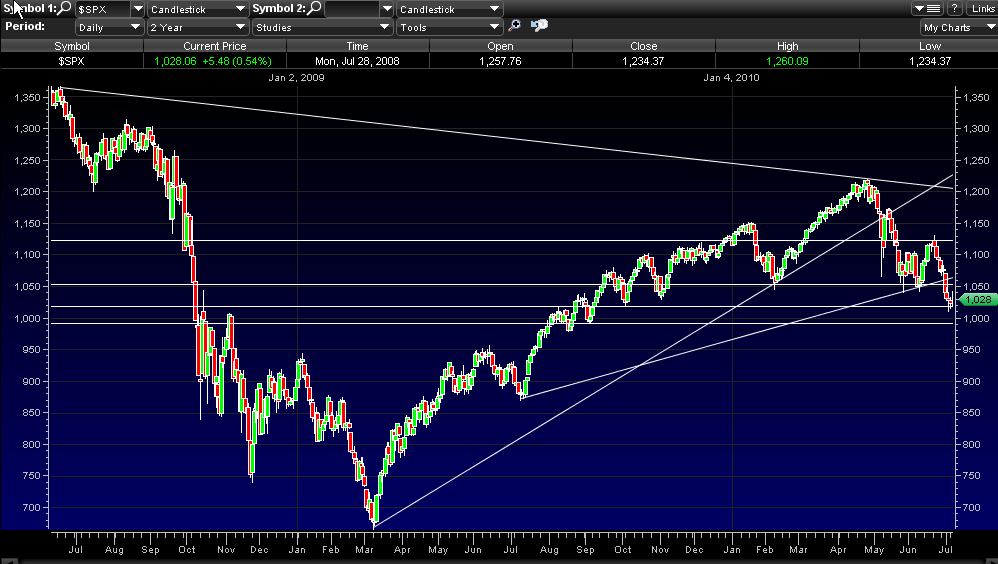
Let me be clear, you need to take advantage of any move of 3% or 5% to get out of positions that you've been holding.  Be careful and sell your positions as we move higher.  Above this area we have lots of tough slogging for bulls and we'll see how the market can face this now tough resistance.  Key areas on the $SPX to examine are 1037 and also 1055.
If the market falls I'll be watching 1018 and then 993 and 978, after that, it is the low 900s. 

Again, the FED will attempt to do anything and everything to bounce and boost this market.  We might get more shorting bans, we might get more outright purchases of equities by the Fed, we might get dollar devaluations, and we might get a kitchen sink or two...... anything and everything to get something positive going, so don't go shorting the market here, but do get conservative because even a 15% move higher will be met with sellers that feel they have been given a gift from the Lord above and they will be very happy to unload their shares once they get back to their April levels.  (If they get there).

Oh yes, I have so many things I want to write about, but I'll give you a quick teaser topic.  Everyone loves gold, be prepared to witness gold trading down to $1040 or so.  The more you hear about Europe implementing austerity measures means that Gold (the alternative currency) will fall.  People have literally been running to gold because they fear a collapse in the Euro.  In the short run they are not going to profit by chasing gold in their fear.  DO NOT BUY GOLD HERE.  I wouldn't doubt that these buyers are ultimately correct, but you'll be able to buy 10% to 15% cheaper.  I will begin buying more again around this area.


As you can see, there is some support below, but lots of resistance overhead.  Doesn't that April high look far away?

GOATMUG

Monday, December 28, 2009

Give Us Something To Believe In

I wrote this article and submitteed it to Tim Knight's Slope of Hope. He usually will post my contributions only on the weekends because they are so long, so I will go ahead and publish it here in case it doesn't fit with his year-end line up. I will post a very quick (I know-I promise it will not be lengthy) updates on where I think the market is from a trading perspective and how to look at the positions we've mentioned in the past. Right now other than the last piece of my KSU that I exited this morning I have no positions.

I've documented the history of actions that caused our crisis and outlined the steps our government has taken to "bail us out". You may find the most recent post at Goatmug's Blog where we discuss The Best Cup of Coffee Ever and how it seemed wonderful and solved all of my problems, yet ended up bitter and disappointing. As I've mentioned, I believe many of the steps taken have either not worked at all, created other problems, or simply hidden the problems. Let's take a few of the items I pointed to in the last post and review the impact and results of their actions

A) The Federal Reserve and Treasury along with other world central banks stepped in and offered their fiscal support and immediately lowered rates again to near zero. Remember, these are front month rates and are the interest rates the government charges banks for overnight money. The Fed voted in recent weeks to keep rates stable at effectively zero percent interest. They voted to do so some 18 months since the beginning of the crisis and 9 months after the beginning of what we now know as one of the largest rebounds in stock market history. In spite of the rally we are still around the 10,500 level on the Dow which is where we traded in January of 2006 and well below the lofty 14,000 area of October of 2007. Am I saying that we cannot return to these areas? No, in fact if the Treasury department remains committed to devaluing the dollar, I can paint a scenario where that might be a real outcome. I doubt it seriously, but it could happen.

Timothy Geithner gave an interview last week on NPR that should put us all on notice. In his words, we will not have a retest or slowdown after this recession. Although many of his other predictions have been flat out wrong, I have a strange sense that he is committed to not letting that happen no matter what. http://www.npr.org/templates/story/story.php?storyId=121778778

Mr. Geithner is only speaking of a short term pull back that he'll help us avoid, for it is too obvious that the Fed and Treasury actions create bubbles and meltdowns and they are coming with increasing speed. I liken this to a drug addict. At first there is pleasure in the use of the substance. Next there is dependency, and then an increasing need for the larger portions of the drug in greater frequency. Think about friends, family members, and others that fit this drug addict description. It usually never has a happy ending does it? I think what we're about to experience is "tough love" provided by our investors. Our friends, (Chinese, British, folks in the Middle East), are about to hold a frightening intervention with the addict and therefore we will be told that we need to shape up and cut out our drug abuse. Unfortunately, I don't think the addict will listen. It is too tempting to let all of that debt go to waste and too hard to cut spending and cut promises and entitlements.

So what are the results of these actions? Interest rates are still low and creating asset bubbles. - Banks and other bank holding companies...er investment banks and insurance companies can now borrow at zero overnight and buy stocks, bonds, and commodities. Is there any wonder why all markets are screaming? What happens when that money is taken back? Remember, this money was intended to buttress balance sheets and also intended to be lent out to companies and consumers, not find their way to the casino!

Banks receive this money and will lend. - NOPE! This has not happened. This I believe is one of the greatest lies that has been made in this crisis. Why would any smart banker lend in the teeth of a nasty, jobless recession? Would you? If you looked at a firm that is asking for credit and he tells you that their business is slowing and they need a loan to make payroll, do you think they are a good risk? Asking bankers to lose money on bad loans is not a solution to the crisis. On a positive note, I am hearing some of my clients being contacted by banks that are desiring to lend on decent terms now. This may be an indication of some thawing.

B) The Fed also bought toxic securities outright from troubled financial institutions and traded those assets for treasuries. Our government offered the TARP funds to help institutions and even made outright purchases of banks and insurance companies. (AIG, Citbank, etc.) We even used these to buy and lend stakes to great car companies like GM! We keep reading that many of the banks and insurance companies that we lent TARP money to have repaid us and we (the US taxpayer) may have actually made some money on these loans. The reality is that we may have made some money on loans that have been repaid, but we have taken a bath on the loans that will never be repaid. Making AIG a government controlled entity makes certain that more losses are headed our way. The Treasury Department and Fed's lack of negotiation with AIG's creditors should be enough to convince anyone that the well connected firms like PIMCO, Goldman Sachs, and Blackrock were feasting on the carcasses of weakened and dying financial firms. In addition, these same favored companies have become the mechanism by which the FED and Treasury actually implement their policies. These companies are providing transaction support (spreads), participating in deals, and also offering consulting services

So what are the results of these actions?
AIG is a mess and still 85% owned by the US. Isn't it great we are in the insurance business?
GM - is still GM.
Goldman, Blackrock, and PIMCO are killing it .

Remember too big to fail? - As a result of the forced marriages between JPM and Washington Mutual, BAC and Merrill Lynch, Wells Fargo and Wachovia, we now have a greater concentration of larger institutions. Seems like the US government has now created larger risk pockets and concentrated more power in less hands. Finally, the repaid TARP money is being used like a slush fund now. The administration and Geithner said they had "extra TARP money" that they could use! Excuse me, just because it is appropriated doesn't mean we need to use it if everything is all fixed, right?
C) In concert with these actions our government also looked to perform direct support (cynics would call it manipulation) in the mortgage market and the treasury market. By guaranteeing and supporting the FHA the US taxpayer became the lender/insurer to 80% of the post-collapse mortgage market. With the announcement of quantitative easing by the Fed we began buying our own treasuries to try to keep prices low and contain rising interest rates.

While short-term manipulation has been successful, it is just that - short term. The bond market is bigger than any one central government and the bet made by Bernanke is going to be called. Once that happens interest rates will climb (and as I type this we are seeing 30 year mortgage rates 10bps higher in one day last week!). THIS IS A HUGE MOVE BY THE WAY! Who will step in to fill the void of the government in this volume at these rates? Stabilizing the home market is job #1 - The government has artificially lowered interest rates and become the dumping ground for all banks to offload their paper on the US taxpayer. Few banks are doing direct lending to residential borrowers without FHA backing. Home sales look to be moving up, but we must ask how long this will continue if rates jump substantially, cash for houses go away, the FED stops buying MBS (stops being the market), or banks actually release the huge backlog of foreclosures that they have kept on their books.

Don't get me wrong, the government is having an impact here and this is positive for the economy. I'm very concerned that this could change if any of the government "help" is removed or investors demand higher rates and push mortgages rates over 6%. For example, in November we were to have the final expiration of the first time home buyer credit. Sales were pulled forward and suddenly we have a reported drop in new home purchases in November. The following Bloomberg article demonstrates what the threat of pulling stimulus does. A mad rush of buyers that would have bought anyway step forward to take advantage of the taxpayer-paid windfall, and then demand dries up in the following months (Cash for Clunkers anyone?). http://www.bloomberg.com/apps/news?pid=newsarchive&sid=al3GTnIut0Ao

Obviously I'll have this prediction in my top predictions for 2010, but I'll suggest here and now that we have a dip in the sales trend in existing homes as much of the inventory that has been clearing has been foreclosures and investors (not occupants) have been swooping in to pick them up. Hopefully those investors have been buying smart and have deep pockets because I will predict that we'll see the new generation of home flippers that have emerged get sunk in 2010. They'll find that there won't be many buyers for these homes when mortgage rates hit 6% or 7% since we're all spoiled and believe that 4.75% is what we should expect! These investors will also get hit hard when banks like Wells Fargo and Bank of America actually release their piles of inventory instead of letting them trickle out. Look for these inventory clearances after 1st quarter reports come out.We were told that housing is the key to recovery - housing has not recovered yet, so I guess there is no recovery yet.

D) The Obama administration got in the act and began programs like the Housing Tax rebate for first time home buyers, Cash for Clunkers, and now Cash for Caulkers. In addition, the federal government has continued its payment of extended unemployment benefits. In addition, as a country we are now running a huge fiscal deficit (nothing new, just the magnitude of it is) and our government's expansion has required us to raise the debt ceiling (allowable debt of the country) to $1.8 Trillion Dollars! This doesn't even account for the addition of any new health care program or new stimulus. As I've mentioned several times, I believe that the Fed and Treasury must be cussing the administration for their interference. The Obama administration has kept to their strategy that they wouldn't waste any crisis and by goodness they haven't. In the hysteria they have continued to plunder the US taxpayer and add more programs and benefits to the entitlements for anyone that will take them.

We are now seeing that COBRA subsidy benefits are being extended to the unemployed (they have been offered for 9 months) and will be provided for another 6 month period. The program pays 65% of the premiums that someone that has been laid off of work must pay to keep their health insurance. It seems odd to me that the US Government and US taxpayer would pay for health plans at rates that are significantly higher than what can be obtained by families in the open market with individual policies. Of course we shouldn't be amazed at all about this, this is what happens when government makes decisions. This one example illustrates how the new health reform plan cannot and will not be an improvement or a cost savings for anyone.

While Obama has added his pork to the budget, the US treasury buyers will not tolerate the bloated debt of the USA. The market will require higher rates of interest and this will cause significant pain for all of us.
Crisis Management- Administrations have added pork laden projects and plans to the backs of taxpayers as an excuse to stimulate the economy. There are no plan for fiscal restraint or management of the budget. What simply blows me away is that I hear Obama speak about finding waste in government programs to pay for more stuff! Where is the idea that you cut costs and if necessary, benefits?

I'll comment more about the health care reform bill in another post, but you need to understand that the winner here is the health insurance industry (for now). As these bills are written they will have a captive audience of buyers. Many of you know that I own a health insurance brokerage and I saw a huge swing in commentary by insurance companies. If you don't think they are giddy, you are WRONG! Check out this email link I received from Aetna. These guys were hammering the Senators and then suddenly came out with this gem. Mind you, if this goes through I hope to sell everyone one of you a policy because I would hate to see you go to jail or pay stiff fines, but everything about this stinks and reeks of over promising and under delivering at a terrible cost to tax payers. A key provision in the plan is the elimination of pre-existing conditions as a basis for exclusion or rating up. Once this exclusion provision is removed we will witness the elimination of INSURANCE! Why would you obtain insurance till you have something serious now? GDP was revised downward and we are seeing that the government is responsible for most of the production for last quarter. I understand that

For all of these programs, what are the results? - We were told we need these programs to stimulate the economy- all have been short term and have done nothing to change the fundamental situation. We still have 10% unemployment and 17% U-6 unemployment. We were told that everything would begin to get better once housing is stabilized, we haven't seen housing stabilize and won't for a while. More appropriately we'll see things stabilize when people have jobs.

E) The accounting standards board (FASB) bowed to pressure from financial institutions and our government by suddenly recommending that accounting standards be thrown out the window. The accounting standards board have been complicit in this crime against investors as the boards were threatened and frightened into thinking that they would be responsible for imploding our economy. Where is the leadership in our country? I am afraid that the move to take a time out on reality simply makes it easier to do it again. The accounting standards board should have stood up and emphatically stated that accounting standards don't change or take a time out because the truth hurts! Future collapses will be much worse because the ponzi schemes the government and banks have set into motion were not stopped here. Clearly now that the banks are bigger and risk more concentrated similar meltdowns will be even more destructive. Accounting standards were thrown out resulting in a lack of understanding of true value of banks and insurance companies.

Where are we now? We still don't know what banks are worth and they are still raising capital and still lying about the risk on their balance sheets.

F) Finally, as we saw in the previous October post called Public Enemy #1-Deflation we see that the Fed and Treasury unleashed its last desperate weapon, Dollar Devaluation. The dollar devaluation trade is simply a move to destroy the value of the dollar relative to other currencies. This makes our dollars worth less and hence our debt worth less. We could also argue that it makes our goods cheaper as we hope to sell them abroad. The Fed has been true to its words that it would implement this strategy if faced with the prospect of deflation. When the government went to work in March the DXY was at $89.20 and they did not disappoint. They have moved the value down by as much at $15.00. The DXY is now trading at 77.64, well off its lows of $74.27 in late November and early December. So as the dollar has been pelted since March, EVERYTHING has gone up. Think about it, stocks, bonds, bread, gas, oil, gold, and the kitchen sink have all increased. http://www.marketwatch.com/investing/index/DXY/charts?chartType=interactive&countryCode=us So now, we've been told that everything is better and that we are recovering. In fact about 3 weeks ago, we had a surprisingly strong jobless claims report that stunned the market and boom, the dollar reversed course and interest rates began to rise. They rose because the strong jobless report indicated that things were stronger than expected and the Fed might need to remove stimulus (increase interest rates or as we know it, take the drugs away from the addict). Since that day there has been a resurgence of the dollar. Bernanke tried to tell the market that they would not raise rates because there were no indications of inflation in the market. Fed governors tried to tell us there was no evidence of inflation, and now Geithner has come out and told us that there is not a chance that we'll have a double dip.

So why are rates starting to rise and the dollar increase? How have we seen the dollar rise and the markets increase? First we have had some credit issues with Dubai, Greece, and Spain. All of those have reminded investors that there really is risk in the credit market and we aren't fully recovered. Scared investors tend to go to safety, and therefore we have seen a flight to safety in the dollar. Having said that, treasuries are a poor investment as the Fed has made sure to destroy any reality in that market (and value too). Therefore it is easy to see how liquidity could move to other dollar denominated assets allowing for the strengthening dollar AND rising equities and bonds (at least here in the last few weeks). Remember, this move up in interest rates and increase in the value of the dollar is contrary to what the Fed and Treasury desire (even though they say they want a strong dollar for the sake of our Chinese buddies). The increase in rates immediately translates to greater borrowing costs for the tax payers AND devalues the value of the treasury assets we already own. The government states that it wants to keep rates low to stimulate lending, but I can also see that we need to keep rates low to keep from blowing our own foot off since we have been purchasing our own debt through quantitative easing. Zerohedge has another good post that captures exactly what I've been saying and leading up to here.

What are the results? - So we have an administration that says they want a strong dollar, but we have a Fed Chief that has stated his strategy to save the economy would rely on a devaluation of the dollar. We have had an engineered rally in all asset classes and treasury rates that are way too low for the risk and duration of the trade. In essence we have a bubble in Treasuries!
My isn't it obvious, where ever we see the footsteps of the Fed, we see bubbles? So what is on the horizon for the Fed and Treasury? In 2010 we will see greater rates as buyers decide to wait it out and purchase their mis-priced treasuries at a better risk-reward. The greater rates will hurt bond holders and most of all the US tax payer. The bond market at some point will change the behavior of our current administration and the corrupt politicians that look to hand out entitlements and lack the idea of being representatives of the people.

We will see drastic cuts in city and state budgets and services before we see anything on the Federal side, but cuts will come at the national level.

If the Fed and Treasury want to keep the charade of low rates going then a fall in the equity markets will be the mechanism to deliver lower funding rates, unless they announce a new set of Q.E.

To wrap this up, we see that in each instance the failed efforts of the government to fix the situation have either simply done nothing or helped to kick the can down the road. As we've elaborated since our first post in August, the game of extend and pretend has been in full force. The problem is that at some point (2010, 2012, or 2015....) there will not be a way to extend it and a creditor will call our bluff and call in our debts. What I am really longing for is for a responsible leader to stand up and say NO, we won't offer this entitlement, no- we are actually going to cut services. Americans are going to be forced to live through these boom and bust cycles at an increasing level of speed and magnitude because our current leadership will not speak truth. The best result of all of this crisis is that average Americans are beginning to wake up and live a paradigm based on their needs and not their wants, based on their own ability and assets, not based on what their neighbor has. I am seeing a genuine reversion to true values of healthy financial management in peoples financial lives and in their businesses. Unfortunately, they had better be ready quickly because our government is saddling them with more debt and taxation to pay for promises and entitlements we can't afford. As an example of the crisis that consumers are facing check out this closing study.

Almost half (46%) of 2,148 consumers surveyed recently said they weren’t confident they could come up with $2,000 within a month in a crisis–from savings, family, friends, credit cards or other sources.Even among those earning $100,000 to $149,000 a year. almost 25% doubted they could raise it, according to the survey conducted by research firm TNS with academics from Harvard Business School and Dartmouth College. “We wanted to know if people could fix a broken car or furnace,” says Harvard finance professor Peter Tufano, who adds that most studies he has seen measure “how much cash people have… not how much they can access.” The survey results surprised him. “The ability to cope with emergencies is much less strong than we might have thought.”

I saw this in reality as people in the South dealt with Hurricane Ike. After 1 day people were cashless and without resources to make it through this terrible emergency. Americans need to wake up and save and communicate to their leaders that it is unacceptable to continue in this fashion. We had a final emergency and the US leadership chose to fake it till they made it rather than employ real fundamental solutions to problems of our own creation. At the end of the day I feel like the Bush Administration, Obama Administration, Treasury, and the Fed have just tried to spin whatever story we would fall for in order to get us to give them time. What they have figured out is that we just want them to give us something to believe in to quote a favorite from Poison (yes, I'm still into 80's hairbands). Guess what, they've given us a few tales, let's hope that no one actually figures out that what we've believed in isn't worth the trust we've placed with them.

Goatmug

Monday, October 19, 2009

BATTLE STATIONS - CENTRAL BANKS TAKE AIM AT OUR POLICIES

Breaking News
Just wanted to update you on some breaking news related to currency and overseas investing.

Please read the following story from CNBC regarding the Brazilian government preparing to levy a 2% tax on all financial capital inflows.


http://www.cnbc.com/id/33357363/site/14081545/for/cnbc/

You Don't Want Our Currency --- Really!
Why would a country do this? What would make Brazil, the shining star of Latin America, take drastic steps to stem the tide of money flowing to their country? They were just given the "honor" to host the 2016 Olympic games, and now they are declaring war on inflows of money?

Well, let's examine the strategies we've highlighted for the past several months. At the end of each monthly analysis I end with the same commentary. "Watch the dollar. If it continues to go down, buy commodities, invest overseas, and buy other currencies." There have been no other themes since my first post here in August.

What are the implications of millions of investors in the US and the world following those exact instructions in one concerted herd-like effort? Simple, as investors shun USD assets like stocks, bonds, and savings accounts that yield nothing, in an attempt to devour off shore investments, we must convert our USD into the foreign legal tender of that nationality. As more and more of our like minded friends pile on, the foreign currency (Real in this case) begins to appreciate in value in comparison to other currencies.

Your Demand for Our Currency Hurts!
Why is this a problem for a country like Brazil? This increase in value of a national currency is a problem for countries like Brazil and Japan because they have many industries that export manufactured goods and raw materials throughout the world. These countries begin to suffer when their currency increases in value because importers that purchase the goods must pay more than they otherwise would for that same good.
A good example is a Japanese company like Toyota. Because the Yen has gone up 20% or more relative to the USD, the Japanese price for the car has technically increased by 20%. Will the US consumer care if a car is 20% more expensive? Heck yes! In reality, Toyota doesn't have a floating car price, so what happens is that the appreciating currency actually causes a loss to Toyota in Japan if they sell a car when those USD are converted to yen. The other solution Toyota has found is that they simply have begun manufacturing cars here in the US to mitigate some of this currency translation issue. Still, if Toyota HQ repatriated ALL of the USD housed here in the United States, the company would take a massive currency loss on the conversion.


Ok, so we can see that if we are a large oil producer or steel producer in Brazil, a rising currency hurts business and slows purchases down as foreign importers begin looking for alternative suppliers. Making matters worse is that the United States also is devaluing its currency on purpose! Emerging markets countries like Brazil get the double whammy as they are suffering from the inflows of all the "created" money looking for a home and the US keeps clobbering its own currency. Do you think many US buyers are actively seeking out purchases of goods and materials in Brazil? The answer is no.

Is It All Bad?
Is it all bad for Brazilians to have a strong currency? No, if they are purchasing imported goods or overseas goods, they seem to be on sale because the purchasing power of their currency is elevated. Think about Europeans coming to New York and Florida buying real estate. The currency exchange rate makes our property seem like it is on cheap.

Let's go back to the article now. What did Brazil suggest that it was going to do to curtail these inflows? Brazil will add a 2% tax on all incoming currency flows. This could slow, if not halt the influx, maybe.

Investment Implications
How exactly might the 2% impact us as investors? If you are an investor in EWZ (Ishares Brazil ETF) you might notice that after hours trading shows that the etf is down $2 or more. While this story is just breaking, I can speculate that new monies flowing into the etf may soon be subject to this 2% tax!!! The ETF takes your investment dollars and purchases ADRs (American Depository Receipts) and stocks in Brazil. It will be quite tough to continue investing directly in the country if every dollar receives an up front 2% hit. Talk about an extraordinary expense ratio!

Does this change mean you run like crazy from EWZ? Perhaps, but it may also mean that we short EWZ for a possible draw down on the news. Even as I type this post, I am not seeing any new news listed under the ticker symbol for EWZ. In addition, any reversal in the dollar will hit EWZ as well.

Why is this important for the United States?
I keep posting on the the weakness of the dollar because it has huge implications for us as investors. Our policy of a weak dollar, (the Fed says we believe in a strong dollar, I know), will have international implications. Brazil is not the first to act as Korea and a few other exporters last week attempted to buy a few billion dollars worth of dollars to reduce the value of their own currencies. Personally, I think the Korean approach is a waste of dollars as I believe strongly that our Fed intends to take our currency much lower. I think t he Brazilian approach is unique and interesting. I'm not sure it will work, but you are really starting to see foreign central bankers try to take action to address the US tactic. Economically speaking, the US is "attacking" these countries and putting pressure on them. You will begin to see increased hostility from exporting nations directed at our country.

Goatmug