Tuesday, February 1, 2011

WHY AREN'T WE TURNING JAPANESE? JAPANESE DEFLATION REVISITED

Please review the Bloomberg story - http://www.bloomberg.com/news/2011-01-13/japan-exporting-deflation-reveals-meaning-of-bernanke-s-economic-nightmare.html

In the last post titled Economic Warfare - Inflation Bombs (Part 1) -  I outlined how the US leadership was attempting to create asset price inflation (stock markets up) in an attempt to change perception and create a state of "feeling better" which actually changes reality so that the economy's participants act in ways that spur improvement and thus makes the economy "better".

The mechanism of this "feel better" cocktail is the use of QE or Quantitative Easing which is simply where the Fed and Treasury "print" electronic dollars and buy US Treasuries from the open market.  Essentially the hope is that this exchange of dollars floods banks and other investors with cash.  In the case of banks, the hope is that they will lend money to borrowers that will then do projects that stimulate the economy and create jobs.  Investors are "encouraged" to buy other things like stocks with their treasury proceeds.    The tidal wave of new dollars has done exactly what the Fed has desired in that the purchases of stocks and other assets have increased substantially in value since the low of March 2009.

As I covered, those same dollars haven't just bought stocks, they bought commodities like gold, silver, oil, wheat, cotton, sugar, cocoa, copper, and every other hard and soft asset.  The by-product of this has been a surge in prices for these commodities.  Read my article for more on the impact of those price increases.

So, to summarize and get to the point of this post, the Fed gambit has succeeded so far in getting stocks up and the economy moving forward.  As Ben Bernanke has highlighted many times, deflation is the ultimate enemy, it was the cause of the Great Depression and some say it was the cause for WWII as well.  Since he is an expert in that economic period, he has vowed to defeat it at any cost.  The cost literally has been in the trillions to accomplish this feat.

There is also one other thing going on in the back ground.  Our government (Bush and Obama) attempted their own fixes in concert with the Fed.  These fiscal  approaches included massive government spending to counter act the decline in personal consumption and spending.  Of course the US government didn't have all the money for the additional trillions it was spewing out, so it created massive deficits and that trend continues today.  What is important to note here is that this massive outflow of government spending and surge in debt now must be paid for in the form of treasury obligations.  So, not only is the Fed buying US government debt for the sake of sparking an asset rally, it is also purchasing the debt of the US due to significant cost over runs.  The amount we owe is so large that we are now sensitive to any increase in interest rates that come from an erosion of the quality of creditworthiness.  Here is the money shot - The US Fed now really has this dual policy mandate (that is unspoken) - 1)  Keep the markets up so the recovery can be sustained   2)  For goodness sake don't let interest rates rise cause we can't pay the cost of interest on our borrowed principle.

So after that very long introduction we know that there is a WAR ON DEFLATION.  So what is the problem with deflation?  What happens to consumers in a deflationary environment?  Let's examine the story about Japan's experience to see what scares Bernanke so much.

  • "Their advantage may be Japan’s disadvantage. Prices in Japan as measured by the gross domestic product deflator have declined almost without interruption since 1994. That has muted the effect of falling wages and provides a cautionary tale for Federal Reserve Chairman Ben S. Bernanke, who has been lecturing on deflation’s perils as a central banker since 2002. "
Ok, so since 1994 prices have declined in Japan for everything from shirts to hamburgers.  Anything bad there?  Let's read on to see. 
  • “Retailers like Uniqlo were able to ride the wave of deflation and grow,” said Yoshimasa Maruyama, a senior economist at Itochu Corp. in Tokyo. “To win these pricing wars at home, companies had to keep cutting workers’ pay, and that’s spiraled down with prices falling and then falling some more, with deflation never ending.”

The article's point here is that the company did cut wages to attempt to compete in the environment.  Therefore, if my wages are cut it must be terrible right?  Actually, if my wages are cut, but all the things I buy are less then I don't really feel it as much.  It seems like Martin Shulz agees.

  • “Everyone knew deflation was bad for jobs and bad for the economy, but gradually, households and companies just got used to it,” said Martin Schulz, a former Bank of Japan researcher and now senior economist in Tokyo at Fujitsu Research Institute. “The risk is that it takes hold in the U.S. as well.”
Admittedly there are negatives.  Companies just don't cut prices, they cut headcount to complete.  But where does the notion come from that deflation is bad in the article? 

  • ‘Unavoidable Endgame’

    Deflation will steadily sap nominal growth, depriving the government of revenue, until one day Japan will no longer be able to finance its borrowing, Jerram said. The country will either default on a debt of about twice the size of the economy or debase its currency to reduce the real value of liabilities.

    “That’s the unavoidable endgame,” said Jerram, who has analyzed the Japanese economy since 1987. “As long as it’s in the future, everybody can pretend it’s someone else’s problem.”
I laugh when I read that text.  Yes, the unavoidable endgame is that the government defaults or devalues IF they continue to have stupid government spending on useless building projects (bridges to nowhere), entitlements, and stimulus spending that achieves nothing!  Sound familiar?  Japan is the future of Amerika!  The endgame is unavoidable if governments continue to have huge fiscal deficits and don't control themselves.  This is where we see the sheer terror of Bernanke and other government leaders.  Delfation is a killer if you have an out of control government that doesn't manage spending appropriately.  How many times have we heard that governments will actually downsize and cut costs?  NEVER!  In fact, the US government builds in annual increases into the budget that do not need to be approved.  So every department's budget grows automatically every year.  That includes salaries and base expenditures!  No wonder we cannot control the power and cost creep of the government!

The takeaway here is that deflation is bad if you are a government official.  Otherwise you'll see that Japan's style of deflation isn't quite as horrible as it is cracked up to be.    Consumers (normal people) actually feel fine with deflation.

  • The success of the companies in Japan has helped consumers adjust to deflation. The average household owns 1.4 cars and 2.4 color televisions, about a quarter more than in 1990, a Cabinet Office survey shows. The proportion of people content with their standard of living was 63.9 percent last year, compared with 63.1 percent in 1989, a government report said.
Contrast the information above with the choice that your federal government and Federal Reserve is making.  They would rather declare war on the retired and poorest US citizens by invoking the spirit of inflation.  Bernanke demands rising prices in gasoline, oil, clothing, and food and those costs become a larger portion of the poorest income --- just to survive!  The middle class are squeezed to death in the spiral of surging prices.  The Fed claims that wages will increase and jobs will be created, but where is the data to support this?  Where are the rising wages?  Where are the jobs?   I've highlight again the statement from above -
  • The country will either default on a debt of about twice the size of the economy or debase its currency to reduce the real value of liabilities.
The reality is that the government and the Fed has chosen not to cut the size of our government and it's entitlements, but has chosen to debase our currency.  The debasement of the currency amounts to the crushing of our poor and also the poor of the world through price inflation (because commodities are priced in dollars).  I wonder how long the Amerikan poor and middle class will put up with these attacks.  When will the rioting of Egypt and Tunisia come to the streets of our cities?  If you think the trend of higher prices in food is going to abate you are absolutely wrong.  If you think we won't see $4 gas this summer you are nuts!  Good or bad, Amerikans are soft and don't have the heart to stand up to these overt attacks by government elites.  Where is the America I grew up in?

Would you rather choose starving to death, being on the government foodstamp roles, and losing your independence and dignity or choose this?

  • “It’s amazing what you can buy with 100 yen now, we didn’t have 100-yen stores before,” said Sachiko Enokida, 80, who lives on her bimonthly pension checks from the government and has witnessed inflation’s ups and downs since the 1940s. “After the war, we all thought this was going to be the last year before we starved. Then things really boomed and people were buying apartments like crazy and you saw wealth everywhere. I would hate for things to get expensive again.”
    With almost one fourth of the population over 65 years old, Japan chose to stay in deflation, said Feldman. That turned cash into an investment, as money left in bank deposits gained in purchasing power the longer it stayed there. Today, Japanese households keep 56 percent of their financial assets in cash, compared with 14 percent in the U.S.

    “The factors that produced and permitted deflationary policy seem likely to persist,” Feldman said in a report.
    Meanwhile, consumers continue to enjoy lower prices. Golfers pay 26,800 yen to play on the weekend with a caddy at Oak Hills Country Club, a course 90 minutes’ drive from central Tokyo designed by Robert Trent Jones Jr. Twenty years ago, the fee was about 40,000 yen, said Katsutoshi Ohira, acting manager.

    “I don’t think I can expect any meaningfully big pay raises going ahead,” said Satoshi Miyazaki, 34, who works for an advertising company in Tokyo. “Since I’m paying for things out of my limited salary, lower prices have been a great help.”

There is going to be a collapse in Japan too, don't get me wrong.  Both countries have pursued poor policies that didn't include government cuts.  Both countries continued to borrow and live in the moment rather than in a mode of planning for the future.  My point here is simply that Bernanke and the Fed have picked the option that benefits the US government, banks, and elites rather than the US citizen.  They have picked themselves over the us.

GOATMUG


    Monday, January 31, 2011

    WALK LIKE AN EGYPTIAN?

    As many readers know I've been highlighting the activities of the Fed and how those actions impact the US and the world.  In the 2011 Outlook I emphasized how the exporting of inflation would cause oil and gas to go much higher and how food would also be impacted as a result. 

    Over the last week we have seen the media blitz as Tunisia and Egyptian riots have boiled over due to poor economic conditions like high unemployment, poor wages, and the rising cost of food.  Tunisia has overthrown their leadership and it appears as though Egypt will also have new leadership.

    The coming changes in Egypt have me wondering what is next.  To assist readers, I've included a link here to Stratfor which is an organization that is made up of former intelligence officers that now sell market and world intelligence to Wall Street and other buyers.  They have a very informed group that has great insight in world politics and economics.  The 8 minute video is worth watching.

    http://www.stratfor.com/analysis/20110128-agenda-george-friedman-egypt 


    There is a ton of great stuff in the interview, but I think the money shot here is that he says that the events in Egypt are of "towering consequence".  In other words, "THIS IS BIG".  The drama that unfolds there is so interesting because it unveils the conflicting US position where we support strong-men dictators while championing democracy.  This is just another opportunity to see how ill prepared Obama (and Hillary Clinton) is to understand and deal with the real-world dynamics of foreign policy.  The truth is that the US and Israel have implemented successfully a strategy of playing on the divisions of the people in the Middle East for many years.  Think about it, we look to take advantage of the differences between Arabs and non-Arabs, and we play to the divide between Sunnis and Shiites.  A homogeneous Middle East dominated by a common "democratically elected" Islamic movement is absolutely not in the best interest of the US, or probably the world.  I hope that there is a skillful way for the US to continue to play this game, we absolutely need adept diplomatic leadership now.
    I also have a few take aways that I've been thinking about over the weekend;

    A change of leadership in Egypt probably ushers in a more overt role by the military.

    Muslim (Islamist) elements will gain a larger presence within the government.  (Remember, these guys don't have to be the President to impact the direction of the state.  They can simply write laws that steer the country in new directions)

    The border with Israel is of great concern.  Remember, Egypt has played a major role in containing the Palestinians by having a "sealed" border.  A government that is more sympathetic to the Palestinians could mean instability for Israel.

    The broader question is whether or not the spread of unrest stops in Egypt.  If a change of power is made, I believe that it will incite others to attempt to try.  The reality is that if new countries are swept up in the move to overthrow current leadership, things could become very nasty and bloody as leaders look to put down to the revolts.  Oman is certainly a place to look for this to occur.  I've heard that perhaps a move like this may take place in Syria as much of the country is not Islamic yet the government is run by the  minority (I don't believe this will happen).  As demonstrators have more success, I look for other countries full of disenfranchised youth to try to "Walk Like an Egyptian".

    GOATMUG

    Friday, January 28, 2011

    I DON'T LIKE YOU BECAUSE YOU'RE DANGEROUS!

    I found this video today and it captures why Amerika is so great.  On a day where the market was down for the first time in 2 months and the Middle East is burning, this is certainly something I needed to make me realize the greatness of the US.  Only Americans with all their ingenuity and witty sarcasm could put such a masterpiece together.  As I mentioned in the post about Inflation Bombs earlier this week, the seeds we are planting are growing into a nasty fruit called unrest in emerging nations.  Yes, there were underlying problems of unemployment, corruption, and horrible governments, but the inflation Ben Bernanke has spewed throughout the world in the form of commodity inflation (FOOD!).  Nothing gets a citizen more angry and desperate as starvation and the thought of not being able to afford food for your children.  You are willing to die to change drastic situations once your kids can't eat.

    If you weren't in touch with the severity of the situation you need to be.  Egyptians rioted violently and the upheaval has spread to Jordan too.  I can't doubt that this will come to Saudi Arabia, Yemen, and other countries.  If a large nation-state falls the reigns of power will be taken up by radicals such as those in Syria led by Hezbollah.  The danger here is that if this change of control happens in Egypt the world could face serious destabilization in the Suez Canal which is the major oil transport route in the world.  Give these guys power over the Canal and you'll make Kim Jong Il look like a child.


    Enjoy!

    Still can't believe they didn't use all of my favorite line in this movie - I still can't believe it.

    " I gotta give you your dream shot! I'm gonna send you up against the best. You two characters, are going to Top Gun. For five weeks, you'll be flying against the best fighter pilots in the world. You were number two, Cougar was number one. Cougar lost it-turned in his wings."

    GOATMUG

    Wednesday, January 26, 2011

    ECONOMIC WARFARE (PART 1) - INFLATION BOMBS

    We've all heard that players in the global economy "export inflation" or "export deflation". In fact I saw an opinion piece on Bloomberg last week where the author stated quite clearly that China is complicit in allowing the US to act AND therefore is bringing inflation on themselves. - Find the opinion piece here - http://www.bloomberg.com/news/2011-01-21/china-can-just-say-no-to-one-u-s-export-commentary-by-caroline-baum.html -  Essentially how this works is the following;


    STATED FED POLICY -
    If the US is trying to create inflation (they are) they will print more of their money supply and flood the world with liquidity and excess credit. As banks have excess liquidity through any of the mechanisms that Bernanke has employed the money finds its way to other things. US Central Bankers state that they hope that the liquidity moves from the banks in the form of loans to consumers and businesses. CLEARLY WE KNOW THIS HAS NOT HAPPENED, BUT STAY WITH ME.  In theory the consumption of these loans for business investments creates new opportunities and projects that will create jobs, stimulate income growth, get consumers buying, and voila, all is better!  Further, while the Fed hopes this is the longer term outcome, they want a quick fix.  Alan Greenspan and Ben Bernanke have directly commented that the best way to get a faster recovery is to give the appearance of a healthy economy by lifting stock market index levels.  Another way to say this is that they know that if they can pump up stock market valuations they can make consumers feel better (even if things really aren't) and that is about 80% of the battle.  Once the economy feels better through "asset price lift" the real economy is sort of dragged along and activity improves.  Now don't get all focused on the fact that structural issues haven't changed, remember they are only talking about perception and how appearance becomes real.  All of these actions by the Fed are based on the notion that is that "inflation is good" and "deflation is bad".  The moves of Bernanke are being made to avoid deflation at all costs.  We'll discuss what deflation looks like and why it is bad for the government, the Fed, the banks, and citizens in a future post.

    ACTUAL OUTCOMES
    Rather than the "expected outcome" we have seen some other results that impact the US and other countries. In a real life scenario we see the pumping of dollars to banks who then have not loaned out their capital. This "unexpected" event has occurred for several reasons including that small businesses just don't want loans because their business outlook is poor, consumers can't qualify for new mortgage loans due to impairments in their properties or lack of income and destroyed personal balance sheets, or frankly banks just don't want to take credit risk and would rather stuff that money in other investments.

    Notice the last item there.  As Ben Bernanke and his FED have printed lots of liquidity and provided it to banks that have nowhere to lend it, they simply have found other assets to buy.  As a result of the magical deployment of excess greenbacks we've seen a historic rise in treasuries recently and now we see an amazing run in stock markets and other commodity markets.  As we've discussed many times though, the flooding of the markets with dollars does come at a price.  The price is that other countries perceive the underlying value of the dollar to be poorer and therefore we see declines in the value of the dollar.  To combat this action, banks, hedgefunds, and investors have looked to deploy their investment dollars in assets outside of the US or into assets that are hard in nature such as commodities.  As typical with all herds, they tend to over do it.  Remember way back in 2008 when oil rocketed to $147? What did we call that despite all of the commodity trading regulators denials? WE CALLED IT SPECULATION!  At that time we heard of banks storing oil in barges and tankers off shore and we saw $4 gasoline too.  While I have not heard of banks store oil now, they seem to be buying great stuff like cotton, wheat, sugar, and coffee. You know, stuff that is needed for absolutely every other product!  We're almost at the point, stay with me.

    There are two reasons that other countries get really upset about the Fed's master plan to engineer the "recovery" of the US economy through printing and devaluing and making the appearance that all things are better through targeted asset price increases. 

    PROBLEM #1 - DEMAND FOR FOREIGN CURRENCY HURTS EXPORTING NATIONS
    First, when investors believe that their home currency is going to be devalued they look for other places to send that money to protect their wealth.  They do exactly like we suggested over the last year which was to "Go Emerging".  I liked this strategy because those countries were growing much faster than the US AND they had a currency that was not the USD.  While I'd like to think that many other investors we're as quick to recognize this as I was, it is clear that many came around and flooded those emerging countries with excess capital.  These remarkable inflows cause the currency of the emerging country to rocket higher compared to the dollar because there is excess demand.    This is a problem because all of these countries are typically big exporters.  When their currency goes higher they have to pay wages in their home currency and yet they receive less valuable payment (dollars) or the buyer in a foreign country sees their costs go much higher because it costs more dollars to buy that Brazilian iron ore, Korean television set, or Chinese plastic thingy.  So, the increasing value of the currency hurts the emerging countries exporters (which is a huge portion of their economy since they have been built on foreign demand rather than domestic consumption).

    PROBLEM #2 - FLEEING SPECULATIVE DOLLARS DRIVE ASSET PRICES BEYOND THE EQUILIBRIUM STATE OF THE CURRENCY DECLINE/GAIN.
    That is a long sub-title there but where I'm getting to is that as more of the herd recognizes that US dollars are being devalued and there is a need to diversify into other assets there is a rush to buy those "hard things".  Remember that many commodities are actually priced in US dollars (oil).  As we've covered, as the dollar drops there is an adjustment in the price of oil or other goods to compensate for that drop in another currency.  The problem with these investors though is that they tend to move the price much more than a 1:1 move to offset the decline in the dollar.  The herd of investors may drive oil, cotton, sugar, wheat, corn, etc much farther than what could be expected.  The extraordinary moves in commodities, especially foods really hurts those emerging economies where laborers make just a few dollars a day.  Think about it, sugar is up from its low in May of 2010 more than 100%.  Grains too are up 70% or more.  If 50% or more of your income goes toward the cost of feeding your family, what is the impact if food costs go up 100% during the year?  We are very fortunate in the US because food costs so little relative to our total income.    Is it any wonder why I mentioned in the 2011 perspective that inflation concerns, government reaction, and political turmoil would be big issues?  When food costs rise dramatically people in those countries riot and seek to overthrow their governments.  We don't need to look too hard to find examples such as Tunisia and even Egypt (over the last couple of days).  These countries have other issues like high unemployment, but the price of food is often the straw that breaks the proverbial camel's back. 

    ECONOMIC WARFARE - WHAT TO DO WHEN YOU ARE HIT WITH AN INFLATION BOMB?
    Brazil has described Bernanke's actions as economic war.  The overt devaluations of the dollar are hurting their economy and are essentially attacks on their prosperity.  What is a country to do in response to these attacks?  In response to these attacks, a country can do a few things to attempt to stem the pain associated with the "imported" inflation.  Unfortunately, the responses also have consequences.

    TACTICAL SOLUTIONS WHEN ATTACKED -A country can slap on currency controls that attempt to limit inflows of foreign investment money.  In this case non-domestic investors may need to pay a 15% tax on all money that is coming into the country.  Countries also may be forced to put taxes or levies on all imported goods to their country because suddenly imports to the country are much cheaper.  Emerging governments also try to reduce domestic lending by banks to reign in access to cash that goes toward investments.  We've also seen governments in emerging countries attempt to crack down on purchase of commodities as people attempt to trade out of currency and into hard assets, creating shortages.  Last, the "responsible" government can increase interest rates in their countries to attempt to head off inflation and crush the "domestic speculation" there.

    The Bloomberg opinion piece I mentioned above stated that the move to increase interest rates and essentially drive the value of the yuan higher was the prescription for China to head off inflation and justify the imbalance of a currency that is valued too low.  But think about it, that move does not happen without serious consequences.  Yes, it may stem food inflation costs in local terms, but it most certainly harms their export driven economy by making their manufacturers less competitive and may even drive them out of business.  Leaders in these countries are faced with tough choices.  Do they endure domestic strife due to rampant inflation for food, or do they crush their exporters making many lose their livelihood?  Further, these choices are being thrust upon them by our central bank and the "devalue the dollar" strategy.  At some level I'm sure these leaders see this as a death by firing squad or death by electrocution choice.  Further, China is facing competition from countries like Vietnam, Malaysia, and Thialand now.  No longer is China the cheapest manufacturing country out there.  Wage pressures have forced Chinese producers to pay higher wages so industries have searched for even cheaper labor in other places.  If China takes the prescription and raises rates and the value of their currency do you think they will lose business to these competing countries?  Of course!  If you had 100 million or 400 million workers in the exporting industries do you think you'd be quick to make them less competitive?  Not a chance.

    BEWARE OF CHINESE PRESIDENTS VISITING BEFORE THE STATE OF THE UNION ADDRESS
    Isn't it interesting that President Hu Jintao of China visited last week?  Isn't it odd that he remarked that the US dollar's place of significance in the world is past its time?  While the US has the ability to inflict serious pain on the Chinese by pursuing our strategy of a lower dollar and inflating away our debt, the Chinese have significant leverage with us because they own more than 1 Trillion dollars worth of US treasuries and other assets.  The timing of President Jintao's visit was not a mistake.  At some point our friends and lenders will try to get our attention in a more overt way by shaking up our bond markets and driving interest rates much higher.  As our Congressional leadership and our President continue to spend money without restraint and produce huge deficits world investors will shun our treasuries.  This action will drive up rates and will also serve to further drive down the value of the dollar.  A move like that would create considerable pain for the Chinese, but since the Fed has dethroned them as the largest holder of US Treasury debt, we would hurt even more.

    (EDIT) - The point I just raised has actually made me think more about what really is going on.  We are beholden to our Chinese friends who don't necessarily like holding our debt because the compensation for holding our bonds is mispriced.  Here we go again, this is and has been the problem with markets for the last 8 to 10 years in that the reward paid for holding debt is too low for the risk that investors (lenders) are assuming.  I'll write more on this, but I couldn't contain my excitement here as I've re-emphasized a common theme I've raised often.

    INFLATION BOMBS ARE MESSY - UNINTENDED CONSEQUENCES
    A smaller nation doesn't have much leverage against the US right now, but this monetary policy may have greater impact in fostering a much more violent response than we think.  Consider that the Fed policy of exporting inflation may drive food prices higher, unemployment rates up, and may even lead to an overthrow of a government in an emerging area.  Is it possible that a terrorist faction or a new government blames the US for its problems (that never happens does it?)?  Do you think that masses of poor disenfranchised young men might want to lash out as the US for harming their family and their country?  Is it as big leap to think that they might act violently and attack in some manner?  Of course this is ridiculous, something like this would never happen! 

    While the chance is probably remote and could never, ever happen, the Fed would be wise to review it's Inflation Bomb strategy.  We know that the approach taken by Bernanke here is about creating the "quick fix" rather than creating a solid foundation for recovery where structural issues are addressed and cured.  We know that Congress (both Dems and Repubs) really has no appetite for cutting spending or fixing our fiscal madness.  It is time we recognize the out of control mess that is going on and take action.  Cutting $100 million or even $100 billion from our budet is like peeing in the wind.  Dramatic cuts in entitlements must be made starting with Social Security, Medicare, and Obamacare and also cutting defense spending.  The Fed's monetization is a mirage and farce and is designed to hide the true cost of these programs and is a strategy of extend and pretend that all is ok and recovering.  It is time for action and the leadership in Washington (all of them) continue to fail miserably.  Unfortunately the policies are failing domestically and also abroad, it is only a matter of time before an Inflation Bomb goes off.

    BE CAREFUL!


    GOATMUG 

    Monday, January 17, 2011

    JANUARY MACRO UPDATE -

    The January Update will be a bit abbreviated in the commentary today.  I'm slammed working on a few things, but most importantly I want to get this out since we're half way through the month.

    TOTAL RAILS - http://railfax.transmatch.com/
    Nothing new here, total rail traffic is an entire shift higher over 2010 levels. 

    RAILS - AUTO SHIPPING -
    Autos continue to be an area where we must be alert.  Shipments are at 2010 levels now and all the "recovery" has not been absorbed.  Perhaps the restocking is done and all of those great numbers reported by GM were the normal games played by car makers and dealers.  Is it time to short GM?  Admittedly, I have already been short GM several times last week.  If I have time I'll post a few charts on that stock, it looks like a great set up.


    RAILS - SCRAP -
    Similar to the tonnage of autos, scrap shipping is in decline.  The next month seasonally looks like we will have a tick up, if we don't we need to be looking for this to bleed into other areas.


    CERIDIAN / UCLA FUEL INDEX - http://www.ceridianindex.com/
    In the chart below we see that there are two data points that are lower and only one higher.  Let's dig into which is which.  First the UCLA Fuel Index (PCI) is reported lower again for November, the Industrial Production numbers too declined, but once again the Dow keeps moving higher.  Before we get too worried, the December release of the Fuel Index is significantly higher at a 109 level so the year end surge in Christmas stocking could have done the trick.  I'll continue to monitor this.


    HOUSING - http://www.realtor.org/research/research/ehsdata
    No real change in housing.  I continue to expect a further decline of 5% to 10% for the year of 2011.  As interest rates rise we will see yet another hindrance to the healing of the housing market.  In another event, GMAC was force drop cases against 10,000 foreclosures that were in process due to robo-signing debacle.  I bet that will help the housing market?  Karl has been on top of this and I won't go into any of this and repeat him.  http://www.market-ticker.org/akcs-www?post=177483


    MIT / MOODY'S TRANSACTION PRICING - http://web.mit.edu/cre/research/credl/rca.html
    A little move up in CRE transaction pricing.  All is good right?


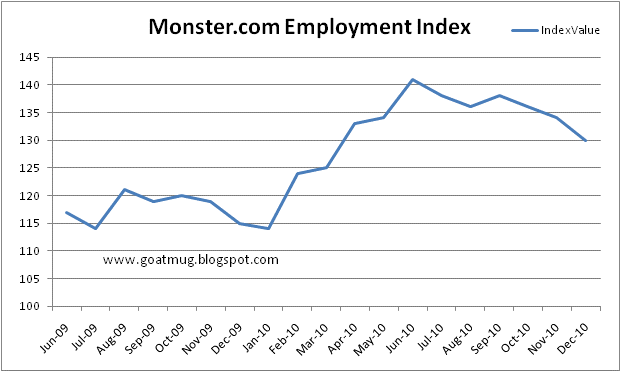
    MONSTER.COM JOB INDEX - http://about-monster.com/employment-index
    The Monster.com Job Index information was released and we continue to see a decline in the number of on-line job offerings.  Jobless numbers have been coming in higher than expected so we certainly need to keep an eye out for any continued weakness in the job numbers.


    FOOD STAMPS - http://www.fns.usda.gov/pd/34SNAPmonthly.htm
    Nothing new here, more and more folks coming to our government for assistance with basic needs.  For the month of October 300,000 more people were added to the roles.  Now it is critical to note that this increase is the lowest monthly percentage increase since February of 2010.  Hopefully the rate of change will continue to decline.


    SCRAP METAL COMPOSITE INDEX - http://www.scrap.net/cgi-bin/composite_prices.cgi?id=100000&num=5
    Not anything unexpected, scrap prices continue higher.


    COPPOCK TURN INDICATOR -
    The Coppoock Turn is still signaling a decline and would continue to do so until the DJIA marked 12,350.  While this may be a great long term indicator, you'd have missed almost 1,800 Dow points since June of 2010.  Now ultimately it may be correct, but I wouldn't hang my performance on this.  I'm continuing to post it here just to watch it and see what happens.


    6 MONTH EURIBOR - http://www.homefinance.nl/english/international-interest-rates/euribor-interest-rates.asp
    Euribor rates continue to climb - Everything all better in Europe?  I think not.


    FINANCIAL CONDITIONS INDEX - http://www.bloomberg.com/apps/quote?ticker=BFCIUS:IND
    The Bloomberg Financial Conditions Index is now fully over zero which signals an expansion.  Happy Days Are Here Again!  The move over zero indicates that the US economy is in an expansion, not a recession.


    BALTIC DRY GOODS SHIPPING INDEX - http://www.bloomberg.com/apps/quote?ticker=BDIY:IND
    The Baltic Dry Goods Shipping Index continues to move lower.  I'm convinced that this is the result of over capacity in the shipping industry.  Another thing that comes to mind is that there are rumors that business men and regular folks in China have been hording metals ranging from copper, iron, and more IN THEIR BACKYARDS!  I'm suggesting that we may be at the level where speculation has run its course and the BDI could be signaling that there is no real demand..  Of course the floods in Oz can't help as coal and other commodities certainly didn't get put on boats in the last week or so.


    USD - http://www.bloomberg.com/apps/quote?ticker=DXY:IND
    What's that?  The USD is starting to fall again?  Who would have thought that might happen?  Perceived threats to the Eurozone may have been fixed for another month or so and now we see that the dollar has continued its slide. 


    TRADING UPDATE
    The market continues to move higher but signs of topping are certainly unfolding.  As I mentioned last week in the 2011 Predictions note I fully expect some kind of correction here, but a final move higher into the end of April and May.  Having said that, markets do look toppy.

    Specifically, I remarked above that I had been shorting GM all last week and I'll post the chart here.  I didn't annotate it here because there is no reason to.  You can clearly see that $39.00 was a point of overhead resistance.  This could easily drop to $35 in a simple overall market correction and that is how I've continued to play it.  Any move above $39.00 will stop me out.


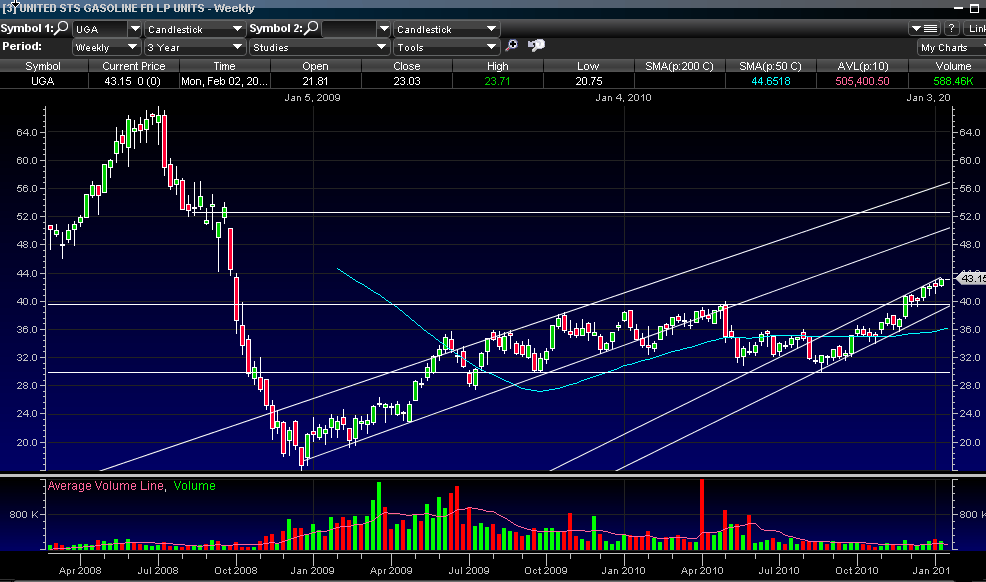
    Metals have been weak too as the ECB and Eurozone look to have solved all of their problems......(not).  Other than the agriculture areas that I highlighted in the 2011 Outlook, I also said that energy would be a place of great gains.  I mentioned XLE, and KOL, but I want you to examine UGA (gasoline).  If there is truly a trade for the first half of the year other than the "softs" I think gas is it.  I'm not writing about natural gas as I  hate the eft for it has been a killer for anyone holding it long term and many of you kow that I am fond of calling UNG the widow-maker  I am referring to the gas in your cars.  We have punched above old resistance at $40.00 and now I can see UGA move to $52.00 or higher as we get into the summer driving season.


    Finally, here is another view of UGA as it shows the 14 day EMA and the 40 day EMA.  This is a longer term indicator I use to show breakouts and breakdowns.  The crossing over of the 14 day EMA on this weekly chart shows that there is a lot of momentum here.  (Wish I would have been watching for this back at $36.00).  Also the CCI is showing that the trend is absolutely in the bullish camp.  A drop below 100 would tell us the momentum is gone.


    In closing, overall macro trends are mixed, but I think the trader's technical set up is one for a correction.  Despite the negative feelings I have, the indices continue to push higher and higher even though individual story stocks are pretty nasty.  I made great money shorting last week with a major gain in shorting the rare earth element companies I've mentioned recently.  Earnings announcements for the last couple of quarters have been a "sell the news" event, so that too gives me more confidence to be on the short side.  Still, blindly shorting will probably yield the same results that we've seen for the last 18 months, so you need to target weakness and sprinkle in a little luck.  Perhaps that is what many shorts will receive today as I note that Steve Jobs is taking a leave of absence and the wonder company AAPL is down pretty big in Germany and Europe (market is closed in the US today).  This may provide the catalyst for the short term correction I've been looking for in the broader market, but I firmly believe that the dip will be bought and that is what I'll be doing in the areas I identified in the 2011 Outlook.

    I'll leave you with one other chart here to underscore what I mean when I am looking for a correction. As I noted in last week's outlook several indicators have signaled just how overdone the rally has been without any hint of a reversal. Market breadth, put/call rations, AAII investor sentiment, and more show that bulls are not only complacent, they are outright crazy bullish. Times like these require, no, I mean demand some sort of adjustment to reign in the euphoria. I've often included work from my friend Guy Lerner from http://www.thetechnicaltake.com/ Below is a simple chart that reflects how bullish his investor indicator is (bottom portion of the graph - red line) and how this suggests that we should see a sizeable correction (holding breath waiting now....). Guy's work is always great and I highly recommend his paid site, it provides super information and is really cheap on the wallet.


    BE CAREFUL!
    GOATMUG