Showing posts with label poor. Show all posts

Thursday, May 17, 2012

HOW MUCH DOES $6 BILLION BUY? - FOOD STAMPS


ONLY 46 MILLION ARE NEEDY, 270 MILLION TO GO!
The release of the SNAP data for February highlights that we are still near record usage for foodstamps here in the US.   The month of February panned out with the following details.

46,326,352 of your fellow citizens are using your tax dollars to feed themselves and their families.
The cost to feed these folks was right at $6.160 Billion.  The average family receives about $278 a month.

YTD, actual participation is down 27bps!! ALRIGHT!  Year-over-year usage is still up 4.8%.


SNAP DATA - http://www.fns.usda.gov/pd/34SNAPmonthly.htm


NO REASON NOT TO, GIVE ME MORE!
The improvement in the data is slight, but I am hopeful that this trend continues.  When we examine the growth of the program it is not hard to see how it came about as the economic times have been tough.  At the same time, we have forces within the system attempting to create and increase dependency  on the government.  In 2010, California renamed their foodstamp program to CALFRESH in an attempt to remove the "stigma" of receiving foodstamps.  Is it any wonder we have citizens demanding services and saying that they deserve to be taken care of?  No, we have officials that tell users of programs that it is their right to be served and cared for, that the role of government is to make sure everyone is healthy, full of food, happy, and catered to.  The notion that government is the benefactor of course is a lie.  Government simply crowds out those people that would naturally step in and care for the needy.  Government also is only the middleman that doles out services by taking funds and spewing them out in an inefficient manner.

I don't want government programs to advertise on radio, tv, and print that they have all this "free stuff" and it is very acceptable to receive benefits.  I WANT there to be a stigma associated with living for free, for receiving free food, for having medical care that someone else provides and pays for.  When there is no stigma there is not any attribution that the services are scarce and that there is an expectation that they will only be provided for a short time.  When advertisements scream that the government wants to provide these resources it suddenly conveys that there is no limit to the amount of benefit that can be received and it costs people nothing.  By having a massive entity taking in taxes and distributing services we create an impersonal situation where recipients never see the real cost of the benefits and feel as though they need to maximize the amount they receive in any way.  (Think about having an insurance company pay your medical bills - you have no real idea about the cost, so you use the benefits as much as possible).

The promotion of dependency must stop for the good of our nation, it's poor, and for the ones that are seen as the producers in our country.  If the target continues to be placed on our most successful, we can bet that the incentive to earn and gain will be less great.


GOATMUG

Goatmug is an investor that cares about you and your family. Goatmug's Blog - Financial Perspectives From The Mountain Top is a collection of thoughts on our economy and how it impacts the lives of investors and average people. While several specific investments are named in many of his posts, these articles are simply invitations for you to do your own research and reference to these securities does not constitute financial advice. Your situation is complex and unique and you should seek professional assistance with your trading and investing. Please visit Goatmug and share your comments at http://www.goatmug.blogspot.com/

Thursday, February 9, 2012

WHAT IS IT LIKE TO BE POOR?

WHAT'S FAIR?
I've been thinking about how our President continually describes people in the US as though they are treated unfairly and they don't receive everything they deserve.  Mr. Obama often suggests that "those people should pay their fair share", and I guess the assumption by folks that listen and believe his comments must believe that the "fair share" will somehow be spent on funding services for others, perhaps even themselves.

As readers know, I am absolutely fine with wealthy people paying taxes, I just want someone to tell me where the limits of "fair share" are and then make a constitutional amendment to mandate that taxation cannot ever exceed "fair share".  What I'm getting at is that Obama's "fair share" today may be 50% of earned income or 60%, but we all know that the amount will go up in time as entitlement programs and benefit services skyrocket and the need for revenue increases dramatically in the future.  In other words, without some cap, there will always be someone that thinks those rich folks don't contribute enough to the poor people.

WHAT'S IT LIKE?
I often wonder about the lives of the needy in our country as I tend to pay attention to the amount of services that are available to low income earners because my health insurance business often allows me to speak with desperate people that have no income that need medical care.  In my practice I am able to guide them to services and programs in our state that are available at low or no cost to provide medical care.  As I educate myself on these topics, I often find other services that are made available to our poor and down on their luck citizens.

WHAT CAN YOU GET FOR BEING POOR?
A recent article I found summarizes one program that I've known about for some time called the Lifeline program where people below the poverty level can obtain cell phones or phone lines.  The "grant" provided in this plan will cover about 250 cell phone minutes per month for free to the qualified user.  I found this program because I saw a commercial on television that was advertising to seniors and suggested that they could qualify for a free cell phone!


WASHINGTON FOOTS THE CELL PHONE BILL FOR OUR POOR


Obviously a program like this was started with great intentions, but as you read the article, you will find that there is some segment of the recipients of the program that have the services, but don't qualify, or have obtained cell phones at multiple carriers, therefore abusing the free system.  Ultimately those in either camp are stealing from the US taxpayer and our government oversight is clearly lacking.  As a cell phone or land line user, you pay significant taxes each month to fund this program, you should know about it and should be pissed off that the government assumes there is about $200 million in theft or mismanagement going on in this $1.6 billion program.

Ok, cell phones are paid for and we know that food stamps are available through the SNAP Program that I report on monthly. (See the most recent post where I outline that 46 million of our fellow citizens are receiving benefits - WHAT'S UP WITH THE PO' FOLK?).  We know that states offer Medicaid services for health insurance for low income earners.  We also have heard about housing benefits for those that live in low-income housing (section 8 housing).  Essentially, I'm painting the picture here that many of the basic and not-so basic needs of a person are being met for individuals and families that are below the poverty line in the USA.

Let's dig a bit deeper then and examine the life style of our poor.  I recently found a book that reveals several key statistics about our poorest and highlights while they are "relatively poor" they do live quite comfortable lives.  The life-style of many of these people is not quite like the poverty-stricken, dirty, and hunger-ridden life we might expect.  Scott Rasmussen's book, "The People's Money: How Voters Will Balance The Budget and Eliminate the Federal Debt", highlights some facts that illuminate just how well off our poor really are. - WHAT IS POVERTY IN THE US?

FOOD PROGRAMS -

  • Parent report they have kids that go hungry  - (only .25% of US homes)
  • 1% of households report that they miss a meal in the day


CAR OWNERSHIP -

  • 70% report they own a car
  • 30% report they own two or more cars!

CABLE TV
  • 63% state that they have cable tv or some other tv service


Rasmussen highlights other items like the fact that 23% use TIVO, 50% have a computer, and 53% have a gaming system.  I guess where he is going here is that these are absolutely not necessary and they are considered luxury items....if you are really poor.  I don't really get to worked up about these, but I do get fired up about cable tv subscriptions.  Both car ownership and cable tv come along with monthly costs.  Clearly car insurance is expensive, but you can use a car to work and pull yourself out of poverty.  Unfortunately, cable tv expenses for our least fortunate is not defensible and is really the thing that makes me the most angry.  Cable bills can range from $50 to $200 a month and this service has become a "right" for our poor.  I've met and counseled many struggling families that need assistance with budgeting and debt management.  One of the first items I challenge them to cut is cable and you can't believe the resistance that I receive.  Perhaps I am nuts, but people that are poor don't "deserve" cable television, it is a luxury and that income could be spent wisely on anything else!

WANT THE BOOK?
Buy the book by Scott Rasmussen from our Amazon Link - The People's Money
(Oh yes, and if you buy anything from Amazon, please go through our search box at the upper right hand of our page!)

US POVERTY RATES BY RACIAL MAKEUPhttp://ardd.sph.umich.edu/about_diabetes_disparities.html

  • 25.9 percent for American Indians
  • 25.8 percent for African-Americans
  • 25.3 percent for Hispanics
  • 9.4  percent for non-Hispanic whites.

CORPORATE PROFIT MAXIMIZATION
Unfortunately, we are a nation of entrepreneurs.  (I don't really mean unfortunately in that sense, I mean that we are so good at it we tend to over do it).  Because we have a system where the great big generous government will meet our poor's needs, we have created an incentive for corporations and organizations to try to maximize sales to the beneficiaries of these governmental services, that often could care less if there is waste or fraud involved.  We've seen this example with the Scooter Store, a Texas wheel chair company that misled senior citizens and filed many false Medicare claims.
http://www.justice.gov/opa/pr/2007/May/07_civ_344.html  Ultimately the Scooter Store paid millions to the federal government and the cause of the problem comes back to the fact that the users of the services didn't pay for them!  When you are spending your own money, you actually care how much things cost.

By creating programs that are paid for and "monitored" by the federal government, cell phone companies advertise heavily and attempt to maximize the number of folks using the "free" system.  This is why the Lifeline program is full of waste, companies are marketing to the user, not the payer, and in this case the payer has no limit on how much they will spend.  While I expect more from businesses and owners, you can't help but to admire a firm that recognizes there is an untapped opportunity to harvest gains in the business landscape by exploiting the demands of users who will not pay for the services.

MEETING ALL NEEDS WILL MAKE KEEP SOME PORTION OF PEOPLE.....POOR FOR EVERMORE
Is the welfare life a good life?  I don't think so, but maybe it is compared to working hard and receiving little or no incremental benefit for your labor.  In other words, if I find a job paying $8 an hour and I have to pay for my own cell phone, food, rent, and other basics by myself with no assistance, I may have a bit more money, but I'm worn out and haven't made any real growth.  I can imagine that this is the logical exercise that many participants go through when evaluating their decision to find a job or two or three.  If you are killing yourself and you are worse off compared to receiving benefits and not working, you'd probably make the rational choice to make less or give less effort.  I think this is the problem with making benefits so generous, it clouds the decision making process and makes the decision less clear cut.

The killer here is that if you provide just enough subsistence benefit to placate some people you will create generations of poor that learn to "work the system" and never get out.  I think the best example of this was New Orleans before Hurricane Katrina.  There were many families with three and four generations receiving benefits from governmental agencies providing for all of their needs.  This corruption of the system ultimately hurt an entire city of people that were stuck in a system of poverty for years and years.  Rather than changing the system and educating the public there, we created a legion of benefit experts that could exploit all of the provisions of social security benefits, welfare benefits and all other types of assistance.  Ultimately, the creation of an entire class of people in the USA that receive subsistence help forever was not the design of the safety net system.

BEING POOR....SHOULD SUCK
Finally, I know that this post may be perceived as a "rich goat" not wanting to share his money with the poor guy, and frankly it isn't.  What this post is about is that we as a nation need to determine what level of life-style we will support for our poorest men, women, and children.  If we decide that at x-income level we will provide food, shelter, healthcare, cellphone, cable television, and a car, we are going to actually attract a whole lot of people that decide that level of "minimum life-style" seems quite fine.  Bad incentives often result in poor outcomes.  For example, if we pay women more section 8 housing allowances, SNAP dollars, and other benefits based on the number of children they have, we'll probably end up with more poor children!

I'm attacking the notion that poverty should be comfortable.  Being poor sucks,.....and it should stink enough to prod the marginally poor to improve, work hard, and strive to become productive.  The problem with an ever-increasing demand for the rich to provide their "fair-share" through taxation is that government mechanism for that payment process is inefficient and sucks away a large amount of resources in waste (federal government cost, fraud, and time).  Federal programs have a tendency to get larger and larger and the aim of the programs should be to be so successful that their use declines.

Unfortunately we don't see declining participation in these programs as free money usually only attracts more and more free money takers.  I'd have less of a problem with many of these programs if they were tied to technical and vocational job training certification programs.  We hear from our large manufacturing employers that the skills they need are not met here in the USA and therefore they go to emerging countries to set up plants to find that skilled labor force.  Why not make technical job training programs mandatory to receive housing, SNAP, cellphone, or medicare benefits?  Why not make the poor life-style with paid housing, healthcare benefits, two cars, cable, a DVD player, game system, VCR, and monthly food payments a temporary program that lifts people up into the next group of earners and make a life long stay in an impoverished state a little less attractive?


GOATMUG

Goatmug is an investor that cares about you and your family. Goatmug's Blog - Financial Perspectives From The Mountain Top is a collection of thoughts on our economy and how it impacts the lives of investors and average people. While several specific investments are named in many of his posts, these articles are simply invitations for you to do your own research and reference to these securities does not constitute financial advice. Your situation is complex and unique and you should seek professional assistance with your trading and investing. Please visit Goatmug and share your comments at http://www.goatmug.blogspot.com/ 

Wednesday, April 13, 2011

DRIVING JUST GOT MORE EXPENSIVE. WHEN WILL THE FED STOP?

TAKING A DRIVE, WHAT IS THE COST?
As I drove the kids to school today I noticed that once again fuel prices are high.  Unfortunately I have one of those cars that takes only the super premium 93 octane blend of gas, so I am always looking at the most expensive level of gas pricing when I drive around town.  This morning's damage in my neighborhood store was $4.11 for the super premium grade.  While I'm sensitive to the cost of filling up the car, I'm fortunate and blessed in that I make enough money where it doesn't harm me and it gives me something to complain about and blog about.  On the other hand, there are people that are getting brutalized daily by the effects of the speculative froth that is caused by loose monetary policy and it's famed QEII debacle.

Quickly I'll review, the Fed buys bonds from dealers and they in turn are using that money to park it in assets that are more likely to provide some type of return.  In addition, since hedge funds and other investors cannot find investments that will compensate them for the risk they are taking (try living on the interest created on a bond portfolio), they are forced into other securities and investments that at least attempt to reward you for the risks.  Thus, the Fed's aim has been wildly successful.  Market participants have shunned safe assets and been driven like a herd into risky assets like stocks and commodities.  And there you have it, investors are buying commodities because they can't get paid anywhere else.  Speculators have bought gold, silver, wheat, corn, cotton, oil, and gas.  Almost every commodity has been on fire.  Remember the summer of 2008 where investment banks had oil tankers filled to the brim sitting off the coast to speculate on the surging price of black gold?  Recall the $148 oil spike?  I'm not hearing the same stories of excess, but we are seeing a mass flood into these alternative assets to flee poor rates of return and a declining value of the dollar.

WHAT WILL BE THE IMPACT OF RISING GAS PRICES? -
http://www.foxnews.com/us/2011/04/11/drivers-start-cut-gas-prices-rise-1546568875/

I'm not sure how Americans will ultimately deal with rising gas prices, but over the last several weeks as prices have soared, drivers have been constraining their fill ups.  As the article notes, drivers bought 2.4 million gallons of gas less than last year at this time.  The average price for gas in the nation was $3.77, remember that the all-time high in July of 2008 was $4.11.

This article says that some folks have been walking more, riding public transportation, and simply not going places.  Other reasons that we've seen a reduction in the consumption of gas may be that Amerikans have bought more fuel efficient cars that require less gas.

CONFUSING DATA - DECLINING GAS CONSUMPTION BUT INCREASING CONSUMER SPENDING?
The foxnews article also keyed on one interesting point here that for me speaks to a larger macro-economic shift. 
"The decline is somewhat puzzling because Americans typically curb their driving only as a last resort, after sacrificing other forms of discretionary spending, like shopping for new clothes, or going to movies, concerts and restaurants.


But demand for gas is falling while other types of spending are on the rise. Retail sales rose 2 percent in March compared with a year earlier, surprising economists who were expecting no increase or even a decline."
So, consumers are curbing gas consumption, but someone is out there spending away.  What is the answer for the data?  I think it clearly shows that the divide between classes is growing AND we can only thank our friends at the FED for the disaster and attack on the poorest who can ill afford to handle the assault on their wallets.  To clarify, the poor working class folks are getting crushed since fuel is a significant portion of their pay checks.  On the other hand, the Fed strategy has been successful driving 401Ks and brokerage account values higher, so the wealthiest of individuals are back spending and engaged in business as usual (let's go out to dinner and a movie!).

Not buying it?  How about the quote here? -
"About two and a half days' worth of Whitney Shaw's pay each month goes just to fill up her 2001 Hyundai Accent. The administrative assistant is thinking about taking the bus for her daily commute, 50 miles each way between Branford, Conn., and Hartford.


"It's three hours of pay from work just to fill up my tank even once, so I'm definitely feeling it," Shaw said while filling up for $3.61 a gallon at a Valero station on the Berlin Turnpike."
Let's assume that it costs $75 to fill up and as Whitney Shaw describes, is 2.5 days of her monthly pay.  Assume also that she works 5 days a week or a total of 20 days a month.  Given all of that, Whitney is making $600 a month, clearly she isn't wealthy and obviously $75 is a large portion of her monthly take home pay, essentially 12.5% of her take home pay.  Perhaps just one year ago, the cost was $55 to fill up?  That is $20 a month less to spend on essentials, pay down debt, or splurge for a movie. 

$5.00 GAS?  IS THAT A POSSIBILITY?
I love the Foxnews article because it simply drops in that most analysts are looking for $4 gas, and some $5.  The way the quote is couched makes it seem like there is no chance that we'll be at $5.00 gas.  I think that $4.00 is absolutely figured in and that $5.00 is easily within reach.  What are the factors that prevent $5.00 gas from arriving?  Where are the forces that will make global demand for oil abate?  Is peace suddenly breaking out in the Middle East?  Probably most importantly, is the US Dollar getting stronger here?

In the article by CBS News - Gas Prices Climbing Toward $5 we get a mind blowing picture of the thought processes of folks that live in Chicago, the home of our President. 

Drivers Monday morning were practically numb to the price spikes.


"“What are you going to do?” said Shannon Thompson. “We’ve become so gas-dependent in this country. There are so many SUVs. I mean, I’ve had a hybrid. It worked great. Right now, I’m just going to deal with it.”


Prices at some gas stations outside the city were still below $4, a bargain compared to the $4.29-$4.40 range at some service stations downtown."
What drives me crazy here is the acceptance of the situation.  I can almost see them shrugging saying, that's the breaks!  "I guess we're stuck with high gas.  I bought a hybrid so that's all I can do!  Yeah OBAMA, just give him a chance!"

Are you kidding me, it's all about the policy?!   We have a Presidential administration that believes that our best course of action is to buy more oil from Brazil rather than exploit our own resources.  We have an environmental policy that holds us hostage to Middle Eastern despots, radicals, and UN pacifists, and we have a FED that is driven to destroy the US Dollar in the name of suspending market principles to save a bankrupt system.

For another perspective I've added an interview here with Stephen Schork, president of the Schork Group.  Stephen talks about the outlook for oil prices and mentions his thoughts on natural gas in the last few moments too.


TRADING UPDATE
So what's the point besides noting that gas is higher and no one has a clue that the Fed is the cause and there is no stopping it?  Well, since January 17th I've been suggesting that we need to buy gas and energy related stocks.

As we look at the trading view, we must examine oil first.  I've used USO here as a proxy for oil, but we all know there are tracking issues with that etf.  Having said that, it gives us a general idea of what we're up against, if you assume that all the fundamental items we discussed (Fed, global demand, summer driving season) are all still in play.


Based on the action here, there may be a drop in USO to the $41.14 area, but this area of previous resistance should be support.  USO has a lot of room to run with a target of $47 and $53.00 

Since USO looks pretty bullish here, that leads us to examine UGA which is the US gasoline etf.  If we are going to see oil move even higher, US gas prices too should inflate.

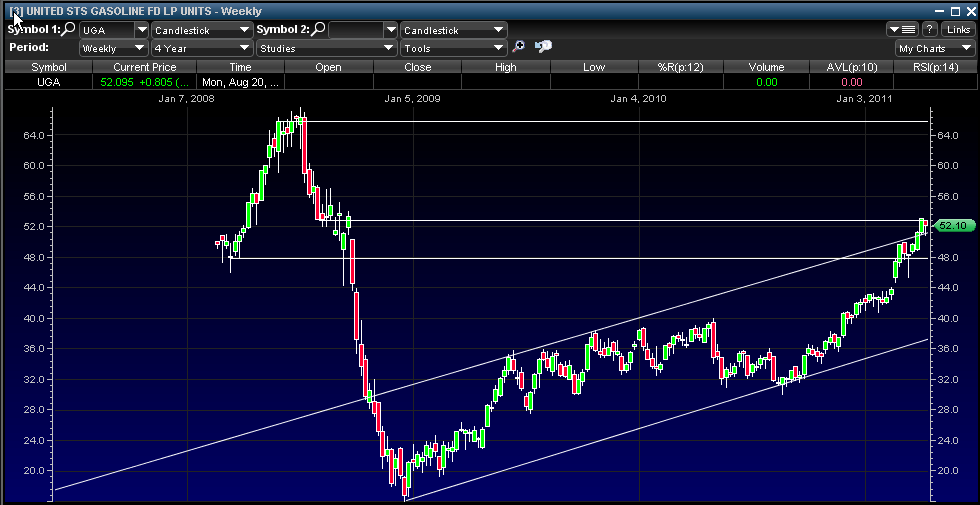
I've presented the 4 year weekly view of UGA and clearly we are at a point of resistance at $52, although I believe it will be minor.


The 3 Year UGA view is also good as it shows the area of support near $48.00.  I dropped the resistance line at the $52.00 area, but please note, it is there. 


As I review it, I believe that the target for UGA is still right at $64 or so, but I'd be out around $60.00 or by late June or early July (next earnings season in July may be a killer) whichever comes first.  The $60.00 target may not seem like that much from here, but if you'll recall we highlighted this target in January when UGA was trading at $39.50.

That is the update, please be careful and of course limit your driving cause it is going to cost you.

GOATMUG

Wednesday, December 8, 2010

WHO CAN ARGUE WITH 43 MILLION PEOPLE - MORE POPULAR EVERY DAY!

SEPTEMBER FOOD STAMP DATA - 14% OF THE US POPULATION ON FOODSTAMPS
http://www.fns.usda.gov/pd/34SNAPmonthly.htm


More than 42.9 million people now are receiving assistance from the Federal Government's Foodstamp/SNAP programs. 
The September 2010 data released this week shows that 42,911,042 are accepting help from Uncle Sam.  At a cost of $5.74 Billion we are feeding many that don't have an alternative. 

This month's number is a 1.23% increase from August, a 10.1% increase year to date, and a 15.4% increase from last year at this time.  Assuming we have 307,000,000 US citizens we are nearing 14% of the population on foodstamps.  Of course all of these recipients aren't US citizens, I'm sure there are one or two illegals from England, Ireland, or Australia in there.

I guess the economic recovery didn't come in September after all?


Be careful!

GOATMUG