Showing posts with label TLT. Show all posts

Tuesday, January 3, 2012

CONFIDENCE LOST, 13 PREDICTIONS FOR 2012

The 2012 year is off and running and before it gets away from me, I wanted to publish the outlook for the new year and get it done before the middle of January like last year.  I will do a review of the 2011 Predictions later, which I might suggest you read here - 12 FOR 2011, where I might say I was right more than wrong and really on point in several key macro level directional calls.  (Back patting over now).

Let's jump into it.

VOLATILITY, VOLATILITY, VOLATILITY
2011 was one of the nuttiest year for the broader markets that I can remember.  The SPX traded in huge ranges and ended up only 2% for the year.  There were many, many swings up and down of at least 5% and this kind of action makes any sane investor sea sick.  As I mentioned many times in the 146 posts I did last year, 3% moves up and 3% moves down in consecutive days is not a sign of a healthy market, it is a sign that the market is absolutely sick.

CONFIDENCE COLLAPSE WILL BE COMPLETE
2012 will be a year where this type of manic action will continue, so I suspect that there will be great periods of euphoria and gut wrenching falls during the year.  Unlike last year where I predicted that the US markets would be positive and increase 6%, I suspect that we'll see an unnerving drop from the closing levels of the SPX to 1144 or a loss of 9%. (everything in me wants to say a loss of only 5%, but this blog isn't for chickens).  Does this mean that there are no gains to be had this year?  NO WAY!!!  In fact, I believe that we'll see a repeat of 2011 with the theme of Sell in May and Go Away being rewarded heavily in commodity and energy names.  This further highlights that if the front half of the year has the potential of being pretty decent, it must mean that the later half of 2012 is going to be nasty for me to get to my -9% prediction.  It is with this in mind that we must note that all Euro deception and troubles will be revealed after May, and this is how I reconcile the two ideas.


The odd thing about the market losses for 2012 will be that the performance will be disconnected from the improving US economy.  What I am saying is that we will actually look back in January 2013 and say "wow, the economy isn't really that bad compared with last year, but what we'll actually see is that Europe is just that bad, and the fall of the Euro will spell a falling market for equity players.

WE JUST CAN'T AVOID IT, WE'RE STILL CURRENCY TRADERS
Even if you don't think you are a currency trader you are.  In relative terms, the USD is so much better than the feeble Euro and we'll see a continuation of the recognition of this issue, therefore the USD will be higher despite a concerted effort in the first 5 months of the year to reverse this trend.

US MARKETS - IMPROVING CONDITIONS BUT WAIT....
1)  JOBS - The jobs picture will continue to improve with the jobless rate dipping to the low 8% levels.  This rebound in the joblessness level has more to do with employers simply hiring under qualified workers to fill specialized roles as this issue has been persistent for the last year or so.  Employers biggest challenge has been to find skilled workers to fill open positions.  In 2012, employers will just suck it up and attempt to train those new hires in the open spots.

Note that there is an extremely troubling problem in our labor environment where unemployment for the uneducated is amazingly high while the unemployment rate for college grads is extremely low.  Despite the stories you hear, if you have a college degree and are willing to move, you should be able to find a job.  This bifurcation of the jobs market feeds the class warfare sentiment and who can argue with it when looking at the issue through this lens?  The trouble is that the uneducated have to WANT to actually work to get educated!  Our nation has become one where many of our citizens don't even make an effort to grasp one of the best attributes that our country offers; the hope and reality of achieving the American dream and having the ability to work hard, risk, and achieve greatness.  Unfortunately our least prepared and least equipped have traded hope and opportunity for the instant gratification of subsistence living and are pacified with social programs that placate many needs and are a facade of comfort.  Why give maximum effort when the short run gains received from working hard are less than or only marginally better than doing nothing?

2)  HOUSING - (CONVENTIONAL WISDOM DIES HARD AND ATTITUDES CHANGE)
I anticipate that the US housing markets will remain flat even in these depressed levels.  Unfortunately we really have no idea what sales numbers can be trusted from NAR because they have fudged reported sales for so long.  Despite this slight of hand and the conflict of interest, I think that we'll see a flat line amount of growth in sales as there is a significant paradigm shift occurring in the minds of the US home buyer.  In the past owning a home was part of the American dream.  Now, given the collapse of real estate markets and the lack of availability of credit (the demand that home buyers actually have 20% to put down) potential buyers are simply now believing that home ownership is quite as cool as they were led to believe.  The myth that home ownership is a great investment is being debunked and this sham is finally getting some publicity.  As this knowledge is now getting widespread acknowledgement, there will be a steady-state level of home ownership and little variation or boost to buy homes.  Add to the mix the notion that Congress is still looking at a move to get rid of the mortgage interest tax deduction and you'd see a continued decline in home ownership.

3)  USD
As I mentioned above, we are all currency traders whether or not we know it.


While it is tough to believe that the USD has merit, it certainly has "relative merit" and therefore I see an even more impressive move higher in the USD currency basket.  The continued revelation that the Euro is done in its current form plus the continued efforts of politicians and financial leaders to keep the "ponzi" intact will only serve to boost the USD to higher levels.  I think a level of 84 is very easy to achieve on the DXY. (See the 5 year chart below).  If USD goes higher, stocks go lower. (chart by www.marketwatch.com )


4)  INTEREST RATES
Did I tell you that predicting interest rates is a fools errand?  Ask Bill Gross, the king of bonds, if guessing where US Treasuries will go is easy!  I am going to say that the last two directional calls of Mr. Gross have made him look like a complete dolt!  Of all of my predictions last year, this is the one that I missed as I expected rates of 3.5% or more!  Ha!  Who is the idiot now?  I guess I anticipated a decent year in the markets and assumed that we'd achieve that decentness by way of actual growth and a clearing of some tough issues.  Unfortunately, I could not have known that we'd achieve the average returns on the Dow by doing what central banks always do, which is create really low interest rate environments that ultimately blow the real economy sky high and collapse financial markets!  (Oddly, I think Bill Gross miscalculated the level of insanity that the Fed would go to to keep the scheme in place, even though he is one that is really close to these nut jobs).

So, where do we go from here?  Lower.  How about a bold call of 1.65% to 1.75% on the 10 Year.  Despite a stronger dollar, we'll actually see yields lower as the flight to quality and away from the Euroland disaster will push 10 years to Japanese type levels. (chart by www.marketwatch.com )


COMMODITIES
Now we get to the fun stuff.  I nailed the macro level calls on commodities this year which makes me feel very nice and warm inside for about 3 seconds.  Unfortunately, that is about as wonderful as it gets as I am reminded that you have to trade the strategy to make money on it!  Yes, I did trade these, and yes, I did make money, but I didn't make as much as I could have because I stayed longer in the trades than I had outlined in the 2011 outlook.  Essentially, the call on all of these was to stay in till May and get out.  If you did that and actually exited on May 1st, and never traded again (or dare say even went short) you rocked.

I will spare you the gloating about how I nailed the calls on oil and gas to almost perfect calls on the high and low, etc.  I will however say that this year is even scarier than last in that we have a quickly escalating Iranian problem and the countries involved are removing all wiggle room for themselves.  It looks like the US and Europe are on a collision course with the real nut job and no one wants to back down, in fact, it could actually be in their best interests to pick a fight!  Without further ambling about things I will obviously write much more on.

I think intra-year, oil and gas ARE the big winners this year, even though they will fall after mid year, other than that, the big winners at the end of the year will be the ag-type commodities like sugar, corn, and wheat.  The play here is that central banks must fight for their lives by providing stimulus in the face of the deflationary forces of the Eurozone collapse, while they won't be successful in saving that which cannot be saved, they will resume the process that helped tear down many of the Middle East regimes by way of out of control food inflation.  Buy your freeze-dried stuff now, cause it is going to cost more by the end of the year!

5)  OIL AND GAS -
This year the theme to buy now and sell in May is again right on.  There is mounting evidence that the US economy is resilient and not collapsing, there is the Fed giving oil and gas an inflationary wind at its back, and finally, Iranian President Mahmoud Ahmadinejad is pushing all of his chips onto the table to buy enough time to go live with several nuclear warheads.  If he can weaponize just one device, he suddenly has tremendous leverage over his neighbors and the USA in the region.  With the brinkmanship at record levels, oil and gas will not sit idly by, they will lurch higher with $110 within easy reach by mid February.

The seasonal play also works well for the plays I made last year and in fact, I am already involved with several of them.  I think WNR and VLO will be winners in the first half of the year and a play in UGA also looks solid.  Targets for these plays are $18, $27, and $54.  I think all of them could easily exceed these levels, but I will stick with the "exit by May 1 strategy" this year even if it means missing out on other gains.

Oh yeah, the big oil names and service companies are awesome too, especially if they pay a dividend.    Portfolio Managers are still in the game of security selection where one would pass on bonds and buy dividend paying equity stocks instead because corporate bond yields are so low.  This benefits almost all large firms and energy firms that are dividend players seem to be a solid approach to capture upside and income.


6)  AG STUFF -
Yes, I said it again, corn, wheat, soybeans, sugar and anything that can be consumed will move much higher.  A safe play is to time the exit in May as well, but I think that agricultural commodities will be the one uncorrelated asset this year that just kills it.  The more intervention we see domestically by Uncle Ben and his round table of doves we will see more food disruption in the form of out of control prices fed into the system.  Tunisia, Egypt, Libya, and Syria will all just be the tip of the iceberg as world citizens rise up to confront their leadership's ability to control prices of food as a result of the never-ending liquidity spigot originating in the USA.  Names to watch here are CORN, JJG, SGG.

7)  GOLD AND SILVER -
I am telling you what, I nailed this one too last year.  While I undershot the move upside in gold and silver, the pricing action did just as expected and clearly the move isn't done.  The crazy euphoria is now gone from the trades and that is awesome because I feel like both gold and silver can now be entered rather safely for longer term trades.  It seems like central bank intervention has eased some fears related to the "buy gold, cause the Euro is going to collapse", but it will return and with a vengeance.

I hesitate to give price levels and targets here, but what the heck it's not like you are paying for this.
I think we will see a revisit to the $1,900 level in gold and probably beyond that given the circumstances that need to be in play for the shiny metal to return to its highs. (charts by www.kitco.com )


Silver, will probably NOT revisit its $50 highs, but will settle in at $44


I think either of those would be nice if you pulled the trigger and then made a hasty exit.

As I noted last year, I actually DID sell 1/2 of my silver position as it was blasting near its highs.  I had experienced enough misery by giving away gains in my refiners and gas trades that I locked in profits on much of my silver holdings.  I am looking to purchase a new replacement slug any day.


8)  COPPER
Copper too was one of the trades that made me look really good in my predictions from last year.  I suggested that copper was going to be a big loser, and it was almost from the start.  There is a chance that copper goes higher this year for several reasons despite the fall of the Eurozone.  First, there is some hope of a recovery in the emerging markets.  Any improvement there will be a benefit to copper.  Second, copper got shelled last year and as a result, is a relative better play.  Despite the chances for a rebound, I won't be buying JJC anytime soon, however a play in FCX might be good for the same May 1 sell time frame since a move higher will absolutely benefit FCX as a miner of gold and copper.  I think this is the best way to play this angle, AND you get a dividend too.  $44.00 is probably a very conservative target (only a 10% move from today's levels, with $55 as a realistic area to expect).

FINANCIALS - 
I just have to say it, I hate them.  They are hard to understand and chock full of liabilities and counter-party risks that are not truly known.  This statement unfortunately goes for banks, insurance companies, and brokerage firms (are there any left?).  There might be gains out there, buy if we can get them from other areas should we really try here?

9)  BANKS - I missed it on banks last year.  I expected that things would improve and they would perform much better, they didn't.  Oddly enough, I think that bank performance could rebound in 2012 IF yields begin to rise.  The margin compression they are suffering as a result of Operation Twist and other FED intervention has been costly and we should see some abatement in this as the program nears its end in 2013.  I think BAC is still a big fat loser and suggest running away from it as some type of Country-Wide or Mortgage Fraud stuff is going to have an impact on them.

It isn't lost on me that Kyle Bass invested a slug of $200MM into Mortgage Guaranty Insurance Corp which is probably more a statement of his feeling that housing is at least bottoming domestically, but it also might be a signal to watch that stock (yes, it is already up 50%, I know and since he bought at $2.50 a share he is also doing quite well).

In this short to medium term for the year, the chart also suggests that GS could rally almost $15.  If we see a $110 or $112 handle on GS and you are crazy enough to be long it, I suggest an exit.

FIXED INCOME -
The question is, does fixed income exist anymore?  The answer clearly is no.  Treasuries are a scam in that the US government through a scheme of the Treasury and the Fed are distorting the prices for bonds to achieve their own goals of suppressing borrowing costs.  The private sector is buying US Government debt as a result of absolute fear, and so are other sovereign nations.  There is no real market here, just a concoction of lies and more lies to cover the first lies up.

The average investor who is a retiree cannot live on the interest produced by any fixed income investment and so they are force to yield search and carry more risk than they normally would or simply abandon this asset class and reach for dividend paying equities.  Unfortunately that strategy will back fire, we just don't know when.  The Fed strikes again.

10)  GOVERNMENT DEBT -
I've already highlighted this topic in the INTEREST RATE section.  Bonds will go higher and yields lower as we near year-end.  The safety trade to flee to US Treasuries will be firmly intact next Christmas.  Downgrades of sovereign debt abroad will make the US yields even cheaper despite the fact that US spending is totally out of control.

TLT looks like it could spend some more time falling to at least the $113.50 area, but if my call for a move up in equities and then down again is correct, we could see an attack at $123 on the long side by year end.  (That's not much you say??? They are treasuries I say, should they really trade in a 10% range?)


11)  MUNI BONDS - 
Meredith Whitney seems like the biggest loser when it comes to Muni Bonds in 2011.  Meredith learned a hard lesson that a great call one time doesn't mean that you will make every call right.  Further, the better lesson is that once you make an awesome call, DON'T PUSH YOUR LUCK and predict the apocalypse!  Everything that Meredith Whitney said is true, the only problem is that she, like Bill Gross, misunderstood the commitment of the players in the system to keep the system afloat.  Also, Ms. Whitney didn't state a realistic time frame for the collapse to hit.  If the Euro crisis has shown us anything, it is that they implosions are slow and are delayed and delayed until they can't be delayed, and then suddenly the market and its willing participants simply wake up one day and reject the credit of entities and borrowers that just one day prior were perfectly fine.  Perhaps if Goldman Sachs had made a prediction like that, things would have fallen apart faster, but it didn't.

If you take a moment to look at Muni yields you are first struck with how crazy one has to be to  buy munis.  First, it is very difficult to get financials for these municipalities that are timely.  Second, it is impossible to get a decent yield, and finally if you attempt to stay shorter in your maturities you will get paid absolutely nothing for the risk you can't evaluate.

Perhaps the best way to approach Muni Bonds is to short them.  Take a look at MUB which looks like it should at least revisit $107 or even $102.


12)  CORPORATE BONDS -
I am going to copy word for word what I wrote last year in this space and I'll only change a word or two.  Wait for commodity and market ramp. That move higher will continue to push corporate bond prices lower and finally put them in a pricing area where they again become interesting. Please note that I usually target buying corporate bonds that are less than 7 years in maturity. I do not subscribe to the hyper-inflation theories and therefore I do believe that a chance to buy solid company bonds yielding a 5%, 6%, or 7% rate will be great.  What did I change?  #1 - You may only get an opportunity to get into corporate bonds in February or March (last year that was the low).  #2 - I reduced the target yields on bonds by a percent or two.  Right now I would do just about anything for a 5% 4 year bond, you just can't find it, (without buying some stupid financial company bond) so when you do, you better buy it with the money that is allocated to a more conservative type investment.

As you look at LQD it seems ripe for a correction to $107 or even $104.  The crazy shorters out there may look to take advantage of a drop in this etf, but the fear trade will drive buyers right back in to fixed income assets by year end.


EMERGING MARKETS
Other than Bill Gross and Meredith Whitney the other big loser of the year was the emerging market trade.  All of these markets were smashed as the shiny veneer was rubbed off the glorious BRIC trade.  The trouble these countries ran into was one of a slow-down in growth, a wind down of credit bubbles, and finally importation of inflation served to them directly from their friends at the Fed.  I've commented often about the currency race to the bottom as they attempted to counter each move of the Fed to stay competitive.  The only problem with fighting the Fed in this fashion results in run away inflation and citizens tend to get really pissed off about paying 10% higher prices for veggies and meat each month!


13) COUNTRIES TO WATCH -
Based on the three causes of the beating that the emerging market players took last year I am hard-pressed to see if there is any abatement in any of those issues.  The answer is no.  Based on this, I think it is quite easy to simply pass on China as an option for further long-sided investment.

I am still a huge fan of Indonesia (IDX) simply because it is a really nice chart to trade.  I would not be caught adding a position here on IDX unless I saw a pop through $31 (I waited all last year for that)  and I'd certainly be watching closely at the $25 level.  In a year when China's FXI lose almost 20%, Singapore's EWS lost 21%, and Russia (RSX) lost 29%, IDX was flat when you calculate and add in the dividend. (Chart below is IDX)


I'm a fan of EWS despite the brutal beating and I like EWM too, but once again sell early.  Finally, readers will recall that I've had this stalker-like love affair with India where I'd wait and wait and wait for EPI to do something positive.....and it never did.  I must believe that India will one day be a powerhouse, but it wasn't last year.  I like the bounce EPI had over the last week and if there was a time to do it, it was then.  A bounce here could take it to $18 or even $20, I'm just a bit gun shy after seeing a 40% loss of a blood-letting over last year.

Let me wrap things up here.  There are the ideas for 2012 and the outlook for the major macro-level areas of the economy.  I could say much more about the defensive approach that fund managers are using going into healthcare, consumer staples, defense, and utilities, but I've already said that many times last year, and it was a highly successful venture for any that took action.

SHORTS
I was fortunate enough to call a few big shorts this year too.  There were a couple that I was very, very, very early on and just killed it being short on like NFLX, MCP, and RIMM (don't believe me, do a search on the blog for those symbols!).  I did tend to sell those too early as is often the case, I think I am so conditioned to believe that some invisible hand will appear and save crappy companies that I am willing to exit trades that I know could be much bigger winners.  That is one of my goals for this trading year, to keep my foot on the throat of dying losers and cash in on them in a much more significant way.  I'll be looking for those entries in earnest in April.  I can't let this section go without mentioning GRPN.  Groupon will be one firm that is out of business in the next 5 years and therefore it is clearly an equity to focus on if it can ever gain any traction and get a bounce.

DISCLAIMER - THE EVENT THAT MESSES UP ALL PREDICTIONS (A swan that makes black swans shake in their boots)
Finally, let me throw in one last disclaimer because it is important.  All of these predictions in some way assume that the US, Israel, Europe, and Iran (along with the Persian country's allies, Russia and China) don't get involved in a real and escalated shootin' match.  If that happens all bets are off.  I don't think this is a situation where the markets rally like they did in 1991after Saddam invaded Kuwait and we invaded Iraq in the first Gulf War.  If there was a quick overthrow internally of the Iranian leadership and hostilities ceased then I think that a bull market rally could follow, but I don't predict that kind of easy internal outcome and frankly I am terrified that an EMP attack on the USA is really something that is possible.  If that were the result from a conflict our markets would cease to trade and the world as we knew it would be over in the blink of an eye.  An EMP assault on our country would make New Orleans after Katrina look like a picnic and a fun day at the park.

Please read the follow up post that I'll put up over the next couple of days which will include bonus predictions on the elections, healthcare, and foreign policy.  Honestly, I think all of those topics may drive the markets more than we appreciate, but this post is about stating where I think things will go and specific reasons why.  The broader drivers like these topics should be covered in another post, so look for it soon!


GOATMUG

Goatmug is an investor that cares about you and your family. Goatmug's Blog - Financial Perspectives From The Mountain Top is a collection of thoughts on our economy and how it impacts the lives of investors and average people. While several specific investments are named in many of his posts, these articles are simply invitations for you to do your own research and reference to these securities does not constitute financial advice. Your situation is complex and unique and you should seek professional assistance with your trading and investing. Please visit Goatmug and share your comments at http://www.goatmug.blogspot.com/

Wednesday, August 31, 2011

CHARTS TO WATCH

I'm posting charts I'm watching. I won't add much in the way of commentary as the charts speak for themselves.


MOS - $72 to $73 area is tough overhead resistance.


LNKD


PPA - Short at $17.75


GLD - Any chance this could retest 162?


TLT - Pretty amazing 10 year trend line.


Getting into the swing of things since going on vacation has been tough, but I think I'm back. Check in at the blog often to see new stuff.


GOATMUG
Goatmug is an investor that cares about you and your family. Goatmug's Blog - Financial Perspectives From The Mountain Top is a collection of thoughts on our economy and how it impacts the lives of investors and average people. While several specific investments are named in many of his posts, these articles are simply invitations for you to do your own research and reference to these securities does not constitute financial advice. Your situation is complex and unique and you should seek professional assistance with your trading and investing. Please visit Goatmug and share your comments at http://www.goatmug.blogspot.com/


Friday, June 10, 2011

IF THIS TIME IS DIFFERENT, WE'RE ALL IN TROUBLE

FORKS IN THE ROAD
It doesn't matter what you call it, the USA and global markets have arrived a period of time where we will see important actions and reactions that impact us all as investors.  Sometimes you cannot see these crossroads coming, other times it is like you are coming up to a big flashing billboard notifying you of the gravity of the situation.  Central bankers will be quite busy over the next couple of weeks attempting to find solutions that don't involve changing the way banking and business is done in the world.  (In other words, these guys will be attempting to extend and pretend just a while longer....again).  My goal in this post is to highlight the areas of concern and give a few ideas regarding positioning of a portfolio for these issues.  In a later post, I'll examine concrete actions and explore the most likely issues that will create dislocations in our economic system.  

FEDERAL RESERVE
At the end of June the Fed has disclosed it will terminate its Quantitative Easing II program.  The Fed promised to stop making purchases of US treasuries.  Since last September, the Federal Reserve has used printed (new) money to purchase bonds from primary dealers in the open market.  As the Fed exchanges treasuries with newly printed money, the net result is that these dollars become investment ammunition in the hands of banks and brokerages.  Holding new dollars, these institutional investors seek to invest in all markets and find the currency finds its way to all kinds of speculative assets (commodities, stocks, corporate bonds, etc). When the Fed warns that they are going to stop the flow of additional purchases, they are saying that they will stop the liquidity wave from growing larger.  It is important to note that they have kept their options open to continue to keep levels the same.  A bond issues in the Fed's portfolio matures, they can still reinvest the proceeds into other vehicles by purchasing other assets like MBS (mortgage backed securities), TIPS, or other treasury issues.  

The termination of the additive effects of additional capital in the QEII program doesn't in itself signal that the stock market is going to drop significantly; it does mean that some of the propellant for incrementally higher prices may not be available now.  Further, as investors anticipate these actions, we have seen savvy managers rotate out of treasuries and move into more defensive equity holdings in an economic cycle rotation play.  These managers believe that the economy may be slowing in conjunction with the Fed's move and therefore have gone to relative safe haven positions in consumer staples, health care, defense industries, and utilities.

EUROPEAN DEBT PROBLEMS (AGAIN)
It seems as though we are in a significant place where the Eurozone countries are now in distress and major work must be done to avert a collapse of the EU infrastructure.  Greece is once again in the cross hairs and it is obvious that despite many attempts to delay and defer, reality is coming home.  Greek estimates for tax revenues and economic growth have completely missed and therefore have pressured any assumption that the tiny country can pay back the interest and debt that it owes.  Additionally, civil unrest has brought any productive asset to a stop in the island nation and further weakened its position.  We know that many of the countries there are insolvent, but that doesn't necessarily mean that we'll see a collapse in asset prices globally or even in the price of the Euro, it just means that more EU taxpayer money will be funneled off to bandage the wealthier banks in the Eurozone (Germans). We know that central bankers don't want to have another financial collapse, so we will see heroic measures to save the system, no matter what happens.

As I type this, we find that those heroic measures are clearly underway.  This Bloomberg article highlights that the talks aim to force Greece to sell off many of its national assets and undergo further austerity measures.  In return, they'll get more loans they won't be able to repay.    GREEKS NEED $65 BILLION MORE.  A follow up story to this was just also penned stating that German leaders are digging in their heels and demanding that investors in bonds step up to the plate and take haircuts in this second round of retooling.  The ECB is rejecting this approach because the loss on investments is technically a default.  GERMANS DIG IN THEIR HEELS.

Now, it is not clear what final measures will be taken to save the system, but there are some pretty obvious results we can look for.  First, I assume that we'll actually see a deal get done this time for Greece.  Ultimately though, we'll endure this threat many more times as each country on the periphery is forced to approach the IMF and ECB with hat in hand.  At some point, a country like Greece, Spain, Portugal, or Italy, will simply tell the political and banking leaders that they won't make further concessions and we will witness a default event that will be a powerful event for the Euro.  As investors of sovereign bonds are forced to take write downs (losses on their investments), we will see a massive drop in value of the Euro relative to the USD. This shaking will also rattle the US stock market as well.  Oddly enough, instead of sending all assets including commodities lower, we may see the value of gold and gold miners move higher even though the USD would move higher as well. To some extent, silver may participate, but I think that gold will outperform silver or any other commodity in this situation.

CHINA 
First a word on the Euro issue in relation to China. China is deeply connected to Europe and this is why you may be starting to read more and more about China's involvement in buying sovereign debt of these problem PIIGS. If Europe collapses or goes into a significant recession, China will be hurting too. Europe is a huge consumer of Chinese products, and a draw down in consumption will only damage the Chinese export based economy more.

China desperately needs its workforce working and commodity pricing pressures coupled with a slowing Eurozone economy would only contribute to idling its immense labor force.  Penniless, hungry, angry, and bored workers are one of the few things that Communist China fears.  China will gladly lose a few billion Euros in order to buy time and keep its populace at work.  
This civil unrest potential is absolutely too much for the central planners in China to risk, therefore it isn't difficult to see a coordinated global interdiction to interrupt a collapse in Europe with China as a major liquidity provider.

While the moves of China in Europe will be made at a central level to stabilize global economies, these moves will be handcuffed because inflation is also tugging at the emerging giant threatening the country in another direction toward overheating. To cool the economy the central bank in China is restricting loan liquidity, raising interest rates, and doing everything possible to reduce this risk. While China is still growing at an amazing pace, these moves will ultimately create a slowdown and that in turn could be very negative for all global economies and commodities.

Inflation is a significant concern in China because it impacts their ability to feed their nation and also to remain competitive in the global export market.  As noted above, China's gateway to the global economy has been through its cheap labor pool and also low levels of environmental regulatory roadblocks.  As inflation pushes up prices of raw materials and labor costs skyrocket to keep pace with price gains in food, Chinese manufacturers are increasingly more expensive than other 3rd world emerging competitors.  Countries like Malaysia, Thailand, and Vietnam are all attempting to encroach on the Chinese dominance in manufacturing and global export.  Until China develops its own domestic markets it must do anything and everything possible to fend off attacks from these competitors, and inflation is clearly making that fight more difficult.

Further, Chinese real estate has been under attack as the leadership has attempted to cool real estate speculation in the mainland.  Interest rates have been increased many times yet investors continue to buy assets where there are no real buyers.  Please view the report we highlighted on China's ghost towns -  BIG TROUBLE IN BIG CHINA (REAL ESTATE MADNESS)

JAPAN
The mainstream media has tired of reporting on this disaster so it would be easy to forget that this issue continues to get worse and worse.  What?  You didn't realize that it still wasn't under control?  You hadn't heard that of course.  If you'd like to take a look at the most current IAEA slideshow from May 31st you'll see that while each of the reactors is classified as "subcritical" there have been almost no other important milestones reached.  TECHNICAL BRIEFING.  Now there are a host of issues that go beyond the human tragedy which has cost around 14,000 known lives along with another 14,000 Japanese that are missing.  This terrible event also has the ability to be far-reaching in other areas too.  I've stated that one of the gravest concerns for market participants is that the Japanese begin selling their US Treasury positions to fund their own liquidity needs and to meet obligations related to the reconstruction of the devastated areas.  Sales of US Treasuries will put pressure on our interest rate structure and could push them higher, something our Fed and Treasury have been fighting against for almost two years now.  (Remember, QE II is a policy tool for reigning in interest costs on our massive deficit spending as well.  By keeping rates artificially low we remain able to pay our interest expense).  We've seen other impacts as manufacturing plants have been offline and unable to produce component parts for cars and other complex machines.  The outages related to the earthquake and tsunami has disrupted the entire global supply chain system of fulfillment.  I urge you to continue to monitor the situation in Japan as we all know that there are major ramifications still to be felt as a result of the disaster at Fukushima.  While we tend to think of the "fallout" as radioactive, major fallout out will rain in the spheres of energy policy, politics, and economics as well. 

OIL
The Fed's action to create excess liquidity to buoy asset prices has impacted oil significantly.  Yes, the fall of the value of the dollar has been the cause for some of the jump, but the moves have also been as a result of the creation of the tsunami of cash in the hands of "speculators".  Those speculators come in the form of hedge funds, banks, and pension plans of course.  Higher oil and gas prices have all sorts of nasty affects on everything else the world produces and consumers, so we are seeing these price shocks ripple throughout all markets.  The unrest in the Middle East which has been named the "Arab Spring" or "Jasmine Revolution" can be attributed greatly to our own Fed's work in commodity markets.  It is quite scary to me to think that the Fed could do in a few months what many Presidential Administrations couldn't do in decades.  While weather issues also have contributed, the Fed has been able to engineer a massive increase in food staples like corn, rice, wheat, and soybeans.  These revolts started in Tunisia and have worked their way through Egypt, Saudi Arabia, Yemen, Libya, Jordan, Syria, and Iran.  As we noted above, hungry unemployed people take drastic action, and these people have risen up and demanded change in their countries.  Interestingly, the very act of revolution in these countries has exacerbated the oil price issues in the rest of the world.  This is not to say that these places were wonderful locations to live, that the leaders were not brutal and the situations not oppressive, it is merely that the actions of our central bank has resulted in the creation of the final straw that was broken to unleash a wave of discontent throughout the entire world.  Why is any of this important to us?

  • First, unrest in the Middle East is destabilizing to the world economy because our economic fuel (our oil supply) becomes uncertain. 
  • Next, the uncertainty of these fuel supplies forces other nations to take action.  Have you thought for a moment what the US and NATO is doing attacking Libya?  The nation produces about 200,000 barrels of oil a day despite having proven reserves of 46 billion barrels.  Libya is not important to the US, but is extremely important to Italy and Germany.  
  • Third, desperate leaders will do crazy things to stay in power.  Think through the actions we've witnessed in the last several months.  Egypt fell, Saudi Arabia's King essentially bribed his people, Syria, Iran, and Libya's leadership attacked its own people.  In the case of Syria and Iran if there is a growing of the revolutions inside the countries is it far-fetched to believe that they might attack Israel as a distraction to turn the attention of the populace to other things?
  • Last, high oil prices often result in a slowing of economies.  When it costs more to ship products or fly somewhere for a vacation, people tend to consume less and hold on to their money.  Oddly, this is exactly the opposite of what our Fed is trying to accomplish.        
West Texas Int Crude -


Gasoline - UGA

US MARKETS
The US housing and jobs markets continue to suffer and languish. With the threat of a removal of stimulus from the system by the Fed and a correction in stock markets underway, we need to continue to remain vigilant. I think the correction in commodities in the first part of May was a big warning to us and even though we've seen a rebound to fill some gaps we may see asset prices fail and fall lower.

Earlier this week Robert Shiller noted the same things he had been saying for the last year or so, that he expected US housing markets to drop another 15% to 20%.  Oddly, someone actually paid attention to his statements.  I think this comment coupled with the weak jobs data suddenly woke some folks up.  There is a real concern that the economy is double dipping and signals from ECRI's LEI (Leading Economic Indicators) has shown that we've had several reports in a row that show slowing and weakness. 

Beginning in early May we noted in this blog that sensible portfolio managers would be trying to get ahead of other participants anticipating a slowdown and a turn in the economic cycle.  (Thanks to Stockcharts.com for the wonderful graphic that is a representation of the cycles and notes what equity sectors do well in that period.  The model is based on work done by Sam Stovall with Standard and Poors.)


As we look forward, I think we are at the tail end of the industrial/ energy / commodity cycle and we'll be entering a more defensive period where consumer staples (think soup!), defense, and health care will be the places that portfolio managers look to invest. They will do this for safety and pre-recession posturing, but also for the dividends.  A Consumer Staples ETF is XLP, Healthcare is XLV, and Defense is PPA. Now you can see that I'm not the only one seeing this rotation as all 3 of these are really ramping over the last month or so.  XLU is also good target for consideration here for exposure to utilities.  Given all the inflection points and issues I've noted above, I AM NOT saying that you need to buy these things, I am simply noting that this is what managers are doing right now. 

BONDS
Overall, we must continue to watch bonds as a gauge for the most visible warning that one of these problem areas explodes into a full blown economic crisis.  It seems that Pimco's Bill Gross' call around mid April to short treasuries was pretty much a bottom for US government bonds, what a tough business!  Don't blame Bill though, as he will ultimately be proven correct.  What is happening now is simply a fear based moved to "relative safety" as equity and commodity markets have declined and folks are fleeing the risk of the Euro.  If the Eurozone does have trouble "fixing" Greece and the other PIIGS we'll see a continuation of the bond rally, but if some short term resolution is found, the Fed and Treasury might lose their cover of under priced risk premiums for treasuries.  There is a huge supply of bonds and a dwindling amount of buyers, so we should see pressure on rates to move up.  A significant move up or a jerky, sudden leap would be our signal that things are getting out of control.

50,000 FOOT VIEW
Let's take a step back though and look at what might be happening in the broader context to the markets.  Is there a chance that all of these inflection points are just issues we'll face and overcome?  Yes, absolutely.  Investors must ask themselves if we haven't already endured several similar occasions like the concerns over a slowing economy, a poor housing market, sluggish job growth, and also a threat that the debt ceiling must be raised.  Many of these concerns were faced last year in January and February 2010.  Look at a chart of DIA and note that there was a significant correction from $105 down to $98.  During that time Congress was faced with the burden of raising the debt ceiling and markets shook, but then ultimately moved higher until reality visited us again and the Fed stepped in with QEII in August of 2010.


THIS TIME IT'S DIFFERENT?
Is this time different?  I tend to think not.  We will once again see a lot of posturing and prattling on about the out of control debt and spending in Washington.  We'll endure politician after politician emphatically sounding the alarm that the situation must be addressed, and we'll see them meekly vote to raise the limit just like all the times before.  The length of time Congress takes to act out their charade will determine exactly how long the stock market will stutter and hiccup.  Unfortunately I am a bit jaded by the experience of seeing our elected representatives go through this process and I admit that I tend to view Wall Street as complicit in this absurd theater. I sense that investors exit stage left in order to add more drama and effect to the entire presentation.  As if on cue, we see markets roll, invoking the threat of economic collapse if that debt ceiling isn't raised.  (Recall TARP and that whole hostage negotiation!) 


At the end of the day, this is what our leadership is hoping for, that all of these core issues can be overcome with more talk, more debt, and more printing.  The sad truth about all of this is that once again the short term results may be that the stock markets move higher in response to an elevation of the debt ceiling and a resolution of the Greek debt problem (for now).  While my last couple of paragraphs may convey the idea that I believe this is all going to be alright, I am most concerned if we actually face a "this time it's different" moment.  If this time truly is different, we are all in trouble.

Over the next couple of days I will be working on the June Monthly Macro Report and a follow up post to this article where we look at actionable steps to take to prepare for a few of the likely scenarios we'll face.  I had to put this post together to reset the issues in front of us in order to know what is driving market participants and economic leaders.  The critical items we are facing demand action from central banks, politicians, and adept investors.  The time for action is quickly approaching.

GOATMUG

Goatmug is an investor that cares about you and your family.  Goatmug's Blog - Financial Perspectives From The Mountain Top is a collection of thoughts on our economy and how it impacts the lives of investors and average people.  While several specific investments are named in many of his posts, these articles are simply invitations for you to do your own research and reference to these securities does not constitute financial advice.  Your situation is complex and unique and you should seek professional assistance with your trading and investing.  Please visit Goatmug and share your comments at www.goatmug.blogspot.com .
 

Thursday, September 23, 2010

XLF UPDATE - RANGE BOUND OPPORTUNITY?

Here is a look at the XLF that I've been watching closely since I posted the Euribor numbers the other day (Sept 16th) which I thought might be a tell as to the direction of the market.  The truth is that banks have been sluggish lately as they have churned around in the upper portion of the range over the last couple of weeks.

Even after this post, we saw a breakout that started to get me excited and then it has turned out to be the ultimate head fake (what is new since all patterns have turned out to be head fakes?). 

The chart posted below is a good one in my opinion because it shows a confluence of many trend lines all centered at the $14.75 area.  As we open up this morning, it wouldn't be too much of a stretch for XLF to drop to the $13.45 lower portion of the range we've seen and then bounce. 


I don't want to overdo things here by getting too bearish and assuming that we are going into the pit.  The recent trend has been to open lower and end the day higher, so I will sell all of my short trading position (long FAZ calls) this morning at the open just to lock in some gains.  There has also been a recent trend to have weakness at the end of each month and especially at the quarter end and then rocket higher after portfolio managers complete their window dressing for regulatory disclosures. 

TRADING STRATEGY -
Overall, I'm harvesting gains (last night was the harvest moon) and not getting too bearish and greedy.  I like nailing a trade like I did yesterday where I bought those FAZ calls at the close, but I don't want to endanger those profits by getting greedy.  The recent strategy to accumulate longs on weakness has been profitable, no reason to change this now.  I will look to add to long positions as we near the bottom of the range (if we get there).

COMMODITIES -
I'm still an uber bull on commodities since Bullard's telegraph of the Fed QE2 strategy in July and August.  Commodities have been on a tear and the dollar has been just clobbered thanks to our great leadership.  We'll probably see more of the same and countries are really getting after trying to crush the values of their currencies.  Competitive devaluations are pretty nasty and it is every man for themselves right now.  Just ask the Japanese and Brazilians.  Look for active devaluations as this is really heating up.  China and Japan tensions are getting hot.  Watch this issue.

TLT -
Here is one last parting shot on TLT.  Remember when the market was rallying and everyone was saying that the long bond (treasuries) were a bubble and they were going to blow up and everyone wanted to buy TBT forever?  Pretty interesting reversal again and still over that important $100.15 level that is marked here as a breakout.  As mentioned several times, we will have 3% 30 year mortgage rates and we will only get there when TLT stays at these levels and higher.  I don't anticipate going back underneath the $100.15 level for a long while.


GOATMUG

Tuesday, September 7, 2010

MONOPOLY LESSONS FOR A BEAR MARKET - SEPTEMBER UPDATE

SEPTEMBER UPDATE
I need to make this post really quick since I have so much going on.  I will be posting quite a few times over the next week or so because I have a lot of material (economic) that I want to share.  Overall, we are seeing divergent data coming through as usual, so we'll have to wait and see where we fall.  In general, I tend to believe the longer term theme that I've laid out that our economic situation for consumers is slowly grinding to a halt while big business is taking full advantage of the globalization of the world economy and managing to keep busy.  I think this is why some of this data remains stubbornly positive despite what Joe 6 Pack is feeling here in the US.  The fact that large multi-nationals are diverse enough to show gains abroad is great and is really beneficial to the US economy, if we didn't have that, I think we'd be in a much worse position.

TOTAL RAIL TRAFFIC - http://railfax.transmatch.com/
Rail traffic can reversed its season decline and all carriers have resumed their forward march.  They still are 10%-20% less than the 2008 period, but they continue to improve.  I need to find some truck shipping data because I have a feeling that trucking companies are opting to load their trucks on rails to save on transit costs.  This obviously makes rail shipping look better.

Total Rail Traffic

MOTOR VEHICLES (RAIL TONNAGE)
Auto shipments rebounded.  As I mentioned last month, it looked like a seasonal decline was causing a drop.  I'm interested to see what happens here in the next quarter as the green line really ramped higher last year.  Is there pent up demand or will this begin to flat line?


WASTE & SCRAP RAIL TONNAGE
Interesting, it looks as though scrap shipments are coming back in line with the 2008 and 2009 level which leaves me wonder what was happening over the last few quarters to fuel the spike.  I believe we will see the same trend happen with those auto shipments.  Despite the leveling off of scrap shipments, scrap prices do continue higher.  See the chart below for those details.


FOOD STAMPS (SNAP DATA) - http://www.fns.usda.gov/pd/34SNAPmonthly.htm
Generally speaking, there is no change in the trend for government food stamp recipients.  There is an ever increasing number of families on government assistance.  I know things are rough and this is highlighting the divide between the haves and have nots.  A person in the US does not need more tax write offs or rebates or enticements to buy more "green" energy stuff or other overpriced crap, they need jobs.
41.2 million people are taking food stamps which is a total of 19.1 million households.  Benefit costs per year continue to edge up at $5.5 Billion.  The average household is receiving $287.00 a month in assistance. 


MONSTER EMPLOYMENT INDEX - http://about-monster.com/employment-index
We've commented on how the Monster Employment Index had been steadily improving as employers continued to buy advertising slots to fill their positions.  Over the last two months we've seen a decline in the listings as June was the index high at 141.  At the end of August we are at 136.  This is still high end of the range for the last year, but clearly we've seen a softening.


HOUSING
I am purposely omitting a discussion on housing.  I am attempting to obtain approval to use a few charts that I found from a great blogger on the topic.  As soon as he grants permission to copy the charts I'll make a post in the next week.  Chart or no chart, the housing market is terrible.


WLI DATA - http://www.businesscycle.com/resources/
WLI data continues to flounder in the low 120's area.  If you've followed any of the recent debate about the usefulness of their data you'd be completely confused.  The ECRI folks have submitted that their data is not an indicator of a recession, or should I say they are saying that their data does not suggest a double dip, however they have consistently advertised that their data can predict recessions.  I think we are simply seeing that all data is completely fouled up due to government influences in the market.  The Fed and Treasury have flooded the markets with excess liquidity that is doing nothing for the general economy, rather propping up asset values (and doing a poor job of it too).  These liquidity streams are really wreaking havoc with the WLI and also the Bloomberg Financial Conditions Index in my opinion.  While overall data is weak, the components that deal with easy money availability are signaling that the good times are here.  The conflicting information is causing these metrics to fail.


MIT/MOODY'S COMMERCIAL PROPERTY INDEX - http://web.mit.edu/cre/research/credl/tbi.html
MIT and Moody's data shows that all is not so good on a national level for commercial real estate.  Price moves up have been met with corresponding drops.  Overall, stock market prices for commercial real estate (CRE) have been doing wonderful this year, as I'm sure that much of the improvement has been a relief that the complete meltdown that everyone expected has not come.  Yet, these are the exact times when we should be examining these investments that have had their relief rallies and now are left with a dose of reality.  Perhaps it is wise to review shorts of several real estate investments?


COSTAR - http://www.costar.com/about/article.aspx?id=7719
Costar is suggesting exactly the same.  I like this chart because it breaks down the space by type of property.  While there are regional improvements, especially in the Western US, the overall health of the CRE space is poor and declining.


SCRAP METALS COMPOSITE - http://www.scrap.net/cgi-bin/composite_prices.cgi?id=100000&num=5
As we've covered several times, Alan Greenspan used scrap metal as a way to take the economic "temperature" of the economy.  We continue to see prices rise here, but I'll be watching for a breakout above these levels to signal that some real recovery activity might be going on.  All in all this may be a reflection of international demand and dollar weakness.


BALTIC DRY GOODS SHIPPING - http://www.bloomberg.com/apps/quote?ticker=BDIY:IND
Speaking of international demand, we are seeing continued improvement in the BDI.  I'm still bullish on pricing for this index to go higher.  If you are looking at this space as an investment, remember that few shippers are leveraged to this metric as they've contracted out their fleets for longer term deals.  There are a couple of shippers that are tied more to the daily rate and you should do some homework on those names.  The bottom line here is that most shippers are leveraged to an extreme and they are subject to dividend cuts (which is why many people own these types of firms).  So, faced with a cut of dividend and high leverage, I tend to shy away from these firms.  Although one can argue that with pricing as bad as it it now, there is only one way to go and it is up!


1 WEEK LIBOR - http://www.homefinance.nl/
Despite rumors of poor banking lending in Europe and around the world, we continue to see 1 week Libor and all other dates come in.  This would normally be an indicator of health in the system as bankers are "trusting" each other more and therefore demanding less of an interest rate for 1 week exposure.  As mentioned above, government interference in this space causes me to question any rate or improvement I see, especially with the concerns that European banks may need more capital.  While this is USD Libor, we are seeing the same rate reductions in all rate curves.


US FINANCIAL CONDITIONS INDEX - http://www.bloomberg.com/apps/quote?ticker=BFCIUS:IND
The USCI has edged above 0 again which would suggest that we are now in recovery mode and in an expansion! HA!  As mentioned with WLI, I have to question it.  The big move is a result of the rebound in the stock market over the last week.  As we have covered, this is exactly the strategy of the Fed, if asset values move higher, people believe that the recovery is in.  Once they believe the recovery is in, they spend like crazy adding to their debt and spending beyond their means for instant gratification!  I'm not buying it and Mom and Pop are not buying it either.  We'll continue to watch this one.


COPPOCK TURN INDICATOR
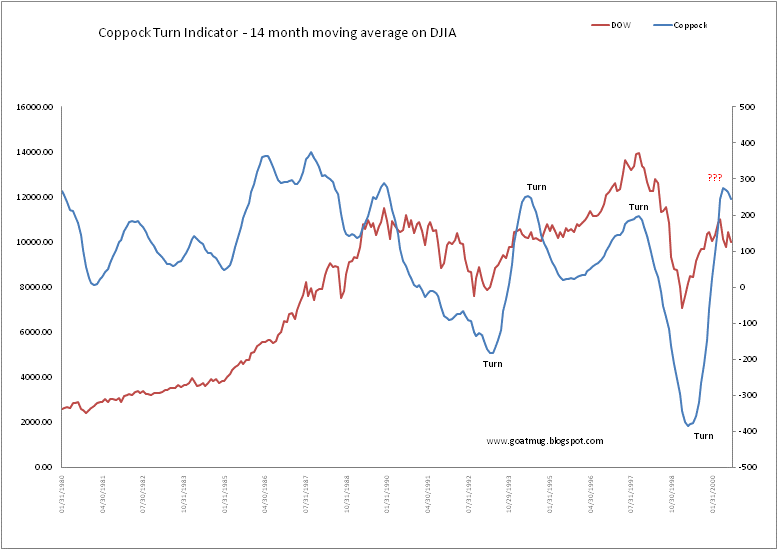
Since I posted the Coppock turn signal in June there has been no looking back.  The signal continues to suggest that you should be out of the market rather than in.  The thing has a decent track record, but won't get you in early  on the turns because it is based on a 14 month average, however, on big swings it does give you decent signals.


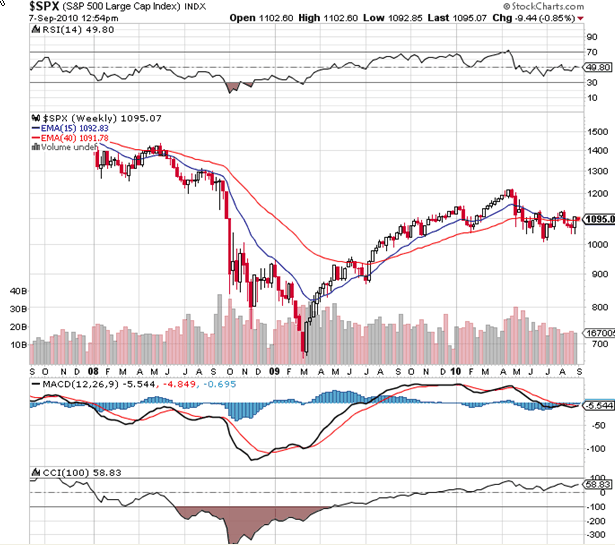
S&P 500 15 DAY / 40 DAY EMA CROSSOVER
Last week's rally has put another bearish chart into question.  We'll need to watch this set up as I type this today, the signal will go back to bearish.  As many know, one of my favorite bloggers Chris Puplava suggests that a very long term signal for market declines is the 15/40 Crossover on a weekly chart confirmed with a sub-50 RSI.  As I posted several weeks ago, we did get that signal in the S&P500.  I wanted to post this here because you might get the sense that I'm bearish (and that would be correct), but I want to make sure that I'm not caught leaning one way when it really is a false signal.  Of real importance is that the DOW has NOT crossed over and therefore is not confirming the action in the S&P500.


USD -http://www.bloomberg.com/apps/quote?ticker=DXY:IND
The US dollar has almost lost all of its gains made in that last several months.  How easy it was for Fed President Bullard and Chairman Bernake to slash the value of the dollar!


TREASURIES (TLT)
Treasuries continue to remain above the levels that suggest stress in the financial system.  While TLT trades higher we must acknowledge that much of the gap higher is related to the Fed's QE program where they buy treasuries.  Of course this incited a stampede to get in front of the FED so we have traded down a bit once the rush abated.  I have spoken with several people that want to short treasuries or buy TBT but I would caution against this trade unless it is very short term in nature.  What we all need to understand is that this program is here for the long haul and we'll continue to see record setting low rates across the spectrum of the debt curve.  We will see 3.25% or 3.5% 30 year mortgages and to have that come to fruition, we'll need to see TLT go higher.


TRADING UPDATE
As bearish as things are beginning to look, I am very concerned when it seems like the entire universe shares my pessimistic view.  I was noting that last week and guess what, we got a big rally!  Fortunately I continued to stay long in the emerging markets strategy I've advocated since July and have rebounded nicely.  In fact, holdings in Singapore and Malaysia continue to outperform.  As we enter September I am going to scale out of positions, or if I retain them, will marry them to a short position to have downside coverage.  I still like corporate debt, but so does everyone else, so I haven't added any bonds to my portfolio in a long time and don't anticipate adding unless I see something come out that is being unloaded by a distressed seller.

For longer term trades, I still believe 100% in my anti-US strategy of going long emerging markets and gold.  The Fed has put us on notice that they will monetize debt and drive the value of the dollar down in an attempt to stimulate, stimulate, stimulate! 

I had an interesting conversation with a few professional oil and gas traders last week.  They reflected that this has been one of the toughest trading years that they can recall.  They were very concerned that top notch guys were getting blown up with the wild swings from day to day.  They commented that several big firms were really in bad shape.  It is these types of conversations that continue to keep me out of oil and gas because you can be directionally correct, but have someone blow up and move the entire market against you. 

MONOPOLY AND THE BEAR MARKET OF 2010
This is dangerous work and it pays to be cautious, patient, and above all protect your capital. I played an online version of Monopoly with my kids the other day and we had an unusual experience that is an example of what will happen in real life in the coming years.


In our online game a computer player landed on an unowned space and he decided that he did not want to buy the property. In our example, when the buyer doesn't want the property, it is sent to auction where all of the other players can bid on it. (Perhaps the real game is like this too, but I never remembered that). In our game we really wanted this Boardwalk-like property and had lots of cash to purchase it since we'd had terrible luck with our rolls. All of the other players were really strapped for cash since they had bought other properties due to their good rolls. Since I'm teaching them "economics and game theory" we entered a clever bid in hopes of stealing this prime property on the cheap. What happened next was very unusual. As the time to enter bids expired we received a notice on the screen that we were the only bidder for the property and therefore bought it for almost nothing!
The message is simple and clear. In Monopoly and in real life bear markets, there will be opportunities, you need to have cash to be able to take advantage of them. Patience is a trade so protect your capital!


Be careful!
GOATMUG


Monday, August 16, 2010

TREASURY RATES SPIKING - FRONTRUNNING OR MELTDOWN COMING?

Below is a picture of TLT, the exchange traded fund that measures the long dated treasuries in the market (20 year plus).  As I've posted before, TLT's breakouts in August of 2008 were a lead indicator for the stress in the equity markets and economy as investors fled to the "safety" of US government treasuries.

As we see in the chart below, I warned a month or so ago that the push up in prices (yields going down) was a warning of bad things to come.  Well, once I posted that we had a nice recovery in July and the price on  TLT dipped back below the 100.15 level which I highlighted as the warning line.

Last week, the Fed announced that they would begin re-buying treasuries when some of the mortgage debt they owned rolled off.  In essence, they wouldn't allow their asset holdings to go away, they would simply find a new home for any money that was repaid.  (I think of it this way - that the Fed is not going to give our money back, we gave it to them (taxpayer guarantee of printed money) and instead of returning it once the stated use of the dollars is complete, they are going to recycle it into purchasing treasuries.


Well, because the Fed told the world they'd buy treasuries and even highlighted which ones they'd buy, the market, (investment houses and brokers), has done what any group of smart investors would do.  They have rushed in and purchased these securities ahead of our government!  Yeah!  Isn't it neat to know that our government is so generous and willing to buy over-priced treasuries from these savvy traders?

So, does the move in TLT signal that the market is melting down, or does it signal that the FED is just stupid (or manipulative) and created a rush into that market?  The answer is probably mostly the second and a little of the first.  Here's what I mean.  By telegraphing its intentions to purchase new securities with the roll off and then describing which ones it might buy, the Fed has really begun to achieve its goals.  (They are not stupid, they are being manipulative). 
First, the headlong rush into treasuries from other participants has further lowered interest rates to all time lows and this allows the government to fund our crushing debt at a much lower cost.  The by-product of announcing this is that there are some hedge funds and investors that are simply gun slingers that are looking to make some quick bucks front-running the FED.  The recent action in TLT especially today is probably mostly attributed to these fine fellows.

But, there are some folks that simply are so afraid of a collapse in markets that they are a new class of buyers of treasuries that have never done so.  Think people in 401Ks and retirees.  These people have lost 40% or 50% of their portfolios since March of 2000 and have endured this terrible market.  They are vowing not to get crushed again.  (They might get crushed again if interest rates rise).  The surge in TLT starting in June can be largely attributed to a large amount of folks retreating from the markets entirely, shunning equities and desiring the safety (hopefully) of fixed income.  This is why corporate bonds as well as treasuries are at extreme lows in yields.

So, whats next?  Well, as we've said many times, the Fed wants low rates to get the economy going (even though it has not worked).  They are so fearful of deflation that they are doing anything and everything to try to stimulate the economy.  Is the run in treasuries over?  No yet in my opinion.  As I've said, we will see 3.0% 30 year mortgages in the next year or so.  Rates for treasuries will need to go even lower than the current historic lows to get us that gift (if you can qualify for a loan that is).

In the longer term, will buyers of treasuries get hurt?  Heck yes! 
Will the move in treasuries lead to a move down in the market?  Possibly.  I'm not 100% convinced.  The argument to support the decline would be any move down that gets going could be met with an absence of buyers as they'll have committed resources to easier leveraged trades in treasuries. In addition, if you think about it, a strong move down would actually make these buyers of treasuries even more money as a drop in markets have have others coming into treasuries looking for a safe haven. Wouldn't it make sense to create a market sell off if you had the capability to move the markets?


Why am I not 100% convinced?  Last month, I suggested that the Fed would do some type of stimulus and therefore if effective they would attempt to juice the market via use of extra dollars sloshing around to purchase equities and other assets, or effectively the devaluation of the dollar.  This is why I said that purchases should be made overseas and in commodities like gold and not in US markets.  I'm still in the camp for the month of August that this should be my approach.

No matter what, the take away here is just another demonstration of how inefficient government is.  When the Fed purchases these bonds, they will be buying at higher prices than 1 week ago due to their prior-signaling of their intended course of action.  Of course this is purposeful and their attempts are made to manipulate the market and keep rates artificially low anyway, so what's wrong with overpaying for $200 Billion in bonds between friends anyway?

GOATMUG