Friday, June 24, 2011

MONEY MARKET RISK - WE'VE LEARNED NOTHING

My eye was caught by this story this morning regarding the potential risk US Money Market funds have to Greek and European defaults.  Please view the story here by right clicking and hitting "open in a new window" (don't click away from the blog!).

http://www.nasdaq.com/aspx/stock-market-news-story.aspx?storyid=201106241206dowjonesdjonline000447&title=us-house-witness-says-greek-default-not-a-risk-to-money-funds

YIELD SEEKING THANKS TO UNCLE BEN -
Why in the world do US money markets have exposure to the Greek debt bomb?  Well, the easy answer is that if it weren't for the Fed and Ben Bernanke, they probably wouldn't.  How is that you ask?  Well see, since short term rates are artificially low in the USA, investors must find alternative investments to find yield.  Great Grandma, Baby Boomers, Money Market Funds, and investors that are risk averse are being forced into investments they normally wouldn't ever consider in an effort to receive just compensation for their investment dollars.  While the Fed's plan has been all along to make money markets unappetizing, there are some investors that have no choice and must use them as an asset class.  The problem is that money market fund managers have this problem too.  They can't buy treasuries or mortgage backed securities anymore because yields are being manipulated lower by QE II and other invisible hands in the market.  They can't buy commercial paper, because that doesn't pay enough since everyone is competing for the same investments and prices are bid up.  They must find enough yield to earn enough to pay their fund expenses and then deliver some sort of return back to investors.  What is a money market to do?  The managers turn to buying paper across the pond and buying high rated bank and insurance company short term paper.  These funds are yield seeking and are probably taking more risk than they should due to the interference in the markets by the Fed. 


During the press conference, Ben Bernanke added to fears that we could be in a situation similar to the Lehman Brothers/Bear Stearns debacle where liquidity in the financial system simply froze up.  In situations where no one trusts each other, no one is willing to lend to one another, unless it is at astronomical prices.  This is a fear that is actually one based on truth - that if Greece defaults, European banks will be hurt financially, and that could impact other institutions.  The freeze could impact the banks and their lenders in several ways.  First, money markets and lenders could see those banks with Greek holdings as a perilous risk, one that perhaps shouldn't be traded with or one who should not receive favorable terms.  In that credit evaluation process things either slow down where lenders take a lot of time to make investment and lending decisions or they stop all together.    Second, if you are the bank on the receiving end of the freeze, you might consider holding on to money that has been lent to you and not returning it on time as you need to keep capital in house as long as possible.   As you can see, a simple default event in one insignificant country could end up being one big problem on a global investment stage.

HMMMM, COULD THAT HAPPEN HERE?
Now let's simply dream a little here and simply make up a fanciful situation where there actually was a default in a small island nation that didn't really matter.  (I know, I know, it could never happen with all powerful institutions like the Fed, IMF, and ECB making sure that all risk is taken only by the tax payer, but run with me on this).  As a risk manager for an investment company, the first thing you do is run a counterparty report to see who you are exposed to once you learn of the default.  You do a little bit of digging and you find out that one or two of the banks you lend money to overnight have significant exposure to Greece.  (Mind you, you don't have direct Greek exposure, you just do an overnight repo or reverse repo with them).  Upon reading the report you quickly fire off an email to your money market traders and portfolio managers directing them to immediately cease all investing in those bank names and put them on a credit black list.  As soon as all outstanding investments (short term loans, repos, swaps, commercial paper) to these banks are paid back to you, your desks will not buying their issues again no matter what the yield.  As this process is repeated, the cascade of capital starvation sets in on the offending banks and they quickly die.  The death of those banks causes waves that destroy other banks because they have long term risk outstanding to the banks at ground zero and now are in jeopardy of not getting paid back.  Sound familiar?  Of course, it is what happened in the financial crisis of 2008.  And yet, here we are again, facing the exact same set of problems, yet this time we are looking at it on a global scale.  We are taking about nations defaulting and being the genesis for the financial tsunami that will swallow the gigantic ponzi-scheme that has captured the world. 

BACK TO THE ARTICLE - COMPLETE HOGWASH
I feel so much better after reading the article where Mercer Bullard (professor) assures us that everything would be great if the SEC would just step forward and tell us it will all be okay.  There are a couple of problems with Mr. Bullard's statement. 

First, although money market funds can only hold short term investments there is no guarantee that a bank or company will actually return those investment proceeds on time if they are in financial trouble.    Banks in crisis don't always play by the rules and if they are dying they could care less if you are a money market fund, a church, or the US government.

Second, the notion that anything the government tells me will make me feel better is simply nuts!  Do you  think the SEC, the Fed, Treasury, or the Administration would tell me if things were really bad?  During the financial crisis did they tell us to get out of Washington Mutual, Lehman Brothers, Wachovia, Citibank, or a host of others?  No, if anything they came out to say that those institutions were fine and stable.  The FDIC said INDYMAC was great, only to find out they were completely insolvent.  Isn't that where we are with Fannie and Freddie too?

The SEC is too busy trying to find some small time trader that made $20,000 for insider trading when there are HFT (co-located high frequency trading computers that step in front of each trade and give you bad execution) that are ripping off investors every day to the tune of millions.  The SEC is too busy watching porn to worry about actually enforcing rules to protect shareowners of fake Chinese companies that don't actually do any business aren't they?  Suddenly the SEC is going to step in and reassure us that money market funds are just great and this will mean anything?
 
 Despite the stupidity of the professors comments, I am struck by the idea that we are two and a half years removed from the pit of the financial crisis and nothing has changed.  We have systematic risk embedded into the system and we have money market holdings that are still at risk of seizing up and collapsing the financial scheme.  What have we learned?  NOTHING!

GOATMUG

Wednesday, June 22, 2011

WHISTLING PAST THE GRAVEYARD ALL WEEK LONG

WHISTLING PAST THE GRAVEYARD
This week has already been very interesting.  We've had the confidence vote for Greece, which means that we'll have more Greek default discussions and posts in the near future.  We also had the FOMC meeting and press conference today where Ben Bernanke seemed much less confident.  I almost feel like the market is whistling past the graveyard in hopes of not disturbing the situation.  Over the last couple of days I've sold many of my shorts and waited for an expected bounce.  Now that we've had some of a relief rally, I'm focused on two specific names that seem to have attributes of weakness.  Specifically, GS has entered a significant period of decline where the 14 day EMA has crossed over the 40 day EMA.  There seems to be some support at $131 for the broker, but it may be worth a shot with the opportunity for a much deeper decline.  FXI also is showing the same qualities although it has not officially crossed over (I expect it to be official at the end of this week).  The "crossover" usually portends nastier things to come.

From a macro perspective we have two issues that will help these trades. We have the Fed removing stimulus (no better said, not stimulating and that should deprive GS of some trading proceeds at our expense) and also China is slowing and confronting inflation while trying desperately to keep from a hard-landing.

FXI
Weekly 14/40 EMA Crossover pending.


FXI (3 Yr Weekly)


GS Weekly View
13/40 EMA Crossover


Goldman Sachs (GS) 10 Year Weekly
The 10 Year view of GS is really interesting.  There is an obvious risk that GS could go up to around $165, but with all the uncertainty and misery in global credit markets it may be worth a short shot.  I think a move below $131 could take us to the lower portion of the downward channel which is at $115 which just happens to be the level that Warren Buffett got his shares.  It would be really interesting to see GS back at those same levels wouldn't it?


GOATMUG

Goatmug is an investor that cares about you and your family. Goatmug's Blog - Financial Perspectives From The Mountain Top is a collection of thoughts on our economy and how it impacts the lives of investors and average people. While several specific investments are named in many of his posts, these articles are simply invitations for you to do your own research and reference to these securities does not constitute financial advice. Your situation is complex and unique and you should seek professional assistance with your trading and investing. Please visit Goatmug and share your comments at www.goatmug.blogspot.com

THE UN-CURRENCY (GIVE ME A GYRO AND SOME GOLD)

The politics of destruction continue somehow as crooked Greek lawmakers voted to keep leaders in positions to destroy their economy.  By allowing the Greek PM to escape through the vote of confidence yesterday, Greek legislators essentially deferred what is going to happen anyway, it only prolongs the pain. 

In the mean time, the mass exodus of money continues as Greeks seek to find places to stash their cash fearing the coming collapse of the Euro they know is coming.  Regular folks are buying gold and silver and even an olive grove to diversify out of the doomed fiat.


http://www.ft.com/intl/cms/s/0/c986823e-9bf8-11e0-bef9-00144feabdc0.html
ATHENS -- Greek citizens are emptying savings accounts and buying gold as they brace themselves for the possibility of a sovereign default and a run on the banks.
Pledges by socialist prime minister George Papandreou that his government would "save the country" have been widely discounted by the public. However, parliament gave him a vote of confidence late on Tuesday night. The socialists have a six-seat majority in the 300-member house.
Sales of gold coins have soared as savers seek a safer and fungible source of value.

"When the global financial crisis started, our sales of coins to investors overtook bullion for the first time," said Harry Krinakis, at Sepheriades, a Greek precious metals trader. "Now the sales ratio has reached five to one."

Tomas, a computer technician, has exchanged his euro savings for gold coins: "I keep them at home just like my grandmother did in the Second World War."

Monthly bank withdrawals were running at E1.5 billion-E2 billion in the first quarter. Last year, depositors withdrew E30 billion, equivalent to 12.3 per cent of total savings, according to the central bank. Greek deposits worth an estimated E8 billion were transferred to banks in Cyprus in 2010. But the flow has dried up this year amid fears that Cypriot banks could suffer contagion.

Andreas, a supermarket manager, transferred the family savings to Munich earlier this year. "The Swiss banks aren't interested unless you’ve got several hundred thousand euros," he said.
"We can't trust the politicians to get us out of this mess [and] have to protect our families," said Sakis, a garage owner, at an anti-austerity protest in Athens' Syntagma Square. "A bank collapse has got to be in the cards." He added he had withdrawn his savings and placed them in a bank safe deposit box "for security. Who cares about interest right now?"

Others put their savings into land when prices fell after Greece's first European Union-led rescue last year. Angelos, a software specialist, bought a neighbour's olive grove. "I grabbed the opportunity," he said. "A year ago I wouldn't have considered making such an old-fashioned investment."

As tough as this is for Greeks, the only question I have it why we Amerikans aren't taking their lead and putting our cash in safer places?  Of course this isn't a situation that will unravel here in the US tomorrow or the next day, but it certainly is a picture of our future.  It cannot be avoided.

GOATMUG

Monday, June 20, 2011

JEDI MIND TRICKS, OIL AND GASOLINE PRICES, AND THE FORCE

"THESE ARE NOT THE DRIODS YOU ARE LOOKING FOR"
Gas Prices are falling a bit and as you can tell from my previous post on Friday I have set a "Line In The Sand" regarding where I'd be stopped out on it. 

There are several things going on that we must be aware of.  I'll lay them out here in bullet form so we can at least have a perspective of what might be pushing this trade lower.

A)  Oil and gas were too high already due to speculation
B)  Middle East unrest was one of the major components of the spikes in oil and gas and there has been an easing of tensions and everything is fine in the area.
C)  Europe and the EURO seem to be coming apart at the seams and this is bearish for global productivity
D)  China and India have have reduced consumption drastically.
E)  The green movement in the USA has discovered a green source for unlimited fuel for cars.
F)  Summer driving season is on hold.
G)  Central bankers realized that this out of control commodity inflation has totally boxed them in and a hit was put out on high input prices. 
H)  A bailout in Europe is effectively a stimulus package gone wild.  Again, the box that central bankers have created is getting smaller.

For the home players out there, I'm inclined to believe that perhaps A, C, G, and H are the only viable answers here.

A)  Perhaps oil and gas got a bit frothy when brent hit $119 or $120 based on the demand out there and levels of inventory.

C)  Euro tension and the Greek situation can't be good for making Europe move forward and growing.

G)  Of all the answers, I think we can see that the guys that have the most to gain from a drop in oil and all commodities are the central bankers.  Coordinated moves to hike margin requirements and douse the flames of speculation are in the interest of these financial leaders.  If the price of oil cannot be controlled, the economic engineers have no room to extend stimulus, because each additional dollar provided is drawn away to speculative assets or consumed to pay for high priced inputs.  The drag caused by high commodities is nasty and has been the target of verbal attacks by Ben Bernanke when he stated that inflation is "transitory".  As we've discussed, he is making this statement to form expectations and drive the market in the direction he desires, trying to "Jedi mind-trick" the market into believing that "inflation is transitory".

H)  If the ECB and IMF and countries step up to bail out Greece, we should see a trade where gold and silver rise, perhaps oil and gas due to since it is inflationary.


JEDI TRAINING INCLUDES ENDURING HIGHER GAS PRICES
Adrian Mitchell and Jennifer Waters have a conversation about gas prices in the pop-up link below.
http://www.marketwatch.com/podcast/podcastpopup/Money%20Markets%20And%20More/4


I've summarized several of the key points;
  • Consumers initially freaked out when gas prices were rising in January and February.  At this time, they are now calming down and are making the assumption that gas prices won't be high forever, that they will be  flat to down next month.
  • Fewer delaying car purchases
  • Consumers now say they feel better and are not considering themselves poor anymore.  Who are these people?  They are still poor.
According to the interview, they quote a report by Richard Hastings of Global Hunter Securities who says that we cannot assume that just because we have a dip in gas prices that the consumer is back.  He had estimated that consumer spending in May and June would be choppy and despite a little relief, consumers are slow to change habits now that they have ingrained some budgetary discipline.  In other words, people say one thing (like things are better) but when things have been bad it takes them 4 or 5 months to act.
 
Finally, the message is that if conditions of falling prices persist we might see improvement in spending and a thawing of the conditions of the frozen consumer, but when gas prices go up again, then all bets are off and we'll see a big slow down.

Ultimately, there is a feeling sigh of relief, US consumers are dealing with the change and budgeting in the price of gas.  They say that the take away is that the consumer is not going to make any rash decisions during this time.


MACRO THOUGHTS - (USING THE FORCE)
While I have a hard stop on my UGA positions I must reiterate several key thoughts about oil and gas. 

First, the impact of the growing consumption of oil by China and India cannot be ignored.  This  is one of those major macro ideas that sets the foundations for long-term trades.  If oil dips or even crashes, the long term trade fundamentals will be in tact and that should be reason to buy oil and gas. 

Second, Middle East tensions have not abated at all.  There is no reason to believe that peace has returned to an area where discord is the norm.  We must watch Iran closely at this time.  Any major actions in the Middle East have the ability to push oil and gas through the roof.  Also Libya is a mess and the entire conflict is about oil, don't let the cover story about freedom fool you.

Green transportation is quite unreliable.  Until I can be assured to go 450 miles without a refill or a plug in, AND maintenance of batteries is not astronomical, as far as I'm concerned it is a waste.

Don't let the central banker box idea pass you by.  We are going to see many creative steps engineered by central bankers in an attempt to wriggle out of the inflationary box they have created.


$48 is still the stop on UGA.


GOATMUG


Goatmug is an investor that cares about you and your family. Goatmug's Blog - Financial Perspectives From The Mountain Top is a collection of thoughts on our economy and how it impacts the lives of investors and average people. While several specific investments are named in many of his posts, these articles are simply invitations for you to do your own research and reference to these securities does not constitute financial advice. Your situation is complex and unique and you should seek professional assistance with your trading and investing. Please visit Goatmug and share your comments at www.goatmug.blogspot.com

Friday, June 17, 2011

LINES IN THE SAND

I've been doing some unusual posts of late and I'm extremely busy.  I've done a lot of looking at charts and I am going to share them with you.  These are positions I've owned for a very long time and have done well in my long term account with.  These are all plays that I've mentioned over the last two years.  Each of them (with the exception of the last 4) look very similar.  I've indicated ones that I actually sold this week, but also have indicated my levels for stops if I still have them.  I don't have time for any commentary on any of them, check out the charts and look at the stop levels, if the stock or eft is below that level, then I'm probably out.

As you know, I expect some sort of resolution to the Greek issue because the ECB cannot let that fail.  We will or should get some relief rally, but I think the bond market will immediately attack Italy, Spain, Portugal, and Ireland again, and we'll reface this same scenario and it will really hurt the prospects in the market till late summer or early September when we have some sort of new stimulus.

By the way, the short on RIMM that I've held on and off for a very long time (since mention on April 5th) has worked nicely.  I'm out of that trade now.  http://goatmug.blogspot.com/2011/04/apple-resting-or-shift-in-play.html


XLE (ENERGY)
Stop $71.45


EWZ - BRAZIL
($71.45 - Sell)

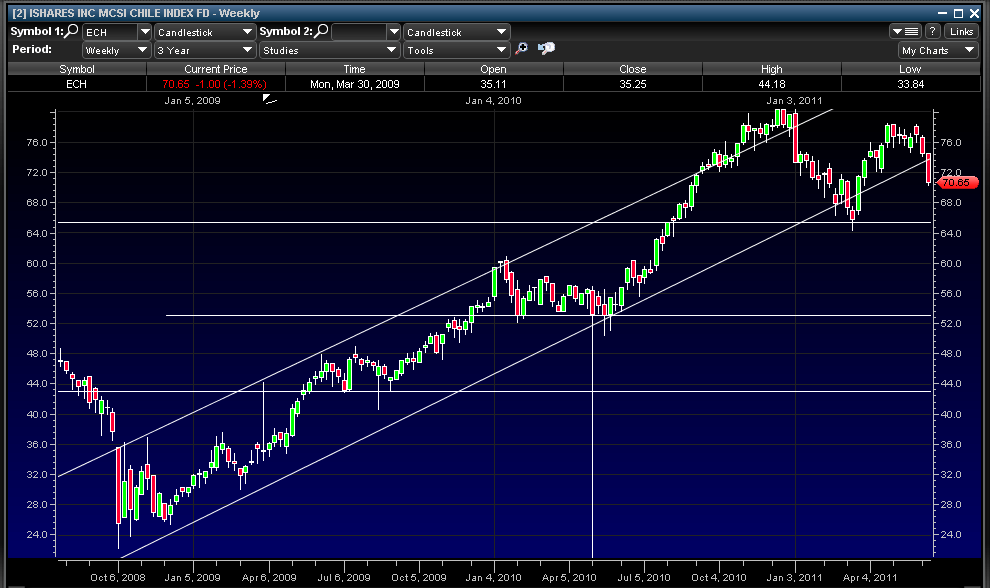
ECH - CHILE
$73.62 - SELL

EWC - CANADA
$30.25

EWM - $14.12

XLI - INDUSTRIALS
$35.75

VLO
$24

UGA - GASOLINE
$48


DBC - COMMODITIES
$28.40

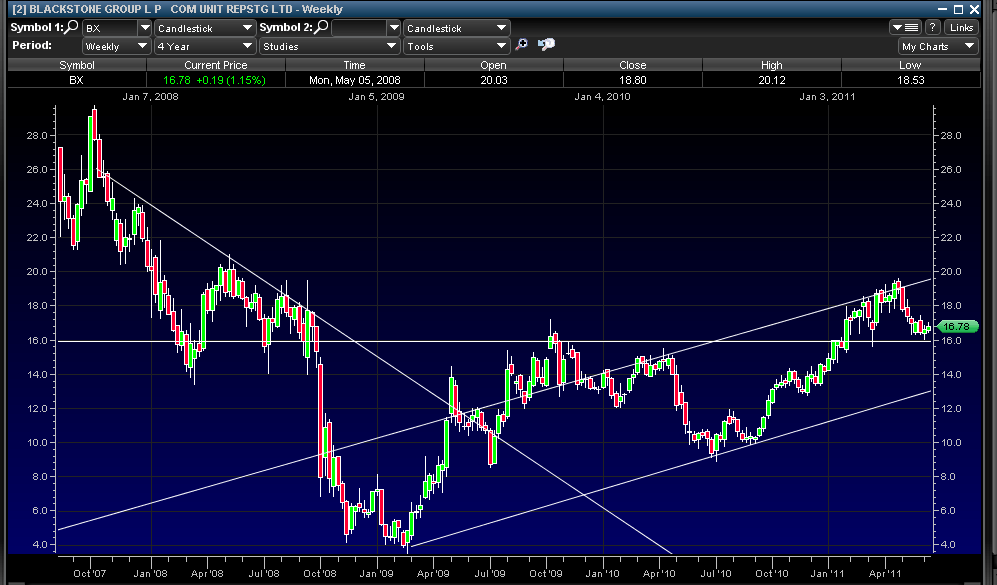
BX -  BLACKSTONE 
$16


DEFENSIVE THEMES - NOT SELLING HERE
XLU - UTILITIES
$30.75


PPA - DEFENSE
$17.50


XLV - HEALTH CARE
$31.66


XLP - CONSUMER STAPLES
$28.80
 
 
That's it, no more commentary than that.  Be careful and blow out of positions that could crush you.  Chances are we get a relief rally this weekend, but it will be short lived and that will be the chance to unload positions that you don't want to have for a long time at lower prices.
 
Please check out the blog at http://www.goatmug.blogspot.com/ I'm got some good things cooking for the weekend.
 
Goatmug is an investor that cares about you and your family. Goatmug's Blog - Financial Perspectives From The Mountain Top is a collection of thoughts on our economy and how it impacts the lives of investors and average people. While several specific investments are named in many of his posts, these articles are simply invitations for you to do your own research and reference to these securities does not constitute financial advice. Your situation is complex and unique and you should seek professional assistance with your trading and investing. Please visit Goatmug and share your comments at www.goatmug.blogspot.com.