Showing posts with label Bullard. Show all posts

Friday, April 1, 2011

PRICE HIKE ON EVERY ISLE? INFLATION, WALMART, & THE FED

WAL-MART SIGNALS AN END TO EVERYDAY LOW PRICES?

USA Today featured an interview with Wal-Mart's CEO Bill Simon.


At 3:34 in the video the Mr. Simon discusses inflation and outlines where he sees it coming from.

DOES THE FED HAVE IT'S EYE ON INFLATION?
So we have Fed Governor Bullard suggesting that inflation may be a problem as outlined in the post from several days ago (MINISTRY OF DISINFORMATION - BULLARD SPEAKS) and now we have the interview with a leading retailer stating that prices of everything are about to go up. 

What next?  Well today we have an article in the WSJ highlighting more misdirection from the Fed in the following note;
DUDLEY - WHY WHAT HE SAID MATTERS.

In the WSJ article by Matt Phillips we note that the President of the Minneapolis Fed, Narayana Kocherlakota, said he expected “a big upward movement” in core inflation — inflation excluding volatile food and energy prices — from about 0.8% late last year to about 1.3% by year-end.

The market needed to snap to attention because this comment combined with Bullard's earlier speech in France started to indicate that the Fed may be signaling some sort of return to a less accommodative policy for interest rates and markets.  Now Kocherlakota isn't seen as an inflation hawk so this also adds to the importance of the statement.  But before we get too excited that the Fed might step off the accelerator of the car that is careening toward the edge of a cliff like Thelma and Louise, we had another statement that just seems to make you wonder what planet these guys live on.

JOBS DATA SAYS KEEP ON PRINTING!

Bill Dudley, President of the NY Fed (the only one that matters) stated today;

“Even if we were to generate growth of 300,000 jobs per month, we would still likely have considerable slack in the labor market at the end of 2012,” he said, adding “the unemployment rate is much too high.”

Dudley is a close ally to Bernanke and is seen to be steadfastly in his camp in terms of their view on interest rates.  So go ahead Bullard, Plosser, Hoenig, and Kocherlakota, spew out your logical double speak about how the Fed is actively watching for signs of overheating and inflation, the NY Fed and Bernanke are the only members that matter and we know they are committed to driving this convertible over the edge in a blaze of glory.

Thelma and Louise Final Scene -


Be Careful!

GOATMUG

Wednesday, March 30, 2011

MINISTRY OF DISINFORMATION - BULLARD SPEAKS

http://www.bloomberg.com/news/2011-03-26/u-s-1st-qtr-gdp-may-not-be-as-strong-as-expected-bullard-says.html

Fed Governor Bullard spoke earlier this week in France and as usual he has been tapped to attempt to send out feelers about future Fed policy.  What I've noticed is that Bullard is sent out to discuss future Fed strategy to test the reaction of markets and sentiment.  This speech is no different as he makes efforts to spin that the economy is improving and perhaps we just don't need the remaining QEII.

From the Bloomberg article -
"St. Louis Federal Reserve Bank President James Bullard said policy makers should review whether to curtail a plan to buy $600 billion in Treasury securities, noting that the U.S. recovery may not need that much stimulus.

“The economy is looking pretty good,” Bullard said to reporters in Marseille, France, on March 26. “It is still reasonable to review QE2 in the coming meetings, especially this April meeting, and see if we want to decide to finish the program or to stop a little bit short,” he said, referring to the second round of so-called quantitative easing.
I'm not buying what Bullard is selling here, or probably better stated, I'm not buying the suggestion that the Fed is desiring to remove QE from markets because they are healthy and ready to get back on track.  I believe that the Fed is actually concerned about commodity prices and the impact it is going to have on corporate margins and also the ability of the market to function with $100 oil.

OIL IMPACT
Bullard continues
"The oil price increases so far are “not enough to derail the U.S. recovery at this level,” Bullard said. “If oil prices stabilize where they are, we’ll be fine.” Prices would have to go substantially higher for there to be a “significant and material effect,” he said.


“We have to weigh those in the decision” on whether to stop the Fed’s QE2 program earlier than planned, Bullard said.
Hmmm.  So if you are the FED and you are concerned about higher oil prices that could impact the recovery what would you do?  Right!  You might talk about how you are going to end the one program that is the cause of all of this commodity inflation!  You don't have any intention of stopping early, but you would at least send out your lacky to talk about the possibility. 

FED STRATEGY
So, if Bullard is trying to signal that the FED may begin to wean the markets of its fiat version of crack, what would be their steps to attempt to detox the market and kick the habit?

"While the economy may still suffer shocks, the “balance sheet should be contingent” and the Fed should be ready if the economy turns down, he said.
“If the economy is as strong as I think it is then I think it may be reasonable to send a signal to markets that we’re going to start withdrawing our stimulus, and I’d start by pulling up a little bit short on the QE2 program,” Bullard said. “We can’t be as accommodative as we are today for too long, we’ll create a lot of inflation if we do that.”
If the Fed opts to start withdrawing stimulus and tighten policy, it should start with the “balance sheet” by selling bonds first, then changing its wording about keeping interest rates near zero for an “extended period” and then raising interest rates, Bullard said.


Bullard has warned since last July about a risk of Japanese-style deflation in the U.S. while calling for purchases of Treasury securities to reduce the threat. Bullard, 50, voted in favor of the Treasury purchase program in November and has rotated this year into an annual non-voting position.
You need to read that statement again --- "We'll create a lot of inflation if we do that".  Yes, for once Bullard and I are in total agreement.   If the Fed doesn't act they will create a lot of inflation (have created a lot of inflation).  What he doesn't say is that they have already created a lot of inflation in asset price terms (stocks and commodities) and we've discussed how this has led to the two year rally from the depths of the abyss and also led to the oil and food price rallies that have caused unrest and misery throughout the world.  Recall that Bernanke likes to say that he can inflate stock prices, but never admits to the inflation of food and fuel prices. 


TRAPPED BY A CREATION OF THEIR OWN MAKING
The next few months are going to be entertaining as the Fed starts with their balance sheet like Bullard suggests.  We'll see exactly how much appetite there is in the world market for over-priced treasuries that provide below market interest.  The FED is in a box and we'll get to view what impact selling bonds has on the market while the Treasury is trying to sell more and more bonds to meet the budget requirements of the ever-growing beast called the US Government.  The Treasury and goverment needs rates to remain low because we cannot service the debt if interest rates rise to market based rates, and I believe that we'll be able to witness just how handcuffed the Fed is once they try to remove themselves.

SINCE WHEN DOES THE FED TIME ANYTHING CORRECTLY?
We should all be very worried about Bullard's last statement below.

“It looks like inflation is bottoming out and if we continue that, I think we will have gone past” the worst, he said. “We seem to be turning the corner there, but I would want to see more data on that.”
I haven't seen a Fed Chairman that has been able to engineer a move in the economy that didn't overshoot one way or the other by injecting too much liquitity or tightening too much.  It is frankly just too hard.  If Bullard says that we are at the bottom of the inflation turn, it is probably more accurate to state that we have already made the turn and it is too late.

This week the FED did sell $2 Billion of their bonds yesterday under the TOMO program.  This is a very small amount, but could be construed as a test sale in the market.

http://www.newyorkfed.org/markets/omo/dmm/temp.cfm?SHOWMORE=TRUE

I believe that the best FED approach would be to announce that they see significant improvement in the economy and that the QEII program will be strategically altered by changing their allotment of allocated money.  This would be done by reducing the remaining purchases on a monthly basis,  but should then suggest that the progam is not ended, in fact, it is extended through year-end with the remaining portion of the $600 Billion as ammunition.  In addition, they plan to begin asset sales from the balance sheet with the expectation that they will raise interest rate at the end of the year or early 2012.  By proceeding in this manner, they essentially make the statement that the economy is getting better, they will try to improve their balance sheet, but they stand ready anytime with already approved liquidity to step in if markets seize up (or in the eyes of the Fed, if stock markets decline).


TRADING UPDATE
What are markets thinking about the notion that Bullard says that inflation might be around the corner?

TIPS


USO


Today and tomorrow make up the period we often call "window dressing" period where portfolio managers begin buying the hot stocks and selling the losers because they are required to disclose their positions at the end of the quarter.  Portfolio Managers don't want to answer questions like "Why didn't you own NetFlix?" if they can help it, so they go out and buy those stocks that have performed well and they sell the ones that haven't.  This has the effect to push up the market leaders over the last few days of the quarter.  It is often noted though that these same managers unwind those same positions near the beginning of the quarter.  If you don't like it, sell it!  I mention this so that we are clear to avoid getting sucked into the bullishness of these next couple of days.

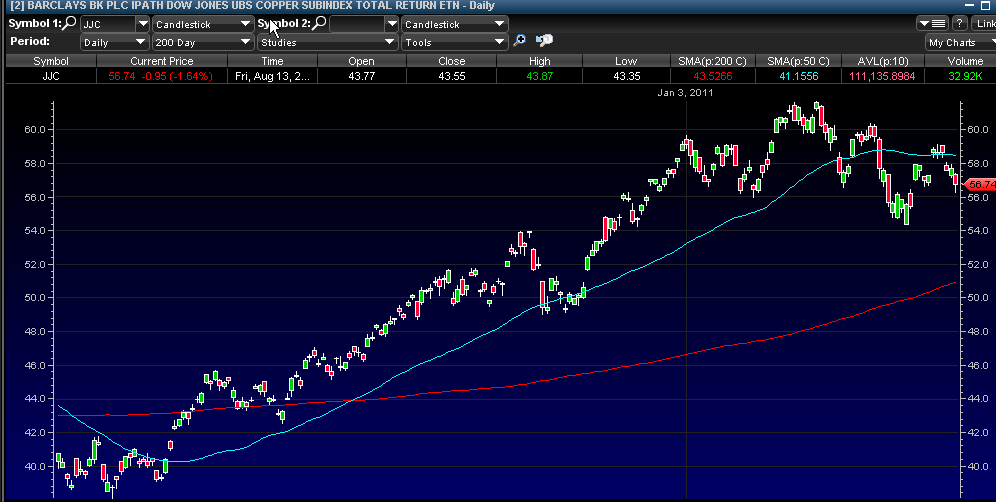
I am concerned about commodities right now and therefore suggest that you do not add to new positions over the next couple of days.  Copper is extremely weak and most commodities follow the trend created by copper.  There are some very fundamental and specific reasons (specific to copper), but that doesn't mean that a big drop in copper won't bring the rest of the commodities market down too.  There are rumors of Chinese businesses buying copper and storing it in warehouses in the effort to then borrow against that asset because they cannot get traditional bank financing as the government has tightened loan availability.  There is talk that there is a huge amount of copper supply just sitting essentially as a funding source.  If copper declines significantly there will be effectively a margin call against those copper supplies and businesses will be forced to sell at the prevailing market rate to get out of their positions.  This squeeze could get really ugly really fast.  This is just another item to watch over the next couple of weeks.

JJC (copper etn)


GOATMUG


Wednesday, August 4, 2010

THROWING DOWN THE GAUNTLET - AUGUST MACRO REVIEW

RAILS http://railfax.transmatch.com/

We begin this month's review looking at rail traffic.  Rail traffic in general continues to improve over 2009 levels.  Because there are some seasonal issues going on around this time, I don't want to over-hype the small draw down that we are seeing here.  Seasonally adjusted we are only down around 1.3% in total tonnage from last month.  Having said that, every report I read is simply talking up how great the shipping tonnage rates are.  In an attempt to examine this, we can simply note that tonnage compared to 2009 is about 20% greater yet it is still around 10% lower than 2008.  In addition, we need to keep in mind that the best years on record for intermodal rail shipping were 2006 and 2007 so it is a bit more sobering to think that we are recovering, but not near peak levels.

GDP adjustments really reinforce this as last weeks revisions to GDP showed that growth in GDP was slowing well before 2008.


RECESSION INDICATORS ON RAILS -
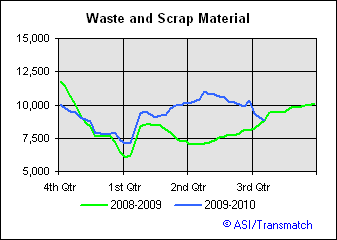
Motor Vehicle rail cargo and waste and scrap metal materials shipping is tailing down in recent months.  The autos shipping and sales data is absolutely seasonal so I don't want to highlight that much given that it may mean nothing, however the drop in scrap metal and waste movement is something to keep an eye on as these are inputs into the manufacturing process.  Later we'll look at scrap metal pricing.

THE WEAKEST SHIPPING TONNAGE - KSU
As I mentioned last month KSU and KSU Mexico continue their slide in tonnage.  I put this up because we need to continue watching these rails and their cargo shipping.  Specifically for them, they are encountering a crossover from levels from last year in this quarter and this may be a concerning development to monitor.  Last month I mentioned CNI and showed their chart as the best performer.  I also suggested passing on their stock simply to wait for a retest below support.  That didn't work out well as the stock is now trading almost $6.00 or 11% higher.  (I wouldn't chase it here).


I wanted to include some data related to jobs.  Below is the information for the Monster.com Employment Index.  This data shows a summary of online recruiting efforts and job availability.  This data highlights information from June, but I will begin updating it monthly in my chart form.  In that time period, Monster suggests that in 13 of the 20 major employment areas in the country, there were additional listings on job boards and company websites.  The biggest gains were made in hospitality and food services industries.  Examining the most recent unemployment report confirms these trends are continuing as well.


ECRI / WEEKLY LEADING INDICATORS and ECRI GROWTH RATES  - http://www.businesscycle.com/resources/
ECRI continues to release data showing that the weekly leading indicators are falling.  Last week's -10.7% growth rate provides ammo to those that are arguing that we are headed for slow down, if not another recession.  Again, the slowing data here is in contradiction to the ever-ramping stock market.


Housing drops and consumers reducing their purchases is driving the drop in growth rates.


MOODY'S / MIT COMMERCIAL PRICE INDEX - http://web.mit.edu/cre/research/credl/rca.html
The most recent Moody's / MIT Commercial Price Index Data shows that commercial real estate prices in the index increased 3.6% for the month of May.  Again, this data is lagging here, and isn't showing that pricing has leveled off yet. 


Equity market gains and other financial market rebounds have fueled the recovery in the Bloomberg Financial Conditions Index.  A level above 0 would indicate that the recession is over, numbers below show a contraction.  We have not pushed through zero yet, but a significant equity market explosion higher in August could at least give us a second attempt at moving into an expansionary number.


SCRAP METAL - GOOD TIME AL'S FAVORITE INDICATOR - Alan Greenspan often said that he watched the price of scrap metal to determine the health of the economy.  Below is a scrap metal chart for the last two years.  Just like every 2 year chart it shows the same shape moving up and to the right, but it is interesting to point out that this index bottomed out in January of 2009.  This would have been a good indicator to use to portend the market's recovery in 2009.  We see that we've endured a drop in scrap pricing in late June and July, only to see a move up in the last week or so.


The USD's dramatic decline seems to have washed away all fear of European collapse or should I say the lack of fear of the European collapse has begun to wash away the value of the dollar!  Those stress tests sure did the trick didn't they?  The decline of the dollar has certainly also ushered in a revival of the stock markets.  Funny, we are now hearing that folks are concerned about the downward direction of the dollar.  The truth is simply this in my opinion.  We will have little upward momentum in the markets without a destruction of the value of the dollar.  Having said that, Alan Greenspan this weekend put into words what the FED is really thinking.  Greenspan simply stated that the market is the economy!  So, we must be on alert that since the "Economy is the Market" we are being reminded that asset values are the only concern of the Fed and the only hope to return things back to the good old days.  Understanding this means we remind ourselves that they seek a return to inflation, easy money and credit, and if it takes it, a decline in the purchasing power of the dollar.  Here me loud and clear.  There may be ups and downs in the value of the dollar, but if the FED has anything to do with it, there will be an ultimate walking down of the value of the currency.  This is the only way to survive and extend with the looming debt issues we have.   


BALTIC DRY GOODS SHIPPING INDEX - http://www.bloomberg.com/apps/quote?ticker=BDIY:IND
The BDI has made a significant drop since May and June and is attempting a bottom here.  As commodity demand increases we should see a move higher in the cost of spot shipping, however the drop in the BDI is a reflection of the over supply of ships that stand ready to carry freight.  Still, if you are an owner of those ships that don't have long term contracts at a fixed price, you are probably hurting very badly at these rates.


TRADING UPDATE -

I like the simple chart provided by the guys at Growthstock Advantage. Based on their indicator that examines the number of stocks trading above their 40 day moving average, the market is NOT overbought yet.  As stocks get extended it is sometimes helpful to see when everyone loves the market.  Typically you might consider scaling out of positions or shorting at that time.  At this point the indicator is NEUTRAL.


C

COPPOCK TURN INDICATOR - I showed this chart last month and it is simply a 14 month moving average of the Dow.  When the average turns and heads south like it did last month at the end of July, it is an indicator that the market may be headed the other direction.  The COPPOCK is one of those indicators that confirms a move rather than one that is predictive.  Having said that, even with July's monstrous performance, the COPPOCK is suggesting that we are still going to go lower and therefore it is BEARISH.


US Libor continues to improve and so do all other denominated Libor measures.  I made a comment right after the European financial stress test result release that I'd be watching these levels to get a confirmation that the banks actually were believing what was being served up.  Because we are seeing a drop in these rates we can confirm that stress is abating. So while the contraction in rates is only a few basis points since last week, it is a 10% reduction in 1 week funding rates, which is significant. 


ST LOUIS FED PRESIDENT BULLARD THROWS DOWN THE GAUNTLET -
As the flood of disappointing news rolls in about a slowing economy, St. Louis Fed President James Bullard moved from his centrist position to one of outright advocacy for the spawning of the Son of Stimulus just like we've been warning for at least a month.  Bullard's discussion warned of the specter of a Japanese style deflation, exactly what they want to avoid at all costs.  Bullard's comments make it all the more likely that the Fed will actually move to invoke more stimulus in the form of buying treasuries, buying more agency backed mortgages, and maintaining a near zero rate (no hikes).

Bullard's comments probably are part of an orchestrated effort to convey the Fed's future policy.  We cannot forget that no matter how ineffective Fed policies have been in creating a real recovery in the economy, this is really about creating a rebound in market or asset values.  Like we've stated above, Good Time Al believes the market IS the economy.  Check back to the post we made last year regarding Bernanke's 2002 deflation speech.  There is no ambiguity there.  He is positively stating that the Fed can and must win against the deflation enemy.  Despite the fact that jobs have not returned and the housing market is still floundering, we will see a new round of QE that looks to further juice the market.  I would guess that this will have a smaller effect in terms of the magnitude of a move on the market and the impact will have less of a lasting effect in terms of time than last time, but if we get confirmation from the Fed that they will provide liquidity, we will see a move up.

This further highlights the notion that we will probably see mortgage interest rates at 3% or 3.5% in 2011.  Isn't it funny how despite their efforts we continue to spiral the way of Japan.  Want to get an idea for what it might look like right now?  You can buy a Japanese 10 Year note and receive 1% on your money!  Hello deflation! PUBLIC ENEMY # 1 - DEFLATION

I'll remind you the futility of the game that the Fed is playing - FDR’s Secretary of the Treasury, Henry Morgenthau came to in 1939 after initially being a proponent in massive fiscal stimulus to cure the depression and employment. His comments are provided below:


"We have tried spending money…We are spending more than we have ever spent before and it does not work. I say after eight years of this administration, we have just as much unemployment as when we started… And an enormous debt to boot!”


30 DAY TRADING OUTLOOK- Ok, so the Fed is beating the drum that they will do anything to stop deflation and they will continue to buy treasuries, what is the play for the month?  It is exactly the same strategy that I outlined on July 3rd in the Mid Year Review. We should continue to invest in emerging market issues focused in countries like Brazil, China, India, Indonesia, Malaysia, Chile, and Taiwan. 

All of these etfs have broken out, and even the S&P 500 extended its gains over the 1120 level I highlighted last week.  While macro indicators confirm the slowing, we cannot deny the short run impact of a committed Fed.  Bullard essentially has thrown down the gauntlet and stated that the Fed will use all of its ammo to fight deflation.  Once again, the Fed playbook is opened and I suggest you read our post on deflation to remind yourself of the commitment to defeat that enemy at any cost.  The hawkish tones of Bullard emphasize what is at stake and the intensity of the desire to prevail. 

While I've been bearish on gold lately expecting a pullback to the $1040 area, I am tempering this because of the expected Fed devaluation.  CPI data will probably come in lower, yet this will only fuel the Fed's aggressive response.

GOATMUG