Showing posts with label jobs. Show all posts

Friday, September 14, 2012

CFOs DON'T CARE ABOUT MONETARY POLICY


CFOS ARE LESS OPTIMISTIC
We received a "gift" from the Federal Reserve yesterday that included unending monthly mortgage bond purchases.  I have another post in the works to help examine the decision by the Fed and uncover what the impact will be on the economy and the market.  Before we delve in the Fed action, I wanted to highlight a new piece of information brought to us by the Fuqua School of Business at Duke University.

As usual, I present to you the quarterly release of the CFO Sentiment Survey.  The survey is important because it provides us a global and domestic examination of what CFOs think about the economy and also their own firm's growth outlook.  I like the CFO angle because these company leaders often have a more realistic assessment of true industry and market direction and how that will impact them financially and operationally.  I often suggest that CEOs can't help but spin and sell a positive outlook because they are wired to promote and push and therefore are often glass half-full (or sometimes glass all the way full) and CFOs tend to just look at what is in the glass.

Let's examine what the most recent survey stated.


SEPTEMBER CFO SURVEY - http://www.cfosurvey.org/12q4/PressRelease.pdf
CFOs admitted in this quarter's results that they are more negative than previous reporting periods.  The financial managers suggest that they have curtailed hiring plans and have reduced their spending budgets as well.  The executives also stated that their capital spending plans would not change even if interest rates fell another percent or two, which suggests that Fed policy to lower rates would have little impact on real companies.  CFOs also stated that they would not change any of their investment plans even if interest rates ROSE 1% which further underscores that the Fed's work is not really going to have a material impact in a traditional business environment.  Clearly the Fed is targeting housing and also attempting to provide banks with more liquidity.

TOP CONCERNS
I like the CFO Survey because it also asks the finance chiefs to list their major concerns.  This survey noted that profit margins, health care cost, maintaining employee morale, and finding qualified employees were their greatest worries.  Europe's recession is also an issue on their radar and very importantly we find that companies are concerned about governmental regulations.


DETAILED RESULTS HERE
I've cut and pasted an image here to examine the survey results.  You can see that this quarter's growth estimates have been reigned in significantly.  If you'd like to examine the pdf, simply click this link - PDF OF SURVEY RESULTS


JOBS AND THE FOOLISH FED
Ultimately, companies are slowing their growth and that includes their capital spending and hiring.  While we keep hearing that the Federal Reserve is acting to support "full employment" it seems like that is a "fool's errand".  Company leaders are stating quite clearly that interest rates don't matter and lower or higher rates won't impact their decision to add more headcount!

Recessionary concerns are important as US firms look across the pond and worry about economic slowdowns visiting our shores.  While the Fed continues to try to work magic, domestic firms are trying to figure out how to balance the powerful impact of greater governmental regulations and cost requirements with the ability to actually run their businesses.  FIRMS ARE NOT HIRING BECAUSE THE REGULATORY OUTLOOK AND MANDATED COSTS ASSOCIATED WITH HIRING IS UNCERTAIN.  The Fed can buy mortgage bonds all they want, but until government gets out of the way, regulatory uncertainty will be a critical barrier to employment growth in the next year.


GOATMUG

Goatmug is an investor that cares about you and your family. Goatmug's Blog - Financial Perspectives From The Mountain Top is a collection of thoughts on our economy and how it impacts the lives of investors and average people. While several specific investments are named in many of his posts, these articles are simply invitations for you to do your own research and reference to these securities does not constitute financial advice. Your situation is complex and unique and you should seek professional assistance with your trading and investing. Please visit Goatmug and share your comments athttp://www.goatmug.blogspot.com/

Tuesday, September 4, 2012

MARKETING WORKS - FOODSTAMP UPDATE


SNAP IS AWESOME!  GET YA SOME!
The government's Supplemental Nutrition Assistance Program has been a powerful success by any measure.  While hard economic times have certainly driven participation in the program in recent years due to the "Great Recession", longer term trends suggest that the foodstamp initiative is amazingly effective at adding to its roles.

The government released June data this month and highlighted that more than 46.67 million Americans are now receiving food assistance.  The new figures show that we have erased the recent drops in participation in February and April and have pushed to new record highs.  We are 3.3% higher than a year ago and 1/2% greater than last month.


DIFFERENT WORLDS?
Stock markets would have us believe that things are better and the outlook much more positive, how can we justify equity index gains and the record participation in government food programs?  We must look only to a massive effort by the last two administrations to drive up enrollment.  The USDA under the leadership of George Bush and President Obama have emphasized participation in the program and we've even had tremendous marketing efforts on television and radio to get the word out that free food is available.  The USDA is spending almost $3 million dollars to get eligible participants to apply for the service in California, Texas, Ohio, and New York.  They are specifically targeting the elderly, working poor, unemployed, and of course.....hispanics (why this group is singled out I have no idea, as if they wouldn't fit in the other highlighted groups??).

TERRIBLE STORIES
The USDA has stepped up its efforts saying that there are more than 1 in 4 eligible people in the US that still haven't applied for the benefits they are eligible to obtain!  Take a look at the video from CNN below.  As I watch this I am simply mortified for this family that they have endured 4 years of struggle.  The frustration they must feel and the shame they obviously feel is terrible as they wouldn't agree to show their faces on camera.  As much as I can empathize with them,  I am also disturbed by the lack of creative thought and noticeable lack of initiative their entire family has shown.  I can guarantee you that the father could start his own small cleaning business or janitorial supply business and earn more than the $18,000 annually the family has made as he labors as an hourly worker.  In addition, I find it hard to believe that the wife isn't working too.


After four years, I would hope that they had improved their situation and I am sure that they do too.  I just almost believe that these "safety nets" have created a group of people that are incapable of being self-reliant and creating their own success.  Clearly they didn't have significant savings as they said they were broke immediately and clearly they have some situation that prevents them from undertaking heroic measures to address their situation (possibly some health issue?).  While I am sorry that the son cannot go to college, I am left wondering why he isn't working and contributing his earnings to his family?  The family has had food assistance, free living (not paying their mortgage), and obviously other benefits too, the question is how will they get out of this mess?  Will they just continue to hope for a corporate job, or will they endeavor to try something new?  My guess is that Obama or Romney won't be able to help someone that clearly hopes to be restored to his previous position and station in life.

SAFETY NETS ARE TRAPS - GOVERNMENTS CREATING DEPENDENCY
Instead of ramping up food program expenditures, I would rather see the government get out of the business of trying to serve more folks.  If a government program must be created, make it mandatory that recipients enter a technical job training co-operative as we continually hear that America lacks skilled labor and jobs at specialized manufacturing plants are plentiful.  I am choking as I'm writing this as it sounds like I'm advocating more government, but it seems as though it is inevitable that the government is going to spend, spend, spend, perhaps it is more reasonable to demand where they are going to allocate it.

The USDA sees lots of new candidates out there and we've seen how effective they are at using marketing to reduce the stigma associated with the lack of desire or inability to provide for basic needs for a family.  I guess we can only predict that we'll see increased role size and more than $80 Billion in annual program expenditures in the near future.  One has to wonder what is wrong with the 85% of the population that isn't using foodstamps, I'm guessing it won't be long till some are enticed to join the program.


GOATMUG

Goatmug is an investor that cares about you and your family. Goatmug's Blog - Financial Perspectives From The Mountain Top is a collection of thoughts on our economy and how it impacts the lives of investors and average people. While several specific investments are named in many of his posts, these articles are simply invitations for you to do your own research and reference to these securities does not constitute financial advice. Your situation is complex and unique and you should seek professional assistance with your trading and investing. Please visit Goatmug and share your comments athttp://www.goatmug.blogspot.com/

Friday, August 10, 2012

THE MOUNTAIN TOP VIEW - MACRO THOUGHTS


A friend of mine asked me about my thoughts on the market and I wanted to capture my thoughts and also put some charts up for review (I did this under two other posts.... CHART-SLAW and SON OF SLAW).  Now we have made it through the Fed meeting and the ECB meeting we are coming to a point where we see that central banks may be boxed in and have little ability to do much other than talk about what they could do..... until they are forced to do something entirely out of the box (yes, this is still coming).

Let's break the perspective into two broad categories.  First, we'll talk about all the reasons the market looks bad and how the gathering clouds could reduce the gains that the market has posted so far this year.  Second, we'll review all of the reasons that the market could actually go higher.

CLOUDS ON THE HORIZON

ECB - LOT'S OF BARK, NO BITE
Draghi and pals really did have great success a month or so ago when they claimed they would do anything and everything without limit to save the Euro.  Well, it sounded good and the market was happy..... till everyone realized that practically no other country would approve the measures and possibly the most important one, Germany, can't constitutionally do what needs to be done to save Europe.  I'm hearing more whispers that perhaps Germany is beginning to see the light and might even consider their own exit from the Euro.  Mark September 7th on your calendar as this is the day the German High Court will decide if the extraordinary measures proposed by the ECB are allowable in the context of their constitution.  If the German court pulls a Chief Justice Roberts and twists their laws to promote a greater government, then the Euro could very well emerge stronger (with a little addition by subtraction as Greece has to go).  If though, the law really is the law, we can expect a very messy situation until the people demand to be saved by the ones that are destroying them.

FED - ON HOLD TILL NEXT MONTH
The Fed last week told us that conditions in the US were slowing, but hadn't gone so far that they would intervene.  Of course they didn't miss the opportunity to let us know that more QE could still come later.  The reality here is that more "twisting" probably won't help too much as rates are in the cellar anyway.  I had an interesting thought the other day that ultimately we would see the Fed buying index futures to bolster stock prices at some point, but so far I don't think this has happened (except during the flash crash --- we'll never know).  When we do see this type of extraordinary action, you can be sure that it will be implemented when the complete collapse is unavoidable.

What do I expect in September?  Well, I think the easy thing to expect is that we will have them tell us that they will not only keep interest rates low through 2014, but we'll also see them promise rate stability through 2015.  This could make some opportunities very interesting and will highlight those ideas later.

The script is already being played out in front of us as we've had a host of Fed Governor's give us their views on what needs to be done.  We've had calls for more stimulus and of course we've had the token hawk, Dallas Fed President Fisher explain that nothing more needs to be done except for fiscal actions by Congress.  As we've discussed at length, Fisher and any other hawks are just useful tools to make it look like there is a reasonable discussion going on.  Dudley, Yellen, and Bernanke are the only votes that count and we all know that ultimately more QE is coming.

DECOUPLED?
Despite the powerful interventions of QE, QE II, QEIII, and all sorts of other efforts, we really are slowing down in the US and globally the economic turn seems to have happened in Europe and in Asian countries.  I think we have determined that the US has not decoupled from the world and likewise, the world has not decoupled from the US.  As world economies slow, we could see the unorthodox intervention I mentioned above to save the US system.  Transports like the rails and UPS are all showing weakness and the sudden and abnormal spike in gasoline prices in July won't help them much either.  Today's MCD same store sales data suggests that Europe is a total disaster so watch those multi-nationals.


NO TRUST - GOOD KNIGHT CONFIDENCE, GOOD KNIGHT
I have posted quite a few notes lately suggesting that the retail investor is simply not on the same playing field as the high frequency trading bots and institutions.  The entire system seems to be structured in a way to rip money away from Mom and Pop and remove them from the markets.  Banks through their trading of derivatives and manipulation of LIBOR continue to show that the culture is rotten in that industry.  We also see the  regulators asleep at the wheel and the PFGBest scandal is a damning indictment of their inability to see any of these acts until the collapse of the ponzi is complete. Finally, the Knight Trading incident added to the fat-finger May 6th flash crash may be the final straw that breaks the back of small investors that are actually paying attention to their accounts.  While I am pretty confident that the average investor has no idea what happened last week to Knight and their bots-gone wild match-making test software fiasco they may hear and learn about it as more dominos appear to fall and of course liquidity will suffer in the long run.  It appears that Knight was able to somehow salvage itself and obtain critical financing to stay in business, but this event shows just how significant "fat-finger" errors can be in terms of lost capital and potential job losses.  Knight employed more than 1,500 people and it boggles the mind to think that all of them could have been out of a job as a result of a software program that ran for 45 minutes.  Makes you want to buy some stocks doesn't it?

Here is a great article today highlighting the impact our markets feel under the weight of HFT attacks.  This post looks at 1 second in time in the trading of gold prices.
http://www.financialsense.com/contributors/dimitri-speck/a-high-frequency-attack-on-gold


FISCAL CLIFF AND POLITICS
Let's not kid ourselves at all.  While Obama has a few left leaning views, Romney is no super-conservative savior either.  In fact, other than a few guys that say they are Tea-Party guys (and then don't actually act like it or don't have any power to actually do anything) both sides are equally terrible.  The bottom line is that the arguments between these two disaster parties are stupid and not based on any real substance.  In order to actually make a real dent in things we need to halt deficit spending and actually force government to quit growing!  These cuts will hurt, and our economy would absolutely grind to a halt..  Unfortunately addictions are really tough to quit and so the process will be painful.  The adults in the room need to ask themselves if they want a few years of pain or a complete collapse.  Since there are no adults in the room (Executive branch or in the Senate or Congress), we will continue down the path of destruction till Japan implodes and it will be too late to do anything but watch the event happen here.

The theatrics of budget cutting and the fiscal cliff are a sham and will certainly be a distraction and may get markets rolling over soon.  Let's not kid ourselves, we'll be rolling over the debt we'll just be subjected to political posturing from both sides with little real substantive cuts or fixes.

SMALL BUSINESS OWNERS = NO JOBS
Policy, policy, policy.  The bottom line is that no smart employer is going to add to headcount in this environment.  Why would you attempt to grow your business with the threat of more regulation and more tax obligations unless you knew there was a significant upside?  While the passage of the Healthcare Act and it's affirmation by the Supreme Court clears the uncertainty it also ensures that employers will think harder about providing benefits and adding people to the roles.  The tax roll-back issue is also one that prevents smart employers from taking significant risks at this time.

COMMODITY PRICES
Commodity prices are really at a critical juncture.  Europe is slowing.  Australia says that China has stopped slowing.  Droughts have caused massive spikes in corn and soybean prices.  Gas dropped significantly since May 1st (when we said to get out...thank you) and now have roared back in a very unusual July move.  Gold and silver seem to have gained some traction, yet also are poised to rally or fall significantly shortly.  So what is the point?  I believe that the main item we need to watch is oil and gas prices.  If oil and gas move higher, Europe and China suffer and we will too.  If oil stays below $90, we could see a domestic improvement here in the US despite some of the headwinds I've noted above.

MIDDLE EAST - ARE YOU PAYING ATTENTION?
Last, them me wrap up this section about the threats to the economy with a thought on the Middle East.  The Arab Spring, or better stated the Islamic Revolution, that seized Africa and the Middle East last year still continues to have a destabilizing impact on the region and the world.  In very short order, the very nature of the Middle East was changed.  The situation is clearly not settled in Egypt and the region's stability is very much in question until this is resolved.  The Syrian situation too seems to just be getting started and the nation's importance is not to be underestimated.  Iran needs Assad and Assad needs Iran and Russia needs a strong Iran in this theater of the world as a thorny irritant of the USA.  If Assad is close to being overthrown we could easily see the use of chemical weapons on the Syrians and or Israel in an attempt to muddy the waters and draw by-standers into the fray (NATO or the US as Russia and Iran already have assets there).  Once Assad reaches this point of desperation, there won't be a check on him as he attempts anything to delay an end to his power.

An attack like this or an entry into this conflict will move oil prices significantly higher and a sustained period of time with high prices will absolutely slow our economy and our consumption.

CONSUMER ISSUES
We are seeing a few signs that all isn't well and that the US consumer is still able to recall what it was like in the financial pit of 2008.  Revolving credit is beginning to fall again as consumers pay down debt and also the high-end retailer Coach missed big last week when they reported their earnings.  Finally, Priceline also fared poorly this week as they cited that European travelers are way down.  Remember, 70% of the US economy is based the American consumer being a total clown and spending their way to poverty.  Without Joe-6-pack blowing his wad of cash on payday, much of the Fed's improvement scheme will have been for nothing.

ALRIGHT, THAT'S ALL NEGATIVE, WHY WILL THE MARKET LAUNCH HIGHER?

THE FED
We've said it before and we'll say it again, the Fed has this market's back.  When the street is actually hoping for negative news, you know that we live in a crazy world!  As I mentioned above, we will see action within the next several months from the Fed and this must be counted as a positive for equities.  I've heard thoughts that the next move will be to drive mortgage rates so low that absolutely everyone will refinance in hopes that it causes every market participant to rush out there and buy a rent house with their uninvested cash.  Perhaps that strategy is starting to work already as I speak with someone every day about low interest rates and the potential for buying rent houses......watch out bubble here we come!

HOUSING
Housing construction and existing sales seem to be improving and certainly homebuilder stock prices continue to do well.  XHB is at 3 year highs too.  Housing related plays like Mohawk Industries all have similar charts that are right at the edge of multi-year break outs higher.

JOBS
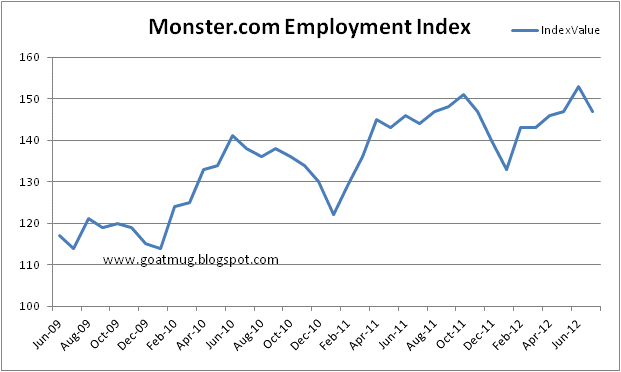
Employment continues to look better here in the US.  We have seen great momentum in agriculture, trade, and transportation areas along with retail.  Negative areas continue to be in public education, public administration, and food service and hotels.  Broadly speaking, jobs are out there and this is shown by the continued growth in online job listings available.  The Monster.com online job index shows that the number of available listings and postings continues to grow, although at a slower pace. MONSTER INDEX


USD TOO STRONG
A quick glance at the USD Index chart indicates that the USD has gone just a bit too far, too fast as it was recently at the top of the 2 standard deviation bollinger band.  Since mid July, that has corrected a bit and thus we've had a nice equity rally.  I think I still might continue to believe that markets will continue to try to believe in Draghi and the ECB's successful management of their crisis.  I do believe that Draghi is crazy smart and was so smart in his recent tact to dismiss concerns about Spanish long term bonds while crowing about the relatively low funding cost levels in the 2 year bonds.  This powerful David Copperfield-like distraction has worked well and I assume it will till it doesn't.  If it does for a bit more time, we'll see the USD Index fall to near $80.


TRADING OUTLOOK - ALL SYSTEMS GO FOR 1 MORE MONTH
In closing, I've laid out both sides of the near term arguments for a higher and lower market.  The US economy seems to be sliding along, but mostly due to a lack of clarity on policy and fiscal issues.  Elections do matter as well, but nothing matters as much as the September 7th German High Court ruling on the fate of the ECB's coordination to save the Euro.

Until September 7th, I do believe we'll see the market defy gravity and wander up simply because this market is one where absolutely 100% of the participants believe it is too high and due for a correction.

The bond market is usually the best indicator of big macro moves, but we know that each credit market is so distorted that real decisions cannot be made based on manipulated treasury rates, Lie-bor rates, and any spread that is derived from them.  Interestingly, I have noticed some odd activity in the corporate bond market in the last several days where new bond positions have appeared for sale at unusually high yields.  While I personally haven't been able to purchase them despite my best efforts, the fact that they are there for just a few minutes indicates to me that really smart money may be liquidating positions since yields are so low (smart money exiting).  While this has only happened 4 times so far this week, this is odd that the offer price was so low and I will continue to monitor these events.


GOATMUG
Goatmug is an investor that cares about you and your family. Goatmug's Blog - Financial Perspectives From The Mountain Top is a collection of thoughts on our economy and how it impacts the lives of investors and average people. While several specific investments are named in many of his posts, these articles are simply invitations for you to do your own research and reference to these securities does not constitute financial advice. Your situation is complex and unique and you should seek professional assistance with your trading and investing. Please visit Goatmug and share your comments athttp://www.goatmug.blogspot.com/

Tuesday, May 8, 2012

MAY MACRO UPDATE - LET'S GET TO THE END


THE NUMBER OF OUTCOMES ARE DIMINISHING
The good thing about time and uncertainty is that as time passes, uncertainty also usually fades away.  I have found this to be the case in so many areas of life, especially in dealing with the family situation I've been a part of for the last couple of months.  I typically like to have a good plan (guess) of what will happen and then I like to make small adjustments to the plan as reality unfolds.  I stress out when the number of variables are so large that I can't truly grasp what will ultimately happen.  As you get closer to specific dates or milestones, your choices tend to be reduced and your actions are often dictated by one or two choices rather than ten or eleven.  Oddly, that has been the scenario we've all been investing and trading in for the last several years.  Will we wake up with a "fat finger" flash crash event, will another big black swan hit the markets destroying what is left, will Europe's experiment with the Euro finally be ended?  Each day I've wondered how will these events happen and what will the resulting impact be on us.  The trouble with trying to really dig into these uncertainties from afar is you'll have so many unanswerable questions and scenarios that you'll drive yourself crazy attempting to create contingency plans.

Before I delve into the notion that our choices and investing outcomes are now becoming less complex, let's look at the Monthly Update and catch up on a few things going on in the macro-environment.

RAILS - http://railfax.transmatch.com/
Railroad traffic has continued its rebound after a collapse in late 2010 and early 2011.  The rate of change of growth has certainly slowed in 2012, but tonnage has been solid.  We can expect this kind of trend to continue if fuel prices continue to move higher as shippers will look for any alternative other than land based truck freight to save on transport.

Coal shipments and grains are falling but the fall in these is being offset by higher metal, auto, and construction supplies.  If the summer is as hot as last year coal may rebound as utilities require more of the dirty fuel to meet peak demands in the heat.


SCRAP - http://www.scrap.net/cgi-bin/composite_prices.cgi?id=100000&num=5
Nothing new is happening with scrap pricing as it continues to trade at the whim of inflation and the USD.  The scrap metal index has fallen some 15% since its peak in February 2011, but is still 13% higher than June of 2010.  Expectations of continued inflationary "heating" up are diminishing and therefore we should see scrap decline.  Uncle Alan Greenspan tracked this indicator as a measure of the health of an economy, and thus we'd suggest that it is in agreement with the idea that the US economy has cooled and probably will continue to do so.


REAL ESTATE - http://www.realtor.org/topics/existing-home-sales
Housing is fixed!  Housing is fixed!  Errr.... perhaps it isn't.  Below is a nice little graph that seems to indicate that housing just isn't quite fixed yet.  In fact, a brief look at this chart might lead us to believe that well see a spike in home prices over the summer, but the price surge will remain lower than the previous lower high, leading to another lower low.  I continue to believe that houses (personal homes) are not investments and that is going to be proved out more and more as homeowners come to grips with the reality that their single largest investment isn't a very good one.  On the other hand, rental houses bought cheaply with very little debt may be a wonderful investment as more and more individuals discover they just can't afford the American dream anymore as their income is eroded by the cost of living that isn't tracked in the CPI.


FINANCIAL CONDITIONS INDEX - http://www.bloomberg.com/quote/BFCIUS:IND
The Financial Conditions Index still signals a contraction in the economy.  Try as the Fed may with all of its liquidity storm and steroid pumped printing presses they still haven't been able to push the Financial Conditions Index into expansionary territory for more than a few weeks.  Does this indicate a collapse?  No, in fact we just may be sitting in this steady state of blah that reveals that the US economy is just not so good, and not so bad all at the same time.


EMPLOYMENT - MONSTER JOBS INDEX - http://www.about-monster.com/employment-index
Clearly the Monster.com Jobs Index is showing some good news.  The Jobs Index tracks the number of online ads the firm has and this gives us an idea of how well the employment situation is at a given time.  As the chart expresses, we are near a 3 year high for job placement ads and this is excellent.  This indicator highlights that employers are in fact looking for candidates.  It is also clear from other statistics that is is an awful time to be poorly educated and underscores the need for specialized training and higher education.  Remember, I rag on college education all of the time for being too expensive, but I never suggest that it isn't good, and some type of technical skill isn't required.  I simply am saying that people need to weigh and balance their expenditures on higher education with what they plan to actually do in life.

Apparently, the work from home gig is easy big money and awesome as I got 3 emails today suggesting that I can replace my income in just a few months by working at home.  Why the heck isn't the 8.1% of the US population out there that is still looking for a job not jumping on this easy money?


BALTIC DRY GOODS INDEX -http://www.bloomberg.com/quote/BDIY:IND
The Baltic Dry Goods Index is still low, but has recovered from its descent into the bowels of nothingness.  I think the best way to look at this index is through a much longer term lens than can be seen here on the 1 year chart below.  A longer view shows that the index went from 120,000 to less than 1,000 in about 3 year's time.  Essentially, the $BDI should hover here in this area until we see a sustained rebound in inflation in the emerging markets including China and also in the USA.


6 MONTH LIBORGraphs and Rates
I wanted to highlight two key things in posting the 6 Month USD Libor chart with the 6 Month Euribor rate below it.  Note that the 6 month rate for USD Libor is around 75 bps and this is near 1 year highs for this metric of "trust" between banks.  This rate climbed steadily after August of 2011 and has plateaued in January of 2012.  Essentially, we saw a rise in rates and frankly this was probably seen as healthy as US bond rates were beginning to rise as the US economy was perceived to be improving.


6 MONTH EURIBOR -
While the chart I've used here for 6 Month Euribor highlights a longer term perspective, yet in Euribor terms we see the a contraction in rates that I personally believe can only be attributed to government coordination (ECB, FED, IMF, etc) as the weakness of the PIIGS is getting more pervasive.  Extra-governmental organizations are doing everything they can to throw liquidity at a situation we all know is unmanageable in the longer term.


USD INDEX  -
Today's closing print of 79.84 for the USD Index brings it that much closer to breaking above the critical 80 level where it hasn't been for almost two years (there were a brief couple of months above, but nothing sustained.)  Is it fear that makes the dollar the haven when the other parts of the world seem to be coming unglued?  Is it just a lack of alternatives?  It is probably both of these as investors are now running away from the Euro and finding anything else that might be a safe haven in this storm.  If and when we see the USD Index move substantially over this key level, we'll know that a real firestorm has brewed overseas in Europe.


10 YR TREASURY - Marketwatch and Bloomberg
The charts below show the 10 year Treasury bond rates.  As of today's close we settled at 1.845%, which is well below the recent highs of 2.25% of just a few months ago when everything in the world was perfect.  Today, post Greek and French elections....not so perfect.  The incredible bull market in treasury bonds continues to defy all logic and as the PIIGS continue their slide and their bonds are shunned, US treasuries will be bought and once again we'll see TLT push to even higher highs.  It is so fashionable to call a top in treasuries, but until the US is perceived as "just as bad" rather than "less bad" then our easy funding will continue.


WHERE NEXT? - TRADING UPDATE
When markets were roaring it was very hard to find anyone that questioned the ability of US markets to rip higher.  Emerging markets also were able to rebound and the last 6 months prior to mid April were simply a dream of positive performance.  Jobs data as contrived as it is with BLS manipulation seemed stronger and stronger, consumer spending had no limits, and manufacturing just continued to improve.  With the passage of a week or two, suddenly the world seems a bit dimmer and there is risk everywhere.  Could it just be a few pieces of slowing Chinese data?  Is it really word of another Spanish bank bailout?  Do elections in Greece and France really matter at all?  The answer of course is yes, and all of these things have come together in one instance to conspire against a run at all time highs in domestic equity markets.  Will the negative news prevail?  Perhaps.... and perhaps not.

On the horizon in coming weeks, we have the Facebook IPO that should wow us all and excite the trading bots a few hundred million times in the first second or so of trading.  We should also hear if the anti-austerity left in Greece is able to actual form a government.

GOLD & SILVER & OTHER METALS
Unless and until we see Chinese inflation, all bets are off on the shiny stuff.  Silver and gold could endure some serious technical damage as they continue to slide.  One strange thing we are not seeing though is a swarm by European holders of cash to buy gold as an anti-currency move.  I can only guess that we are not seeing a "Euro-collapse, buy gold response" because everyone has already hunkered down and has already diversified as much as they can into physical assets.

I personally will pick up another few ounces of gold and more silver if we near $1,400 and $26.00.

OIL, GASOLINE, AND NATURAL GAS
As long as we don't have a Middle East eruption involving Israel and Iran, we should see oil continue to fall.  Along with the slide in oil, I've suggested that May 1st was a good time to exit gasoline related trades, and that would have been a very nice exit.  Oddly, natural gas may actually be a bullish play here as we are now finally starting to hear about production being shut in.  The last couple of weeks have actually seen natural gas go higher, which is frankly very strange indeed!  NO, YOU MAY NOT BUY UNG, IT IS A PIECE OF SH$T!!! (Sorry to be profane, but I knew what you were thinking!)

IS THERE A REASON TO NOT COUNT EQUITIES OUT?
If US GDP is leveling off or falling and global investing insecurity is rising, why or how could equities still be a place to invest given that I've said for six months that you should exit in May and stay away?  Well, frankly, getting out then would have been a great strategy and if you are disciplined and have been long and in the market, then you have done well and you might consider it.  If you are one of those long only guys that hates the idea of sitting in cash even when markets are falling, then I'm talking to you!

Again, I need to emphasize that I write this because I know that some of you will demand to stay long rather than exit or even short the market.  As a result, your play here is centered on the "relative performance" aspect of fund managers as we've discussed over time.  In the past we've discussed how defensive times require you to consider utilities, healthcare, consumer staples, and defense sectors. Any continued fall in markets and a perceived overall weakness in the domestic economy will cause fund managers to rebalance and overweight these sectors.  Of course these are all dividend paying types of firms and this too will entice investors to hide here in a  relative yield search.  Essentially treasuries and corporate bonds are so overbought and expensive, new money purchasing these bonds earn you less yield than the purchase of the dividend paying company equity.  Money managers look at this risk/reward trade off and often will lean to the equity saying that it is cheap relative to the credit.  Since investors have piled out of the rigged casino....errrr stock market, they have looked to corporate bonds and have bid them up so high, stocks may be cheap.

Other institutional investors also will suggest that earnings have been great (compared to lowered analyst expectations of course) and also that the US consumer is going wild and is unstoppable, thus the spending data supports that notion that the US economy is not going to derail.

All of those positive items may be reason to support the stock market as we've said, the economy isn't the market and the market isn't the economy, so anything is possible especially when you have the threat of a round of QE loaded in the 3-barrel QE FED shotgun.  I think the key risk here is that even if you are picking up a 3% yield in your stock, you have the risk of giving up a tremendous amount of gains you've earned and could risk a part of your initial investment.  A good stock to look at to examine this action is CAT.  This stock is one I've liked for a long time and yet all of the gains earned in this name could be in danger if you still are holding it.  A friend of mine did not sell it when I advocated letting it go near $110, I think we both wish he'd had been willing to just hold cash.


REDUCING POTENTIAL OUTCOMES
I am excited to see what the coming week brings.  We are nearing a point in the Euro experiment where countries are at the tipping point and citizens have realized, really realized that "global citizen" bankers, politicians, and billionaires, are men and women without honor, without country, and allegiance to only the elite firms that provide them power.  The people of these countries are beginning to embrace nationalism rather than globalism as the deception of a global village and Euro unity has left them poorer and without industry, saddled  with unpayable debt.  As we get clarity on the direction of new governments in France and Greece we'll see that the number of outcomes reduced and be able to invest accordingly.  Until then, I'm sure that we'll see new and more emergency liquidity from every side of the pond

The coming events will serve to essentially make our investment decisions binary in the sense that we can trade according to the assumption that the Euro survives or doesn't.  If Greece exits, surely it will lead to an exodus by Spain and Portugal at least.  Clearly those economies will suffer for at least a couple of years if the global financial system can survive.  While I can imagine many other scenarios about a global financial meltdown and even potentially a stronger Euro after a big fall, the easy trade frankly is that the USD will be much stronger in the short run relative to the Euro.  That strong dollar leads to other plays like a continued short on gold, silver, and oil.  Further justification is found in the lack of strong Chinese data suggesting that global inflation is down and almost out in this round.  


GOATMUG

Goatmug is an investor that cares about you and your family. Goatmug's Blog - Financial Perspectives From The Mountain Top is a collection of thoughts on our economy and how it impacts the lives of investors and average people. While several specific investments are named in many of his posts, these articles are simply invitations for you to do your own research and reference to these securities does not constitute financial advice. Your situation is complex and unique and you should seek professional assistance with your trading and investing. Please visit Goatmug and share your comments at http://www.goatmug.blogspot.com/

Friday, January 20, 2012

THE 3 PILLARS OF THE FED MANDATE


I almost fell out of my chair today at lunch as I scanned Bloomberg's news stories.  There in not-so-black -and-white stood the statement that completely summarized all of the issues that America has with Wall Street and its crazy view of the world.  There, plainly for all to see, one statement characterizes why the last two years of my blogging has been therapy in a way.  This sentence captures the essence of why Main Street will never get Wall Street, and why Wall Street won't be happy until the entire nation's financial system is completely destroyed.

WE NEED MORE POWER!
In an interview this morning with Bloomberg Surveillance, Tom Keene spoke with Ira Jersey of Credit Suisse Group.  In the discussion, Ira gives us his view that more quantitative easing is needed and more liquidity should be spent to stimulate the economy.  Mr. Jersey starts with;

"The policy-making Federal Open Market Committee meets Jan. 24-25. The central bank is forecast to keep its target for the federal funds rate at zero to 0.25 percent. The target has been at that level since December 2008 and the Fed has pledge to keep it there until mid-2013. 
The central bank has purchased $2.3 trillion of mortgage and government bonds in two rounds of so-called QE. In September, it announced plans to sell $400 billion of short-term debt and use the proceeds to buy an equal amount of longer- maturity securities, in a program as nicknamed Operation Twist after a similar action in 1961 designed to contain borrowing costs for companies and consumers."
“We do think the Fed is going to do another round of asset purchases later in the quarter, probably aiming for April,” Jersey, director of U.S. rates strategy at Credit Suisse" 

ALL IS FIXED, LEAVE IT ALONE?
Ok, so we are told daily on CNBC that jobs are getting better,  housing is improving, banking is returning to normal and banks are healthier, inflation is under control,  foreclosures are abating, and the consumer is out there spending and adding to his revolving debt.  How could we possibly need more QE?

Well, if you are a Main Streeter, perhaps all of those positive things would lead you to conclude that while the economy is not fully recovered, it is on its way and the government and Fed should wait and see how things are going and maintain the status quo for a while.  You'd probably think that allowing market forces to take over might be a good thing.  While you might feel that way, bankers don't exactly see it the way you do.

"Jersey said a third stimulus effort may be more focused toward the housing market and buying mortgage-backed securities. 
A Bloomberg news survey conducted in November found 16 of the 21 primary dealers of U.S. government securities said Fed Chairman Ben Bernanke and his fellow policy makers would start another purchasing program during the first half of 2012. The dealers’ estimated that the Fed may buy about $545 billion in home-loan debt. 
“We need to get confidence up, in particular business confidence up,” Jersey said. “That would help stimulate jobs, which helps stimulate the residential housing market, and that’s what gets you out of the doldrums.”  

HOUSING, HOUSING, HOUSING IS NOT OK
So, we need to get the business confidence up and that will fix housing and everything else.  Why the heck didn't I think of that? Have you noticed that everything comes back to these housing values?  If I didn't know any better, I'd almost suspect that banker's balance sheets could somehow still be impaired after all this time.  Mr. Jersey believe that the Fed will act to drive mortgage rates even lower and somehow this will get economic activity really fired up.

WHERE IS HE GOING WITH ALL OF THIS AND HOW DOES IT RELATE TO THE FED?

Mr. Jersey casually drops this bomb on us, which is frankly just awe-inspiring.
“We are growing, we just don’t feel prosperous. It is a part of the job of the Fed to assure prosperity, one of the ways to do that is to kick- start housing.”

WHAT??  THE 3RD LEG OF THE FED STOOL
Did Ira Jersey just say what I thought he said?  Of course he did.  Didn't you know that there was a 3rd mandate of the Fed?

First, we want to maximize employment, second, we want to maintain price stability and NOW, Credit Suisse has added that we need to expect the Fed to make us feel prosperous!! It is so nice to know after all of my years in the markets that I had completely left one of the Fed's mandates out!

Clearly this interview reveals the divide between Wall Street bankers and normal people.  We want the Fed to just stop, and the bankers just want the Fed to make them happy.  Unfortunately we also know that the only thing that makes bankers happy is a predatory economic attack on our wealth and our savings (sort of like the government too eh?).  Somehow I think regular people don't have a chance in this fight.

Finally, if you want to read some old speeches about the Fed mandate, how about this gem from another Fed Governor who helped do "research" that helped collapse a Euro nation a couple of years ago. - MONETARY POLICY & THE DUAL MANDATE - Fred Mishkin


GOATMUG

Goatmug is an investor that cares about you and your family. Goatmug's Blog - Financial Perspectives From The Mountain Top is a collection of thoughts on our economy and how it impacts the lives of investors and average people. While several specific investments are named in many of his posts, these articles are simply invitations for you to do your own research and reference to these securities does not constitute financial advice. Your situation is complex and unique and you should seek professional assistance with your trading and investing. Please visit Goatmug and share your comments at http://www.goatmug.blogspot.com/

Wednesday, June 15, 2011

WHEN SOFT PATCHES BECOME HARD LANDINGS - JUNE MACRO UPDATE

JUNE MACRO UPDATE -
I am back to publishing the macro update in one huge post again.  I found that trying to break it up might be good for web-traffic rankings, but doesn't do much for continuity and simply getting it done.  In fact, last month, I posted only half of the data.  To simplify life for readers and myself, I'll just post the whole enchilada here.  If there is too much, simply scan the pretty charts.  If you desire more detail or Goatmug's take on the data, simply read the fluff. 

RAILS - http://railfax.transmatch.com/

Rail traffic in the US continues to push higher in year-over-year comparisons.  We did see coal shipments under perform last year during this week.  So far year to date, only food tonnage is down from last year at this time.


TOTAL RAILS
We continue to see the improvement over last year's shipments, while the economy has encountered a "slow patch" it will be important to follow the trend to see if we see a further regression toward last year's totals.


CP - Regular readers know that I often examine individual rail company delivery statistics to try to catch an edge on short term trades, especially to identify outpeformers and poor performers.  Canadian Pacific continues to be a laggard that I'm watching.  It appears as though railfax had some data issues because we don't see the chart populated for the last several weeks, despite that, I don't see much change in the information from other sources.


UNP is barely exceeding last year's hauling numbers so I thought it would be one to put on our radar.  It is also notable that the only other rail that is showing negative y-o-y shipping totals is Ferromex which UNP owns a 26% stake in.  Don't pull the trigger on this one, just add it to your watch list as a potential short.


THE RECESSION INDICATORS - CRUSHED STONE AND CHEMICALS
Railfax continues to tinker with the information they provide and in fact are toying with the idea of limiting much of their data (boooo!).  In the last couple of years we saw shipping information on autos, scrap metal, and timber, but this month we are back to Crushed Stone and a new one, Chemicals.  Both of these metrics are good for gauging economic health.  Crushed stone is used in the commercial real estate areas and obviously chemicals are used in manufacturing, agricultural, and energy applications.  There is nothing shocking to report here.


MOODY'S/MIT TRANSACTION BASED INDEX - http://web.mit.edu/cre/research/credl/rca.html
If the Crushed Stone data didn't give us a tip off, the MIT Transaction Based Index sure will.  Once again the index is showing that real commercial real estate transactions are losing ground and seller's positions are weakening.  We note here that there was a 4.23% decline in March in the value of deals getting done.


MONSTER.COM EMPLOYMENT INDEX - http://about-monster.com/employment-index
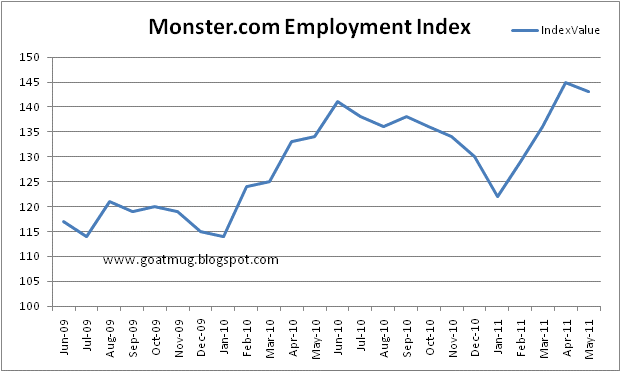
It all can't be bad right?  Despite the poor jobs reports, Monster Worldwide is showing some pretty positive numbers in terms of the number of job listings on Monster.com.  May dipped a little, but clearly April and May indicated that job listings are a a higher point than they have been for almost two years.  I'm generally pretty skeptical and negative about this economy, but this is a good sign.


NAR - EXISTING HOME SALE PRICES - http://www.realtor.org/research/research/ehsdata
The average home price is finally moving up and we'll call this a trend.  Yes, of course in some parts of the nation things are nasty, but overall we are seeing a pick up in the average home price.  Pricing is still at levels that are equal to the "pits of hell" of late 2009, but at least we're heading higher.  The recent drop in the stock market and resulting bid for treasuries may actually be a boon for housing data as mortgages rates are falling.  Now, the only trick will be for those scrappy realtors to find quality buyers to scoop up all those deals!  (I've had two conversations this week already with home sellers and realtors that have lamented about the inability of folks to actually borrow).


ECRI - http://www.businesscycle.com/resources/
I've decided to put the ECRI data back into the monthly packet, but have avoided populating my own graphs.  I'll simply highlight their information here about the trends in home prices, and while real home prices continue to dip, leading indicators for home pricing seem to show that there is some rebound happening.  This is of course backed up by the NAR data, which makes me feel better about the NAR data, because we've already seen that NAR economists are essentially an arm of the realtor marketing alliance.  They would never, ever, ever, come out and say that it wasn't a good time to buy, would they?  The area I live in has been totally insulated from much of the drop, so I feel like I live in some alternate reality where everyone I meet can afford a home that costs $1 million and more importantly can afford the $3,000 a month in property taxes that comes along with that house payment.  In that price range, things have been fine in my town, but clearly other parts of the US have not been shielded by such fortune.


In addition, we find the ECRI Weekly Leading Index information showing a downturn for the fourth consecutive week. I think this is one data set that has the market spooked and this is really why I brought this back out.  The "rate of change" is indicating that the "green shoots" are turning yellow and are wilting. 


SCRAP METAL - http://www.scrap.net/cgi-bin/composite_prices.cgi?id=100000&num=5
Good old Alan Greenspan used scrap metal as a bell weather for the economy's health, however perhaps we should say he used it for a measure of the health of a bubble.  If it's good enough for Uncle Al, it's good enough for the Goat!  Scrap prices hit the skids since peaking in February.  While the composite index has tried to build a base over the last two readings I am not sure that the downward trend has abated.  Frankly, base metal prices and all commodity prices have been under attack since Ben Bernanke's declaration that commodity price inflation is "transitory", so the correction is not surprising.  It is in the economy's best interest to see commodity input prices fall and relieve some of the stagflationary risks we are faced with presently.


UCLA / CERIDIAN FUEL INDEX - http://www.ceridianindex.com/
I find the Ceridian / UCLA Fuel Index study full of information, however I despise that it offers this data with a two month lag.  As I've often reminded visitors to the blog, this piece of data is great for confirming direction and slowdowns that have occurred in long term trends, we just have to deal with the dated data.  The PCI (fuel index) seems to have peaked in March and turned downward.  This study is so great because the PCI (fuel index) consists of real time (errr not so real time for us) data from commercial trucks.  Each time they fill up, they transmit the amount of fuel they consume.  This information gives us a powerful view into the real transportation activity and health in the nation's economy.


Despite all of the tremors related to Greek insolvency and all of the undeniable issues with the PIIGS, we see that 6 month Euribor is just under 1.75%.  Remember the amazing days when interest rates had a 3% handle on them?  Rates have been climbing over the last couple of month and are up almost 65% since last September.
In contrast to those really expensive 1.75% Euribor rates, we see that the 6 Month USD Libor rate is  down to an eye-popping .40%.  Unlike our friends across the pond, our rates have about 15% since last September.  Obviously "one of these pledges is not like the other".  The divergence between the two sets of rates continues to illuminate how differently our central bankers have attacked these problems.  Their leadership has attempted some sort of fiscal control and monetary restraint in an effort to actually begin steps toward normalcy, our guys have thrown caution to the wind and jammed rates lower and lower and lower. 

I always find that Bloomberg's US Financial Conditions Index is one of my favorites.  Yes, it has it's flaws especially since it is driven by liquidity flows and stock market gyrations, but despite that, it seems to tell the truth quite often.  Over the last month, we've seen a total meltdown in the FinCon Index and it has steered itself toward a sub-zero reading.  Anything below zero is a recession, while numbers above also indicate that there is growth.  We are in that no-man's land area where we can't say one way or another where we'll end up, but if we are growing, it isn't overwhelming, that is for sure.
In a valiant effort, the Baltic Dry Goods Index has battled through May to just under 1400 again, where it looks as though it may drop.


The USD has risen a point or so against an incredibly bad chart.  The buck is in a make it or break it position here, and if it doesn't hold these critical support levels, we'll see commodities off to the races with $140 oil within striking distance.  As we've discussed many times, the devaluation of the USD must be thought of as a dance, something that is choreographed and one that has a rhythm.  Our leadership simply couldn't "crash" the dollar, they have to walk it down gently or else the entire scheme would fall apart very quickly. 

LONG TERM VIEW OF USD -
If you had any doubt that your purchasing power had eroded, look now further than this graph to clearly understand what Alan Greenspan and Ben Bernanke have done to your dollar, business, family, and lifestyle.  In order to support bubble after bubble and keep interest rates artificially low, they have purposefully crushed the value of your currency.  Isn't paper money great?


COPPOCK TURN INDICATOR -
I've been keeping this one around for entertainment purposes only.  As if right on queue as soon as the Coppock signaled a reversal and gave a buy signal, all hell broke lose!  Interestingly, if the Dow Jones stays under 12,350 it will signal a SELL.  Perhaps the indicator will redeem itself after all.  Please note, according to Coppock rules, it is still in a BUY till the end of the month as these are monthly data inputs.


WHERE SOFT PATCHES BECOME HARD LANDINGS
William Dudley, NY Fed Governor said  recently that "Despite our recent soft patch, economic conditions have improved over the last year."  Typically Dudley, Yellen, and Bernanke are the only 3 Fed bankers that you need to pay attention to, because they are the driving force behind the Fed.  As you might expect, they usually support the same positions and don't ever go "off the reservation" like some of the other guys.  As many of you know, I believe the "other guys" are simply there to make it seem like there are honest discussions occurring at the Fed, when in reality all the other players matter little.

As I mentioned though, Dudley is one of the guys that matter, so I often make sure to read and re-read his statements because they are another read into Bernanke's views.  In fact, they often use the same words and language to describe our economy and its challenges.  In this case, Dudley gives us more of the reasoning behind the famous "commodity price inflation is transitory" because he lays out that our weakness in the economy is due to several key issues.  He states that rising commodity prices, the Japanese earthquake, and severe weather are passing issues.  Dudley goes further, just like Ben Bernanke and highlights that they can have faith in their notion that inflation is transitory because long-term inflation expectations are stable, BUT what is even more illuminating is that he says that these levels are now elevated and it does have the Fed concerned.  This is much less confident of a statement than what we heard from the Chairman in April. 

This is the rub.  The Fed still believes that it is in control of the situation despite the fact that it is having funding issues, has tremendous balance sheet risk when interest rates rise, and is backed further into a corner when commodity prices rise.  No wonder why we are seeing them impress upon us how small inflation is, how temporary it is, and how it really isn't anything to worry about.  These comments are part of the PR campaign to make expectations a reality. 

The problem with this "soft patch" is that many of the important metrics we are watching are still falling and weakening.  If the continued weakening persists and they can't force oil, gas, softs, and other commodities lower to kill longer term inflation expectations they'll be at risk for driving us off a cliff.  We've noted many times before that each basis point of interest rates cost us taxpayers billions, and this doesn't include all of the bad execution on treasuries we've bought at less than best prices.  If this soft patch gets any worse, we'll certainly be in for a hard landing.

TRADING UPDATE
I have continued to hammer home the idea that we've lived through this before.  We've endured the issues with falling economic metrics, a weak stock market, and political threats to collapse the financial world if the debt ceiling isn't raised.  Couple that in with a few legitimate jitters over the status of the Greek bailout and you have a perfect storm for trading challenges.  The question is really though, can the markets deal with it and still go higher?

Here are specific plays to think about over the next few weeks as you position your portfolio.

SECTOR ROTATION TRADES
Look, about 80% or more of professional money managers must be fully invested all the time.  As they perceive areas like energy and industrials to be more risky, they need to rotate out to the next thing.  In the sector rotation model I posted a couple of days ago we find that Consumer Staples, Defense, Utilities, and Healthcare are all part of that next step in the process.  I personally love cash, so I view these trades differently, as usual we need to know the game that is being played by portfolio managers that are trying to beat the index.  The gamble is that these defensives will lose less or outperform the risky stuff, therefore they can incrementally beat their benchmark and get paid their bonus.  We on the other hand have cash as an option, I'd use it too.

PPA (Defense)
XLV (Healthcare)
XLP (Consumer Staples)
XLU (Utilities)
Oh yes, I'm short a few technology names in anticipation of the rotation out and a slow down.  I'll highlight a few of these in other posts where I can give more specifics.

EUROPEAN COLLAPSE TRADES
GLD or physical gold would be the answer here.  Everyone knows this will be the final outcome, no one wants to end up holding the bag.

SUMMER DRIVING SEASON AND MORE MIDDLE EAST UNREST
Gasoline has continued to be a tough trade that has been very volatile.  I have closed this trade, but there is still a good potential for a move higher, one little hurricane in the Gulf of Mexico would move this solidly higher.

COLLAPSE OF THE DOLLAR TRADE (DEBT CEILING ISSUES)
EMLC - I like this play here, it is an etf constructed of sovereign and foreign debt in the local currency of the issuers.  If Bernanke is able to slide the value of the dollar  lower, you will gain in the currency play as well as the yields associated with these foreign bonds.

Physical gold or silver and GLD if you like fake paper stuff.  My view on silver and gold is oddly different here, I am a long term holder, therefore this is NOT a quick hit trade like I usually focus on.  Silver could easily test $32, but I still have a very large position in physical silver and it isn't going anywhere.  Who knows, I may need to kill an intruder with a 40lb brick of silver if we go Mad Max anytime soon.

That's it for the monthly update, I'll do more in the coming days about specific trades mentioned here and also reveal other positions that I have on now.

GOATMUG

Goatmug is an investor that cares about you and your family. Goatmug's Blog - Financial Perspectives From The Mountain Top is a collection of thoughts on our economy and how it impacts the lives of investors and average people. While several specific investments are named in many of his posts, these articles are simply invitations for you to do your own research and reference to these securities does not constitute financial advice. Your situation is complex and unique and you should seek professional assistance with your trading and investing. Please visit Goatmug and share your comments at www.goatmug.blogspot.com .