Friday, June 17, 2011

LINES IN THE SAND

I've been doing some unusual posts of late and I'm extremely busy.  I've done a lot of looking at charts and I am going to share them with you.  These are positions I've owned for a very long time and have done well in my long term account with.  These are all plays that I've mentioned over the last two years.  Each of them (with the exception of the last 4) look very similar.  I've indicated ones that I actually sold this week, but also have indicated my levels for stops if I still have them.  I don't have time for any commentary on any of them, check out the charts and look at the stop levels, if the stock or eft is below that level, then I'm probably out.

As you know, I expect some sort of resolution to the Greek issue because the ECB cannot let that fail.  We will or should get some relief rally, but I think the bond market will immediately attack Italy, Spain, Portugal, and Ireland again, and we'll reface this same scenario and it will really hurt the prospects in the market till late summer or early September when we have some sort of new stimulus.

By the way, the short on RIMM that I've held on and off for a very long time (since mention on April 5th) has worked nicely.  I'm out of that trade now.  http://goatmug.blogspot.com/2011/04/apple-resting-or-shift-in-play.html


XLE (ENERGY)
Stop $71.45


EWZ - BRAZIL
($71.45 - Sell)

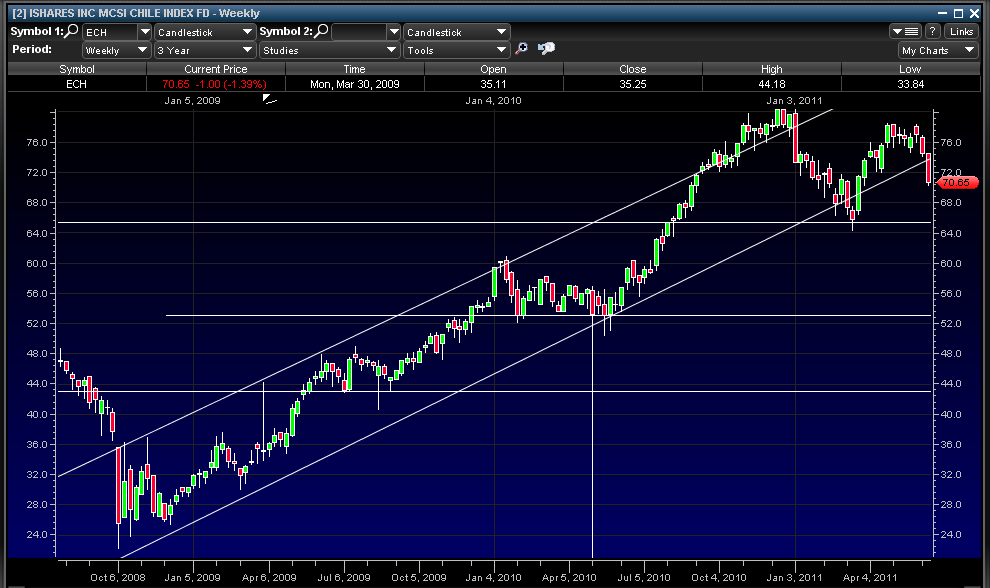
ECH - CHILE
$73.62 - SELL

EWC - CANADA
$30.25

EWM - $14.12

XLI - INDUSTRIALS
$35.75

VLO
$24

UGA - GASOLINE
$48


DBC - COMMODITIES
$28.40

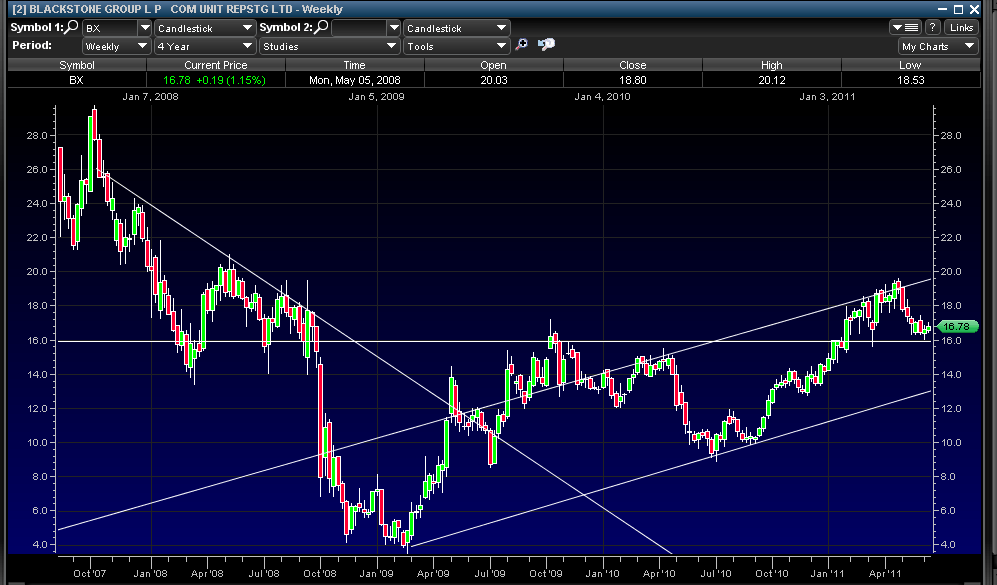
BX -  BLACKSTONE 
$16


DEFENSIVE THEMES - NOT SELLING HERE
XLU - UTILITIES
$30.75


PPA - DEFENSE
$17.50


XLV - HEALTH CARE
$31.66


XLP - CONSUMER STAPLES
$28.80
 
 
That's it, no more commentary than that.  Be careful and blow out of positions that could crush you.  Chances are we get a relief rally this weekend, but it will be short lived and that will be the chance to unload positions that you don't want to have for a long time at lower prices.
 
Please check out the blog at http://www.goatmug.blogspot.com/ I'm got some good things cooking for the weekend.
 
Goatmug is an investor that cares about you and your family. Goatmug's Blog - Financial Perspectives From The Mountain Top is a collection of thoughts on our economy and how it impacts the lives of investors and average people. While several specific investments are named in many of his posts, these articles are simply invitations for you to do your own research and reference to these securities does not constitute financial advice. Your situation is complex and unique and you should seek professional assistance with your trading and investing. Please visit Goatmug and share your comments at www.goatmug.blogspot.com.

Wednesday, June 15, 2011

TIME FOR A RESPONSE

WHAT CAN WE DO?
While this post is somewhat off topic in terms of economics, I find it noteworthy that many will only turn to God when they are enduring such hardship and pain that they are forced to cry out for help from above.  We are currently living in times where people are without hope and looking for anyone or anything that can assist them.  It is obvious that our political leaders do not have the answers and its even true that regular folks don't have the answers.  My personal view is that only Jesus is willing and able to save us (spiritually and physically).

THE RESPONSE

On August 6th from 10 AM to 5 PM Christians from the nation and the world will gather together to respond to a call to fall at the feet of Jesus fast and repent, exalt His name, and worship the risen Lord.  Please watch the video and click the links below for more information.


The Response Promo from The Response USA on Vimeo.


http://theresponseusa.com/

If you plan on attending, contact me via email and let me know, I am planning on going to Texas for the event.  If you have questions about Jesus, prayer, or fasting, please contact me as well.

GOATMUG

WHEN SOFT PATCHES BECOME HARD LANDINGS - JUNE MACRO UPDATE

JUNE MACRO UPDATE -
I am back to publishing the macro update in one huge post again.  I found that trying to break it up might be good for web-traffic rankings, but doesn't do much for continuity and simply getting it done.  In fact, last month, I posted only half of the data.  To simplify life for readers and myself, I'll just post the whole enchilada here.  If there is too much, simply scan the pretty charts.  If you desire more detail or Goatmug's take on the data, simply read the fluff. 

RAILS - http://railfax.transmatch.com/

Rail traffic in the US continues to push higher in year-over-year comparisons.  We did see coal shipments under perform last year during this week.  So far year to date, only food tonnage is down from last year at this time.


TOTAL RAILS
We continue to see the improvement over last year's shipments, while the economy has encountered a "slow patch" it will be important to follow the trend to see if we see a further regression toward last year's totals.


CP - Regular readers know that I often examine individual rail company delivery statistics to try to catch an edge on short term trades, especially to identify outpeformers and poor performers.  Canadian Pacific continues to be a laggard that I'm watching.  It appears as though railfax had some data issues because we don't see the chart populated for the last several weeks, despite that, I don't see much change in the information from other sources.


UNP is barely exceeding last year's hauling numbers so I thought it would be one to put on our radar.  It is also notable that the only other rail that is showing negative y-o-y shipping totals is Ferromex which UNP owns a 26% stake in.  Don't pull the trigger on this one, just add it to your watch list as a potential short.


THE RECESSION INDICATORS - CRUSHED STONE AND CHEMICALS
Railfax continues to tinker with the information they provide and in fact are toying with the idea of limiting much of their data (boooo!).  In the last couple of years we saw shipping information on autos, scrap metal, and timber, but this month we are back to Crushed Stone and a new one, Chemicals.  Both of these metrics are good for gauging economic health.  Crushed stone is used in the commercial real estate areas and obviously chemicals are used in manufacturing, agricultural, and energy applications.  There is nothing shocking to report here.


MOODY'S/MIT TRANSACTION BASED INDEX - http://web.mit.edu/cre/research/credl/rca.html
If the Crushed Stone data didn't give us a tip off, the MIT Transaction Based Index sure will.  Once again the index is showing that real commercial real estate transactions are losing ground and seller's positions are weakening.  We note here that there was a 4.23% decline in March in the value of deals getting done.


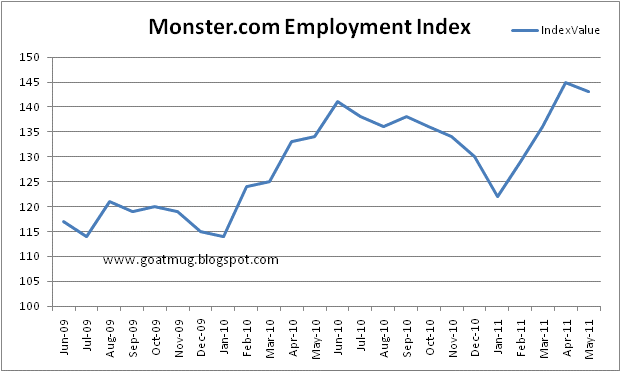
MONSTER.COM EMPLOYMENT INDEX - http://about-monster.com/employment-index
It all can't be bad right?  Despite the poor jobs reports, Monster Worldwide is showing some pretty positive numbers in terms of the number of job listings on Monster.com.  May dipped a little, but clearly April and May indicated that job listings are a a higher point than they have been for almost two years.  I'm generally pretty skeptical and negative about this economy, but this is a good sign.


NAR - EXISTING HOME SALE PRICES - http://www.realtor.org/research/research/ehsdata
The average home price is finally moving up and we'll call this a trend.  Yes, of course in some parts of the nation things are nasty, but overall we are seeing a pick up in the average home price.  Pricing is still at levels that are equal to the "pits of hell" of late 2009, but at least we're heading higher.  The recent drop in the stock market and resulting bid for treasuries may actually be a boon for housing data as mortgages rates are falling.  Now, the only trick will be for those scrappy realtors to find quality buyers to scoop up all those deals!  (I've had two conversations this week already with home sellers and realtors that have lamented about the inability of folks to actually borrow).


ECRI - http://www.businesscycle.com/resources/
I've decided to put the ECRI data back into the monthly packet, but have avoided populating my own graphs.  I'll simply highlight their information here about the trends in home prices, and while real home prices continue to dip, leading indicators for home pricing seem to show that there is some rebound happening.  This is of course backed up by the NAR data, which makes me feel better about the NAR data, because we've already seen that NAR economists are essentially an arm of the realtor marketing alliance.  They would never, ever, ever, come out and say that it wasn't a good time to buy, would they?  The area I live in has been totally insulated from much of the drop, so I feel like I live in some alternate reality where everyone I meet can afford a home that costs $1 million and more importantly can afford the $3,000 a month in property taxes that comes along with that house payment.  In that price range, things have been fine in my town, but clearly other parts of the US have not been shielded by such fortune.


In addition, we find the ECRI Weekly Leading Index information showing a downturn for the fourth consecutive week. I think this is one data set that has the market spooked and this is really why I brought this back out.  The "rate of change" is indicating that the "green shoots" are turning yellow and are wilting. 


SCRAP METAL - http://www.scrap.net/cgi-bin/composite_prices.cgi?id=100000&num=5
Good old Alan Greenspan used scrap metal as a bell weather for the economy's health, however perhaps we should say he used it for a measure of the health of a bubble.  If it's good enough for Uncle Al, it's good enough for the Goat!  Scrap prices hit the skids since peaking in February.  While the composite index has tried to build a base over the last two readings I am not sure that the downward trend has abated.  Frankly, base metal prices and all commodity prices have been under attack since Ben Bernanke's declaration that commodity price inflation is "transitory", so the correction is not surprising.  It is in the economy's best interest to see commodity input prices fall and relieve some of the stagflationary risks we are faced with presently.


UCLA / CERIDIAN FUEL INDEX - http://www.ceridianindex.com/
I find the Ceridian / UCLA Fuel Index study full of information, however I despise that it offers this data with a two month lag.  As I've often reminded visitors to the blog, this piece of data is great for confirming direction and slowdowns that have occurred in long term trends, we just have to deal with the dated data.  The PCI (fuel index) seems to have peaked in March and turned downward.  This study is so great because the PCI (fuel index) consists of real time (errr not so real time for us) data from commercial trucks.  Each time they fill up, they transmit the amount of fuel they consume.  This information gives us a powerful view into the real transportation activity and health in the nation's economy.


Despite all of the tremors related to Greek insolvency and all of the undeniable issues with the PIIGS, we see that 6 month Euribor is just under 1.75%.  Remember the amazing days when interest rates had a 3% handle on them?  Rates have been climbing over the last couple of month and are up almost 65% since last September.
In contrast to those really expensive 1.75% Euribor rates, we see that the 6 Month USD Libor rate is  down to an eye-popping .40%.  Unlike our friends across the pond, our rates have about 15% since last September.  Obviously "one of these pledges is not like the other".  The divergence between the two sets of rates continues to illuminate how differently our central bankers have attacked these problems.  Their leadership has attempted some sort of fiscal control and monetary restraint in an effort to actually begin steps toward normalcy, our guys have thrown caution to the wind and jammed rates lower and lower and lower. 

I always find that Bloomberg's US Financial Conditions Index is one of my favorites.  Yes, it has it's flaws especially since it is driven by liquidity flows and stock market gyrations, but despite that, it seems to tell the truth quite often.  Over the last month, we've seen a total meltdown in the FinCon Index and it has steered itself toward a sub-zero reading.  Anything below zero is a recession, while numbers above also indicate that there is growth.  We are in that no-man's land area where we can't say one way or another where we'll end up, but if we are growing, it isn't overwhelming, that is for sure.
In a valiant effort, the Baltic Dry Goods Index has battled through May to just under 1400 again, where it looks as though it may drop.


The USD has risen a point or so against an incredibly bad chart.  The buck is in a make it or break it position here, and if it doesn't hold these critical support levels, we'll see commodities off to the races with $140 oil within striking distance.  As we've discussed many times, the devaluation of the USD must be thought of as a dance, something that is choreographed and one that has a rhythm.  Our leadership simply couldn't "crash" the dollar, they have to walk it down gently or else the entire scheme would fall apart very quickly. 

LONG TERM VIEW OF USD -
If you had any doubt that your purchasing power had eroded, look now further than this graph to clearly understand what Alan Greenspan and Ben Bernanke have done to your dollar, business, family, and lifestyle.  In order to support bubble after bubble and keep interest rates artificially low, they have purposefully crushed the value of your currency.  Isn't paper money great?


COPPOCK TURN INDICATOR -
I've been keeping this one around for entertainment purposes only.  As if right on queue as soon as the Coppock signaled a reversal and gave a buy signal, all hell broke lose!  Interestingly, if the Dow Jones stays under 12,350 it will signal a SELL.  Perhaps the indicator will redeem itself after all.  Please note, according to Coppock rules, it is still in a BUY till the end of the month as these are monthly data inputs.


WHERE SOFT PATCHES BECOME HARD LANDINGS
William Dudley, NY Fed Governor said  recently that "Despite our recent soft patch, economic conditions have improved over the last year."  Typically Dudley, Yellen, and Bernanke are the only 3 Fed bankers that you need to pay attention to, because they are the driving force behind the Fed.  As you might expect, they usually support the same positions and don't ever go "off the reservation" like some of the other guys.  As many of you know, I believe the "other guys" are simply there to make it seem like there are honest discussions occurring at the Fed, when in reality all the other players matter little.

As I mentioned though, Dudley is one of the guys that matter, so I often make sure to read and re-read his statements because they are another read into Bernanke's views.  In fact, they often use the same words and language to describe our economy and its challenges.  In this case, Dudley gives us more of the reasoning behind the famous "commodity price inflation is transitory" because he lays out that our weakness in the economy is due to several key issues.  He states that rising commodity prices, the Japanese earthquake, and severe weather are passing issues.  Dudley goes further, just like Ben Bernanke and highlights that they can have faith in their notion that inflation is transitory because long-term inflation expectations are stable, BUT what is even more illuminating is that he says that these levels are now elevated and it does have the Fed concerned.  This is much less confident of a statement than what we heard from the Chairman in April. 

This is the rub.  The Fed still believes that it is in control of the situation despite the fact that it is having funding issues, has tremendous balance sheet risk when interest rates rise, and is backed further into a corner when commodity prices rise.  No wonder why we are seeing them impress upon us how small inflation is, how temporary it is, and how it really isn't anything to worry about.  These comments are part of the PR campaign to make expectations a reality. 

The problem with this "soft patch" is that many of the important metrics we are watching are still falling and weakening.  If the continued weakening persists and they can't force oil, gas, softs, and other commodities lower to kill longer term inflation expectations they'll be at risk for driving us off a cliff.  We've noted many times before that each basis point of interest rates cost us taxpayers billions, and this doesn't include all of the bad execution on treasuries we've bought at less than best prices.  If this soft patch gets any worse, we'll certainly be in for a hard landing.

TRADING UPDATE
I have continued to hammer home the idea that we've lived through this before.  We've endured the issues with falling economic metrics, a weak stock market, and political threats to collapse the financial world if the debt ceiling isn't raised.  Couple that in with a few legitimate jitters over the status of the Greek bailout and you have a perfect storm for trading challenges.  The question is really though, can the markets deal with it and still go higher?

Here are specific plays to think about over the next few weeks as you position your portfolio.

SECTOR ROTATION TRADES
Look, about 80% or more of professional money managers must be fully invested all the time.  As they perceive areas like energy and industrials to be more risky, they need to rotate out to the next thing.  In the sector rotation model I posted a couple of days ago we find that Consumer Staples, Defense, Utilities, and Healthcare are all part of that next step in the process.  I personally love cash, so I view these trades differently, as usual we need to know the game that is being played by portfolio managers that are trying to beat the index.  The gamble is that these defensives will lose less or outperform the risky stuff, therefore they can incrementally beat their benchmark and get paid their bonus.  We on the other hand have cash as an option, I'd use it too.

PPA (Defense)
XLV (Healthcare)
XLP (Consumer Staples)
XLU (Utilities)
Oh yes, I'm short a few technology names in anticipation of the rotation out and a slow down.  I'll highlight a few of these in other posts where I can give more specifics.

EUROPEAN COLLAPSE TRADES
GLD or physical gold would be the answer here.  Everyone knows this will be the final outcome, no one wants to end up holding the bag.

SUMMER DRIVING SEASON AND MORE MIDDLE EAST UNREST
Gasoline has continued to be a tough trade that has been very volatile.  I have closed this trade, but there is still a good potential for a move higher, one little hurricane in the Gulf of Mexico would move this solidly higher.

COLLAPSE OF THE DOLLAR TRADE (DEBT CEILING ISSUES)
EMLC - I like this play here, it is an etf constructed of sovereign and foreign debt in the local currency of the issuers.  If Bernanke is able to slide the value of the dollar  lower, you will gain in the currency play as well as the yields associated with these foreign bonds.

Physical gold or silver and GLD if you like fake paper stuff.  My view on silver and gold is oddly different here, I am a long term holder, therefore this is NOT a quick hit trade like I usually focus on.  Silver could easily test $32, but I still have a very large position in physical silver and it isn't going anywhere.  Who knows, I may need to kill an intruder with a 40lb brick of silver if we go Mad Max anytime soon.

That's it for the monthly update, I'll do more in the coming days about specific trades mentioned here and also reveal other positions that I have on now.

GOATMUG

Goatmug is an investor that cares about you and your family. Goatmug's Blog - Financial Perspectives From The Mountain Top is a collection of thoughts on our economy and how it impacts the lives of investors and average people. While several specific investments are named in many of his posts, these articles are simply invitations for you to do your own research and reference to these securities does not constitute financial advice. Your situation is complex and unique and you should seek professional assistance with your trading and investing. Please visit Goatmug and share your comments at www.goatmug.blogspot.com .

Tuesday, June 14, 2011

CALLS FOR STIMULUS BEGIN AGAIN

EVERYTHING LOOKS LIKE A NAIL TO A HAMMER
Larry Summers, former advisor to President Obama in his role as Director of the National Economic Council, wrote a couple of articles this weekend stating that the answer to all of our problems must be "more stimulus". 

Unfortunately, economists and government leaders have this infatuation with the government and believe that the only answer for every question is "more government and more of my money". 


NOT SO ORIGINAL
Summers came up with two brilliant ideas that are absolutely not original;
1)  Increase the payroll tax holiday and expanding it a bit
2)  Greater spending on public works projects!

Personally, I don't agree with Summers that the payroll tax could have an impact in this environment.  Small business owners are scared to death of the potential for tax increases and more regulatory interference.  These worries all prevent them for taking steps to hire more and especially hire a person that would throw their company over the 50 headcount threshold.  Some readers may say that I'm over doing it and going too far.  I would simply reference the study on Health Care from McKinsey released last week that stated that as many as 30% of employers would drop health coverage and force their employees to use a government option in 2014.

ANY REASON NOT TO HIRE
What does health insurance have to do with a hiring decision?  A lot.  Health insurance costs are just one more justification for not taking additional risk in this scary environment.  Note also something that didn't get much play in the fervor after the study release.  When employers were extremely informed of the ramifications of Obamacare on their business, they stated that they were MORE LIKELY to drop coverage for their employees.  50% of these informed employers reported they'd make this decision.
This is pretty damning and will undermine the stated goals of the Patient Protection Act, the foundations were based on employers continuing to offer coverage, not shifting the burden to the government plan and exchanges.

Finally, our President quipped yesterday that we haven't seen as much job growth in the US because "shovel ready" jobs weren't really shovel ready.  The excuse made was that government regulations held up many of the projects that were slated to have amazing impact on the jobs markets.  Clearly, this acknowledgement rebuts Summers' notion that government projects could be a boon for the jobs market.  What we do know is that government stimulus and jobs does little in the long run to change the employment landscape.  We also know that too much government crowds out private sector jobs, and finally we see that the threat of more government keeps employers from hiring and providing benefits for new and existing employees.

Let's just stop the stimulus and get back to solid fiscal management of government and our out of control spending.  Many of the absurd policies made by the Fed and US Treasury are made in an effort to obscure our reckless deficit spending, let's not give them more reason to create inflation and unrest.

GOATMUG 

 
Goatmug is an investor that cares about you and your family. Goatmug's Blog - Financial Perspectives From The Mountain Top is a collection of thoughts on our economy and how it impacts the lives of investors and average people. While several specific investments are named in many of his posts, these articles are simply invitations for you to do your own research and reference to these securities does not constitute financial advice. Your situation is complex and unique and you should seek professional assistance with your trading and investing. Please visit Goatmug and share your comments at http://www.goatmug.blogspot.com/.   Please check in often as we are updating stories daily.

Friday, June 10, 2011

IF THIS TIME IS DIFFERENT, WE'RE ALL IN TROUBLE

FORKS IN THE ROAD
It doesn't matter what you call it, the USA and global markets have arrived a period of time where we will see important actions and reactions that impact us all as investors.  Sometimes you cannot see these crossroads coming, other times it is like you are coming up to a big flashing billboard notifying you of the gravity of the situation.  Central bankers will be quite busy over the next couple of weeks attempting to find solutions that don't involve changing the way banking and business is done in the world.  (In other words, these guys will be attempting to extend and pretend just a while longer....again).  My goal in this post is to highlight the areas of concern and give a few ideas regarding positioning of a portfolio for these issues.  In a later post, I'll examine concrete actions and explore the most likely issues that will create dislocations in our economic system.  

FEDERAL RESERVE
At the end of June the Fed has disclosed it will terminate its Quantitative Easing II program.  The Fed promised to stop making purchases of US treasuries.  Since last September, the Federal Reserve has used printed (new) money to purchase bonds from primary dealers in the open market.  As the Fed exchanges treasuries with newly printed money, the net result is that these dollars become investment ammunition in the hands of banks and brokerages.  Holding new dollars, these institutional investors seek to invest in all markets and find the currency finds its way to all kinds of speculative assets (commodities, stocks, corporate bonds, etc). When the Fed warns that they are going to stop the flow of additional purchases, they are saying that they will stop the liquidity wave from growing larger.  It is important to note that they have kept their options open to continue to keep levels the same.  A bond issues in the Fed's portfolio matures, they can still reinvest the proceeds into other vehicles by purchasing other assets like MBS (mortgage backed securities), TIPS, or other treasury issues.  

The termination of the additive effects of additional capital in the QEII program doesn't in itself signal that the stock market is going to drop significantly; it does mean that some of the propellant for incrementally higher prices may not be available now.  Further, as investors anticipate these actions, we have seen savvy managers rotate out of treasuries and move into more defensive equity holdings in an economic cycle rotation play.  These managers believe that the economy may be slowing in conjunction with the Fed's move and therefore have gone to relative safe haven positions in consumer staples, health care, defense industries, and utilities.

EUROPEAN DEBT PROBLEMS (AGAIN)
It seems as though we are in a significant place where the Eurozone countries are now in distress and major work must be done to avert a collapse of the EU infrastructure.  Greece is once again in the cross hairs and it is obvious that despite many attempts to delay and defer, reality is coming home.  Greek estimates for tax revenues and economic growth have completely missed and therefore have pressured any assumption that the tiny country can pay back the interest and debt that it owes.  Additionally, civil unrest has brought any productive asset to a stop in the island nation and further weakened its position.  We know that many of the countries there are insolvent, but that doesn't necessarily mean that we'll see a collapse in asset prices globally or even in the price of the Euro, it just means that more EU taxpayer money will be funneled off to bandage the wealthier banks in the Eurozone (Germans). We know that central bankers don't want to have another financial collapse, so we will see heroic measures to save the system, no matter what happens.

As I type this, we find that those heroic measures are clearly underway.  This Bloomberg article highlights that the talks aim to force Greece to sell off many of its national assets and undergo further austerity measures.  In return, they'll get more loans they won't be able to repay.    GREEKS NEED $65 BILLION MORE.  A follow up story to this was just also penned stating that German leaders are digging in their heels and demanding that investors in bonds step up to the plate and take haircuts in this second round of retooling.  The ECB is rejecting this approach because the loss on investments is technically a default.  GERMANS DIG IN THEIR HEELS.

Now, it is not clear what final measures will be taken to save the system, but there are some pretty obvious results we can look for.  First, I assume that we'll actually see a deal get done this time for Greece.  Ultimately though, we'll endure this threat many more times as each country on the periphery is forced to approach the IMF and ECB with hat in hand.  At some point, a country like Greece, Spain, Portugal, or Italy, will simply tell the political and banking leaders that they won't make further concessions and we will witness a default event that will be a powerful event for the Euro.  As investors of sovereign bonds are forced to take write downs (losses on their investments), we will see a massive drop in value of the Euro relative to the USD. This shaking will also rattle the US stock market as well.  Oddly enough, instead of sending all assets including commodities lower, we may see the value of gold and gold miners move higher even though the USD would move higher as well. To some extent, silver may participate, but I think that gold will outperform silver or any other commodity in this situation.

CHINA 
First a word on the Euro issue in relation to China. China is deeply connected to Europe and this is why you may be starting to read more and more about China's involvement in buying sovereign debt of these problem PIIGS. If Europe collapses or goes into a significant recession, China will be hurting too. Europe is a huge consumer of Chinese products, and a draw down in consumption will only damage the Chinese export based economy more.

China desperately needs its workforce working and commodity pricing pressures coupled with a slowing Eurozone economy would only contribute to idling its immense labor force.  Penniless, hungry, angry, and bored workers are one of the few things that Communist China fears.  China will gladly lose a few billion Euros in order to buy time and keep its populace at work.  
This civil unrest potential is absolutely too much for the central planners in China to risk, therefore it isn't difficult to see a coordinated global interdiction to interrupt a collapse in Europe with China as a major liquidity provider.

While the moves of China in Europe will be made at a central level to stabilize global economies, these moves will be handcuffed because inflation is also tugging at the emerging giant threatening the country in another direction toward overheating. To cool the economy the central bank in China is restricting loan liquidity, raising interest rates, and doing everything possible to reduce this risk. While China is still growing at an amazing pace, these moves will ultimately create a slowdown and that in turn could be very negative for all global economies and commodities.

Inflation is a significant concern in China because it impacts their ability to feed their nation and also to remain competitive in the global export market.  As noted above, China's gateway to the global economy has been through its cheap labor pool and also low levels of environmental regulatory roadblocks.  As inflation pushes up prices of raw materials and labor costs skyrocket to keep pace with price gains in food, Chinese manufacturers are increasingly more expensive than other 3rd world emerging competitors.  Countries like Malaysia, Thailand, and Vietnam are all attempting to encroach on the Chinese dominance in manufacturing and global export.  Until China develops its own domestic markets it must do anything and everything possible to fend off attacks from these competitors, and inflation is clearly making that fight more difficult.

Further, Chinese real estate has been under attack as the leadership has attempted to cool real estate speculation in the mainland.  Interest rates have been increased many times yet investors continue to buy assets where there are no real buyers.  Please view the report we highlighted on China's ghost towns -  BIG TROUBLE IN BIG CHINA (REAL ESTATE MADNESS)

JAPAN
The mainstream media has tired of reporting on this disaster so it would be easy to forget that this issue continues to get worse and worse.  What?  You didn't realize that it still wasn't under control?  You hadn't heard that of course.  If you'd like to take a look at the most current IAEA slideshow from May 31st you'll see that while each of the reactors is classified as "subcritical" there have been almost no other important milestones reached.  TECHNICAL BRIEFING.  Now there are a host of issues that go beyond the human tragedy which has cost around 14,000 known lives along with another 14,000 Japanese that are missing.  This terrible event also has the ability to be far-reaching in other areas too.  I've stated that one of the gravest concerns for market participants is that the Japanese begin selling their US Treasury positions to fund their own liquidity needs and to meet obligations related to the reconstruction of the devastated areas.  Sales of US Treasuries will put pressure on our interest rate structure and could push them higher, something our Fed and Treasury have been fighting against for almost two years now.  (Remember, QE II is a policy tool for reigning in interest costs on our massive deficit spending as well.  By keeping rates artificially low we remain able to pay our interest expense).  We've seen other impacts as manufacturing plants have been offline and unable to produce component parts for cars and other complex machines.  The outages related to the earthquake and tsunami has disrupted the entire global supply chain system of fulfillment.  I urge you to continue to monitor the situation in Japan as we all know that there are major ramifications still to be felt as a result of the disaster at Fukushima.  While we tend to think of the "fallout" as radioactive, major fallout out will rain in the spheres of energy policy, politics, and economics as well. 

OIL
The Fed's action to create excess liquidity to buoy asset prices has impacted oil significantly.  Yes, the fall of the value of the dollar has been the cause for some of the jump, but the moves have also been as a result of the creation of the tsunami of cash in the hands of "speculators".  Those speculators come in the form of hedge funds, banks, and pension plans of course.  Higher oil and gas prices have all sorts of nasty affects on everything else the world produces and consumers, so we are seeing these price shocks ripple throughout all markets.  The unrest in the Middle East which has been named the "Arab Spring" or "Jasmine Revolution" can be attributed greatly to our own Fed's work in commodity markets.  It is quite scary to me to think that the Fed could do in a few months what many Presidential Administrations couldn't do in decades.  While weather issues also have contributed, the Fed has been able to engineer a massive increase in food staples like corn, rice, wheat, and soybeans.  These revolts started in Tunisia and have worked their way through Egypt, Saudi Arabia, Yemen, Libya, Jordan, Syria, and Iran.  As we noted above, hungry unemployed people take drastic action, and these people have risen up and demanded change in their countries.  Interestingly, the very act of revolution in these countries has exacerbated the oil price issues in the rest of the world.  This is not to say that these places were wonderful locations to live, that the leaders were not brutal and the situations not oppressive, it is merely that the actions of our central bank has resulted in the creation of the final straw that was broken to unleash a wave of discontent throughout the entire world.  Why is any of this important to us?

  • First, unrest in the Middle East is destabilizing to the world economy because our economic fuel (our oil supply) becomes uncertain. 
  • Next, the uncertainty of these fuel supplies forces other nations to take action.  Have you thought for a moment what the US and NATO is doing attacking Libya?  The nation produces about 200,000 barrels of oil a day despite having proven reserves of 46 billion barrels.  Libya is not important to the US, but is extremely important to Italy and Germany.  
  • Third, desperate leaders will do crazy things to stay in power.  Think through the actions we've witnessed in the last several months.  Egypt fell, Saudi Arabia's King essentially bribed his people, Syria, Iran, and Libya's leadership attacked its own people.  In the case of Syria and Iran if there is a growing of the revolutions inside the countries is it far-fetched to believe that they might attack Israel as a distraction to turn the attention of the populace to other things?
  • Last, high oil prices often result in a slowing of economies.  When it costs more to ship products or fly somewhere for a vacation, people tend to consume less and hold on to their money.  Oddly, this is exactly the opposite of what our Fed is trying to accomplish.        
West Texas Int Crude -


Gasoline - UGA

US MARKETS
The US housing and jobs markets continue to suffer and languish. With the threat of a removal of stimulus from the system by the Fed and a correction in stock markets underway, we need to continue to remain vigilant. I think the correction in commodities in the first part of May was a big warning to us and even though we've seen a rebound to fill some gaps we may see asset prices fail and fall lower.

Earlier this week Robert Shiller noted the same things he had been saying for the last year or so, that he expected US housing markets to drop another 15% to 20%.  Oddly, someone actually paid attention to his statements.  I think this comment coupled with the weak jobs data suddenly woke some folks up.  There is a real concern that the economy is double dipping and signals from ECRI's LEI (Leading Economic Indicators) has shown that we've had several reports in a row that show slowing and weakness. 

Beginning in early May we noted in this blog that sensible portfolio managers would be trying to get ahead of other participants anticipating a slowdown and a turn in the economic cycle.  (Thanks to Stockcharts.com for the wonderful graphic that is a representation of the cycles and notes what equity sectors do well in that period.  The model is based on work done by Sam Stovall with Standard and Poors.)


As we look forward, I think we are at the tail end of the industrial/ energy / commodity cycle and we'll be entering a more defensive period where consumer staples (think soup!), defense, and health care will be the places that portfolio managers look to invest. They will do this for safety and pre-recession posturing, but also for the dividends.  A Consumer Staples ETF is XLP, Healthcare is XLV, and Defense is PPA. Now you can see that I'm not the only one seeing this rotation as all 3 of these are really ramping over the last month or so.  XLU is also good target for consideration here for exposure to utilities.  Given all the inflection points and issues I've noted above, I AM NOT saying that you need to buy these things, I am simply noting that this is what managers are doing right now. 

BONDS
Overall, we must continue to watch bonds as a gauge for the most visible warning that one of these problem areas explodes into a full blown economic crisis.  It seems that Pimco's Bill Gross' call around mid April to short treasuries was pretty much a bottom for US government bonds, what a tough business!  Don't blame Bill though, as he will ultimately be proven correct.  What is happening now is simply a fear based moved to "relative safety" as equity and commodity markets have declined and folks are fleeing the risk of the Euro.  If the Eurozone does have trouble "fixing" Greece and the other PIIGS we'll see a continuation of the bond rally, but if some short term resolution is found, the Fed and Treasury might lose their cover of under priced risk premiums for treasuries.  There is a huge supply of bonds and a dwindling amount of buyers, so we should see pressure on rates to move up.  A significant move up or a jerky, sudden leap would be our signal that things are getting out of control.

50,000 FOOT VIEW
Let's take a step back though and look at what might be happening in the broader context to the markets.  Is there a chance that all of these inflection points are just issues we'll face and overcome?  Yes, absolutely.  Investors must ask themselves if we haven't already endured several similar occasions like the concerns over a slowing economy, a poor housing market, sluggish job growth, and also a threat that the debt ceiling must be raised.  Many of these concerns were faced last year in January and February 2010.  Look at a chart of DIA and note that there was a significant correction from $105 down to $98.  During that time Congress was faced with the burden of raising the debt ceiling and markets shook, but then ultimately moved higher until reality visited us again and the Fed stepped in with QEII in August of 2010.


THIS TIME IT'S DIFFERENT?
Is this time different?  I tend to think not.  We will once again see a lot of posturing and prattling on about the out of control debt and spending in Washington.  We'll endure politician after politician emphatically sounding the alarm that the situation must be addressed, and we'll see them meekly vote to raise the limit just like all the times before.  The length of time Congress takes to act out their charade will determine exactly how long the stock market will stutter and hiccup.  Unfortunately I am a bit jaded by the experience of seeing our elected representatives go through this process and I admit that I tend to view Wall Street as complicit in this absurd theater. I sense that investors exit stage left in order to add more drama and effect to the entire presentation.  As if on cue, we see markets roll, invoking the threat of economic collapse if that debt ceiling isn't raised.  (Recall TARP and that whole hostage negotiation!) 


At the end of the day, this is what our leadership is hoping for, that all of these core issues can be overcome with more talk, more debt, and more printing.  The sad truth about all of this is that once again the short term results may be that the stock markets move higher in response to an elevation of the debt ceiling and a resolution of the Greek debt problem (for now).  While my last couple of paragraphs may convey the idea that I believe this is all going to be alright, I am most concerned if we actually face a "this time it's different" moment.  If this time truly is different, we are all in trouble.

Over the next couple of days I will be working on the June Monthly Macro Report and a follow up post to this article where we look at actionable steps to take to prepare for a few of the likely scenarios we'll face.  I had to put this post together to reset the issues in front of us in order to know what is driving market participants and economic leaders.  The critical items we are facing demand action from central banks, politicians, and adept investors.  The time for action is quickly approaching.

GOATMUG

Goatmug is an investor that cares about you and your family.  Goatmug's Blog - Financial Perspectives From The Mountain Top is a collection of thoughts on our economy and how it impacts the lives of investors and average people.  While several specific investments are named in many of his posts, these articles are simply invitations for you to do your own research and reference to these securities does not constitute financial advice.  Your situation is complex and unique and you should seek professional assistance with your trading and investing.  Please visit Goatmug and share your comments at www.goatmug.blogspot.com .